
HFSS Multipaction Analysis
HFSS Multipaction provides a finite element approach to simulating vacuum multipaction in space-born communications systems and vacuum electron devices. When space charges are accelerated by time-harmonic fields in a confined space surrounded by materials, the charges can knock electrons off the material surfaces. If the transit time is in sync with the time-harmonic fields, the electron multiplication can be sustained and will eventually lead to an electron avalanche.

Detecting multipaction through measurement is difficult and expensive for a large antenna feed network on a satellite. Failure is also not an option for a mission-critical space project. Therefore, there is a big incentive to run computer simulation for identifying components prone to multipaction before launching a satellite into space. HFSS can guide the design of multipaction suppression measures.
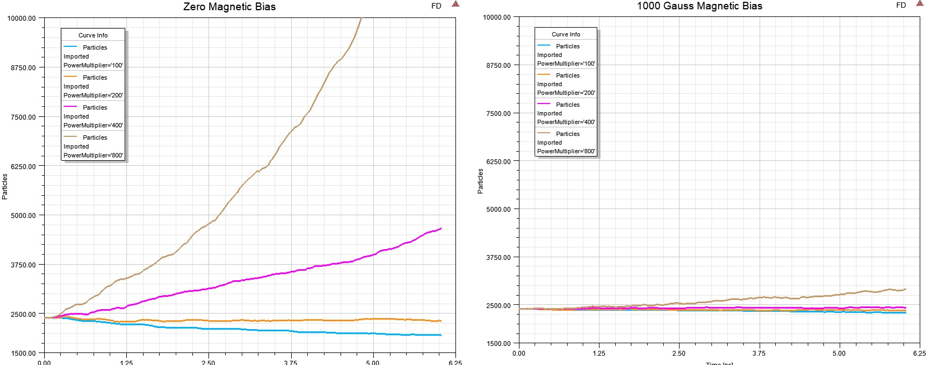
HFSS Multipaction supports multipaction on both metallic and dielectric surfaces. You can set up a uniform DC bias field as part of HFSS Multipaction, or use Maxwell near field links to set up non-uniform DC bias fields. This is helpful in design and simulation because multipaction is less likely to happen after applying magnetic bias.
Optionally, you can select the Charge distribution option in the Multipaction Analysis setup to output particle and geometry mesh information used to produce particle plots and animations.
Prerequisites
- A multipaction analysis requires the time-harmonic fields being saved for a driven-terminal or driven-modal solution.
- While HFSS Multipaction can simulate uniform bias, to simulate the effect of non-uniform bias fields, use Maxwell near-field links.