
Using the Layer Stackup Wizard (HFSS 3D Layout)
The Layer Stackup Wizard is a powerful utility that allows users to build and modify laminate layer stacks to meet precise impedance requirements for single-ended and differential microstrips and striplines. SIwave’s fast and accurate method-of-moments transmission line solver is used in all calculations and fully accounts for frequency-dependent dielectrics, non-uniform (e.g., trapezoidal) trace cross-sections, and surface roughness parameters. In Analysis mode, users can assess the impact of changing material parameters, layer thicknesses, etc., on the impedance of single-ended and differential lines whose width and separation are fixed. In Synthesis mode, users can compute trace width required to achieve a specified impedance value on a given layer. For differential nets, users can compute either trace width or trace separation to achieve a given impedance and trace separation (or width) values. Computed trace widths can then be applied to SIwave’s layout editor. Traces that are subsequently routed on layers with updated width values has the exact impedance value specified in the Stackup Wizard
A key component of this utility is the interactive, 3D visualization of the layer stack. This view, which can be panned, zoomed, and rotated using the mouse, provides users with an intuitive understanding of the dimensions and composition of their layer stack.
Opening the Layer Stackup Wizard
From Layout, select Layers to open the Edit Layers window. Then click the Layer Stackup Wizard icon to open the Layer Stackup Wizard window.
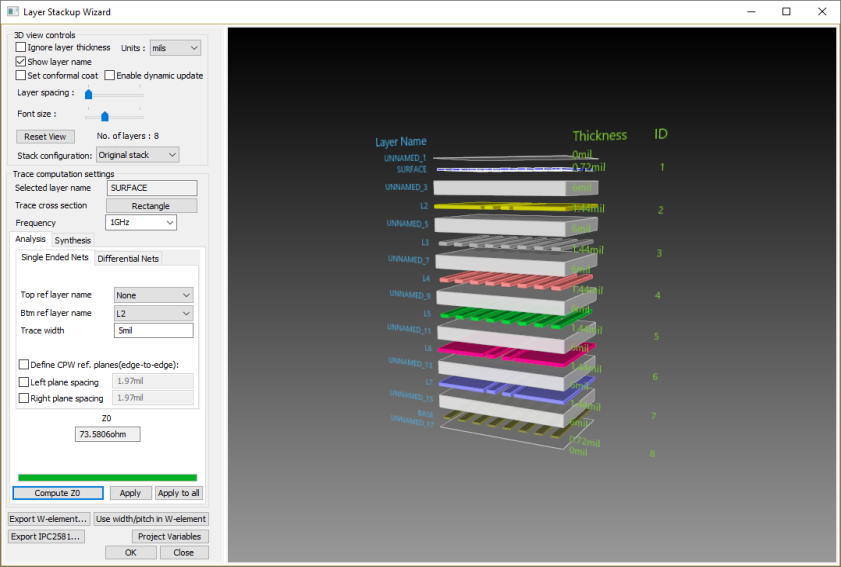
The Layer Stackup Wizard window contains two panes:
- Control Pane – located on the left, this pane allows you to configure the layer stack, and to calculate Impedance, Differential Impedance, and Trace Width/Pitch.
- View Pane – located on the right, this pane displays the current layer stack. The pane automatically updates as you change settings in the Control Pane, and you can add, remove, or edit certain layer properties directly from this pane. Use the mouse or hot keys to rotate and zoom the model. Use Ctrl+D to auto-zoom.
Configuring the Layer Stackup
From the 3D View Controls area, make the chosen selections on the following options.
- Ignore layer thickness – Checking this renders all layers at the same thickness. If this option is unchecked, layers display at their actual thicknesses.
- Show layer name – Checking this displays layer names. If this option is unchecked, layer material names display instead.
- Set conformal coat – Select this check box to add conformal coat layers. These layers are a set of dielectric layers on the top and bottom of all packages and PCBs in the design. They have a default material of "SolderMask" and a default thickness of 15 microns. They are shown with a Layer Type of "CONFORMAL_COAT". If dielectric layers are already present above the top layer and below the bottom layer, their material is changed to SolderMask and the layer type is changed to Conformal Coat.
- Units – Use this drop-down menu to update the units displayed in the View Pane, and in the impedance calculator.
- Enable Dynamic Update – when enabled, dynamic update performs the following actions when any change is made in the Layer Stackup window:
- The design updates.
- Impedance and differential impedance are recalculated.
- W-element plots are recalculated and replotted.
- Layer spacing – Use the slider to increase or decrease the space between layers.
- Font size – Use the slider to increase or decrease the size of the font in the View Pane.
- Reset View – Click to reset the View Pane to its default view.
Exporting Data
- Export IPC2581 File – prompts you to select an *.xml or *.cvg file for export.
- Export W-Element – allows you to export the w-element.
- Use width/pitch in W-element – uses the calculated trace width or pitch in the w-element analysis.
- Project Variables – allows you to edit design variables.
Viewing Impedance Plots
Right-click a layer in the View tab and select Show Impedance Plots to open the Impedance Plots for [Layer Name] window.
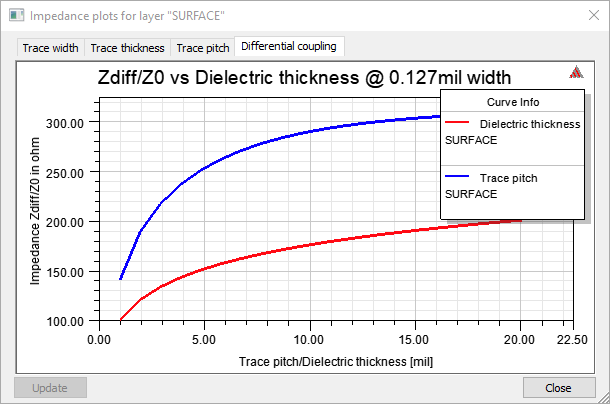
This plot is modelless. Make any change in the Layer Stackup Wizard to enable the Update button and use the tabs to navigate between plots.
Other Capabilities of the Layer Stackup Wizard
From the Layer Stackup Wizard, you can also: