
Computing Insertion/Return Loss and Time Domain Crosstalk (HFSS 3D Layout)
From the Export W-Element window, you can compute and plot insertion loss (IL), return loss (RL), far-end time domain crosstalk (FEXT), or near-end time domain crosstalk (NEXT).
Prerequisites:
- Use the Layer Stackup Wizard to calculate trace width/pitch, impedance, or differential impedance.
- Export W-element.
To calculate and plot IL/RL/FEXT/NEXT:
- From the Export W-Element window, click IL/RL/FEXT/NEXT to open the Frequency Sweep window.
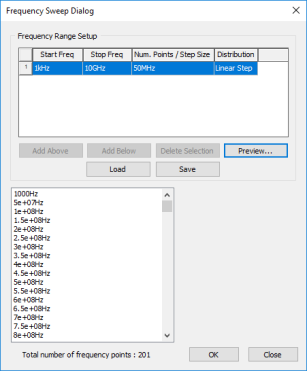
- Add, remove, and edit frequencies as appropriate. Click Preview to preview the number of frequency points.
- Click OK to open the IL/RL and Time Domain Crosstalk Plot window to the L/RL tab.
- Select the FEXT/NEXT tab to view the crosstalk plot instead. While the plot computes, a green progress bar displays the progress. When it is finished, the selected plot appears.
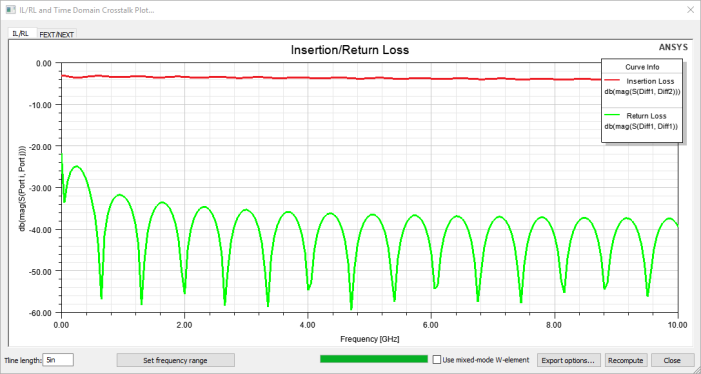
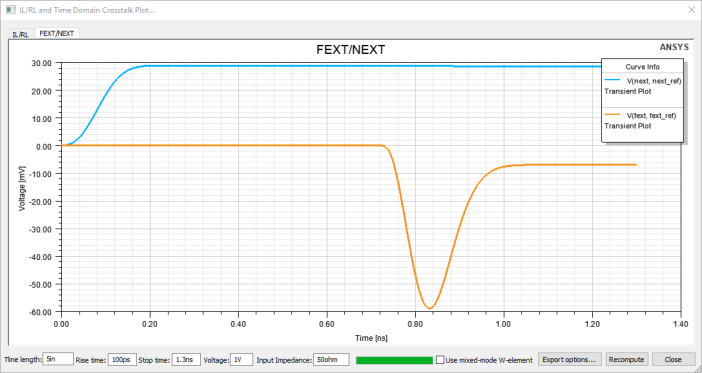
For IL/RL plots, you can adjust the Length or click Set frequency range to change the frequency range of the plot.
For FEXT/NEXT plots, you can adjust the Tline length (trace length); edit the Rise time, Stop time, and peak Voltage of the driver attached to the aggressor net; or modify the driver Input Impedance value. This impedance is also used to terminate all transmission lines in the specified cross-section.
If you wish to export plot data, click Export Options:
- For IL/RL plots, select Export w-element schematic to circuit (in *.aedt format) or Export touchstone file.
- For FEXT/NEXT plots, select Export w-element schematic to circuit (in *.aedt format) or Export .csv file.
If you change values and need to regenerate the plot, click Recompute.
Right-clicking in the plot enables additional plotting actions.
- Click Close to exit the plot window.