Calculating Trace Width and Pitch Using the Layer Stackup Wizard (HFSS 3D Layout)
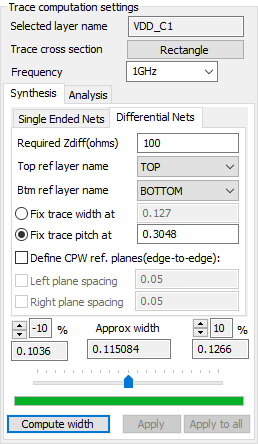
From the Trace Computation Settings area of the Layer Stackup Wizard, you can configure and perform a trace width (or pitch) calculation.
Prerequisites:
- Use the View Pane to select a layer. The Selected Layer Name field displays the currently selected layer.
- Click Trace Cross Section to open the Trace Cross Section editor.
- Click the Frequency drop-down menu to select the frequency used for trace width calculations.
To calculate trace width or pitch:
- Select the Synthesis tab.
- Select the Single Ended Nets or Differential Nets tab.
- Use the drop-down menus to select the required impedance or differential impedance (in ohms), and as reference layers.
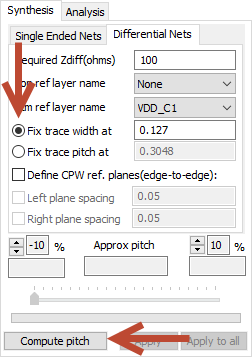
- If you are using the Differential Nets tab, select eitherFix trace width at or Fix trace pitch at and enter a value.
Important:
By default, Fix Trace Pitch is selected. Selecting Fix Trace Width changes the calculator so that it computes pitch instead of width.
- If you wish to define coplane wave reference planes, select Define CPW ref. planes (edge-to-edge) to enable additional options.
- You may select Left plane spacing, Right plane spacing, or both.
- For W-element export, selecting Left plane spacing means that aggressors may only be added to the right of a victim trace; any traces to the left are removed. Selecting Right plane spacing means that aggressors may only be added to the left of a victim trace; any traces to the right are removed.
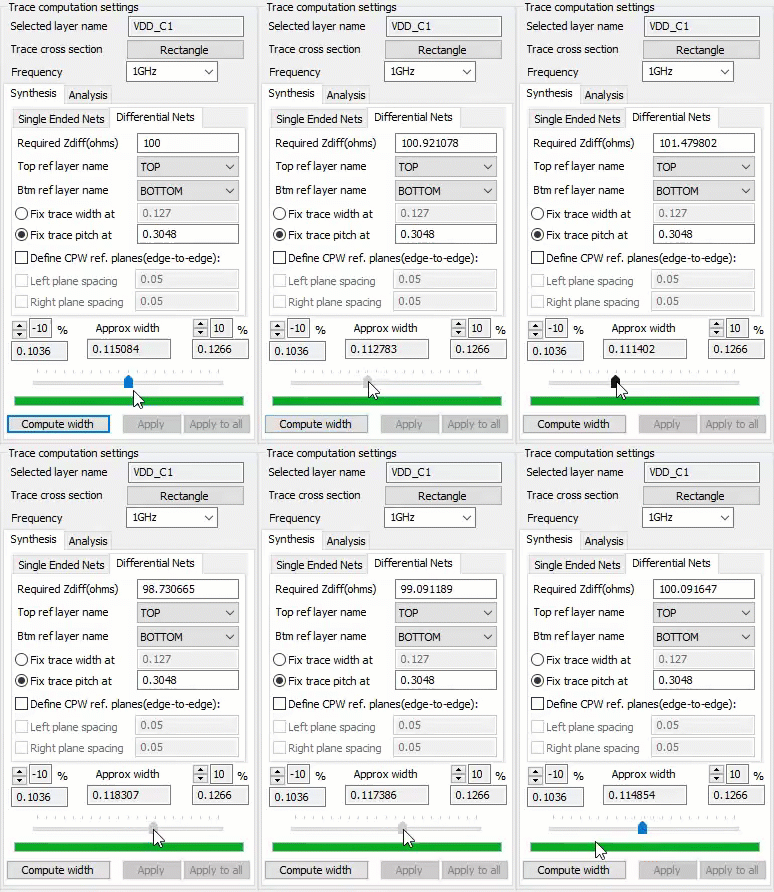
- To perform the calculation, click Compute width. The green progress bar shows the calculation's progress.
When the calculation is complete, the Approx width area updates to show the calculated result.

- Use the slider above the progress bar to update trace width and the required Zdiff value.

- To perform the calculation, click Compute width.
- The Approx width area updates to show the result.
- Use the slider above the green bar to update trace width and the required Zdiff value.