


As the analysis progresses, LS-DYNA writes information, warnings, and error messages in ASCII text format to the d3hsp file and the mes* files (one file per MPP thread for Massively Parallel Processing (MPP) and one message file for shared-memory parallel processing (SMP)). These files also contain information on the progress of the implicit
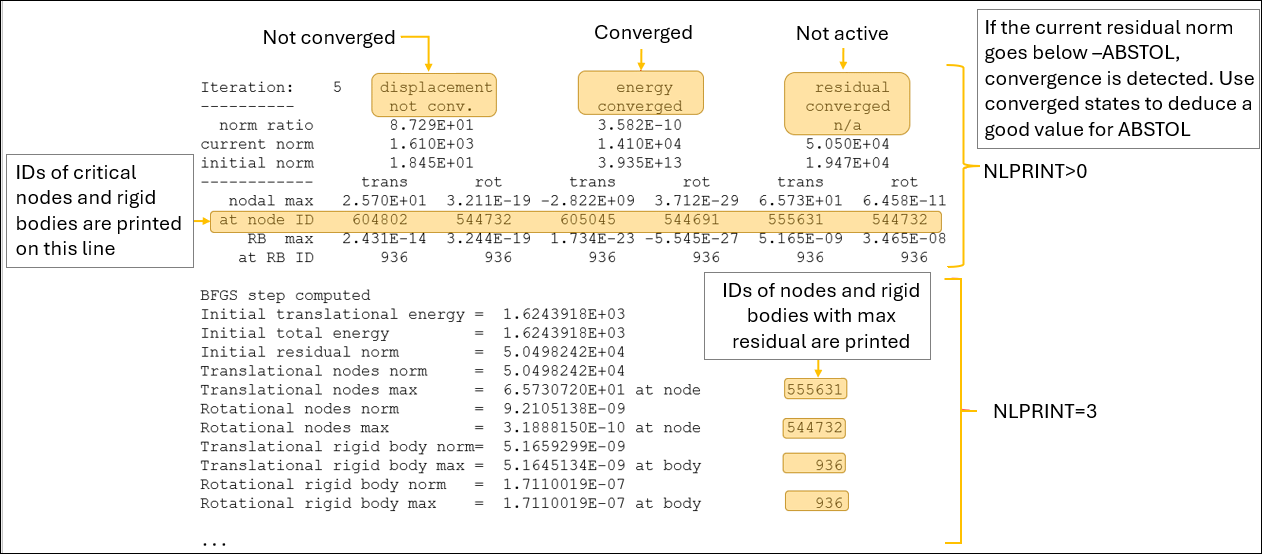
solution (see Figure 11.1: Tracking convergence information in the mes0* files). Iteration information with respect to the relative norms is saved to the d3hsp and mes0* files. The mes0* files also contain line search progress and Mortar contact information before each time step. Set LPRINT = 2 or 3 on
*CONTROL_IMPLICIT_SOLVER to request additional information from the linear solver for troubleshooting.
You can study the evolution of displacement, energy, and force residuals during the iterations to see if the solution is converging. In addition to reading this information in a text editor, the D3hsp View tool in LS-PrePost provides a graphical visualization of the residual norms, as described in Figure 11.5: The D3hsp view-tool in LS-PrePost and Figure 11.9: Tracking the convergence histories using the D3hsp View tool in LS-PrePost.
If the solution converges well, typically:
The norms decrease with almost each iteration (as shown in Figure 11.2: Examples of convergence histories).
The line search converges in less than 10 iterations.
Convergence of a time step is achieved within less than 50 iterations.
The penetrations reported from Mortar contacts stays within reasonable limits.
.
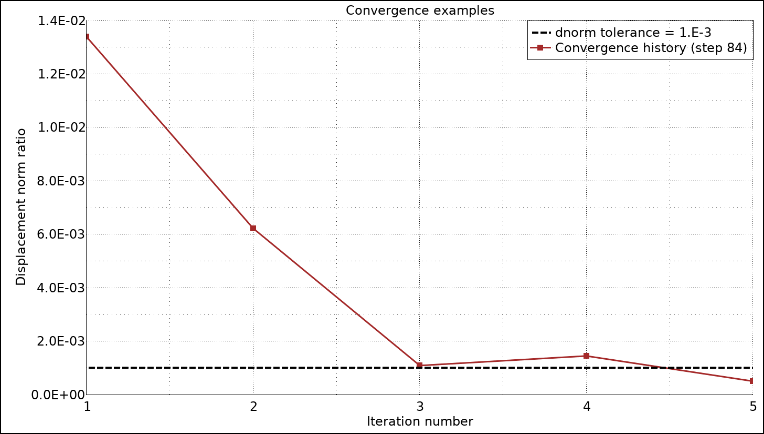
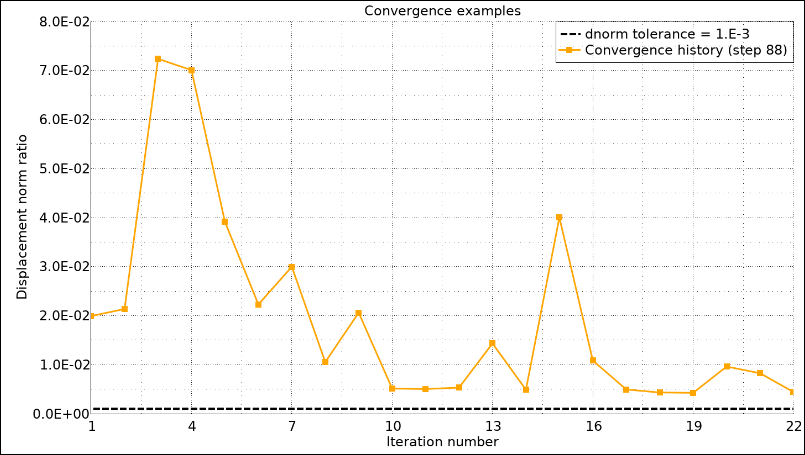
The above figure shows rapid decrease of the displacement norm, and the required tolerance is met in 5 iterations. In contrast, the next figure shows signs of convergence problems. The residual norms deviate from the ideal behavior by jumping up and down rather than decreasing consistently with increasing iterations, and the step is abandoned after 21 iterations. If non-converging behavior of the residual norms is observed, or if many (>100) iterations are required to find equilibrium indicates, the solution might have convergence problems.
If equilibrium cannot be established within the given number of iterations, the following message is printed, and the time step is attempted again with a reduced time increment.
automatic time step size DECREASE, RETRY step:
If the time-step size decreases below the minimum allowed, the following error message is printed, and the solution terminates.
*** Error 60004 (IMP+4)
    *********************************************************
    *                                                       *
    *                - FATAL ERROR -                        *
    *                                                       *
    *     Nonlinear solver failed to find equilibrium.      *
    *                                                       *
    *********************************************************