
Setting Hybrid Region Parameters for HFSS
When you set up an adaptive analysis for an HFSS with Hybrid and Arrays solution type, define the following parameters under the Hybrid tab of the Advanced Solution Setup dialog box:
- IE Solver Options. You can specify the
IE Solver type as ACA (the traditional method) or as MLFMM, which is
superior to ACA for models with large FE-BI surfaces, and also works
for IE regions. The default choice is Auto, in which
the choice is made based on the characteristics of the design.
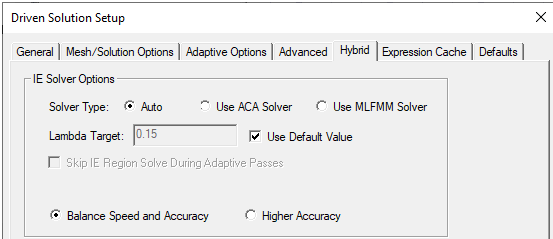
Both IE solvers support distributed memory using MPI. The MLFMM solver option provides a more efficient solution to certain classes of scattering problems. The MLFMM solver is typically more efficient (in memory and speed) than the ACA solver for problems having electrically large, mostly smooth, scattering surfaces which are comparable in all three dimensions. For a more detailed discussion, see MLFMM Usage Guidelines.
- Lambda Target for IE Solvers. This refers to the background material. For these fields to be active, the Do Lambda Refinement option on the Options tab must be enabled. If the Use Default Value check box is checked, the text box is disabled, and the 0.15 Lambda target value is used. If you uncheck Use Default Value, you can specify a target value for the background material for IE regions. This can be useful for designs that include curvilinear elements.
- Skip IE Region Solve During Adaptive Passes. If the design contains at least one FE-BI domain and at least one IE region or PO boundary, you can choose this to solve the FE-BI region before solving coupled FE-BI and IE and PO regions. An IE port is not allowed for skipping IE region solve during adaptive passes. If the design also contains SBR+ Regions, the Skip SBR+ Solve During Adaptive Passes feature must also be selected.
- Use Radiation Boundary During Adaptive Passed for FEBI. If selected, the solver uses a radiation boundary instead of FEBI during adaptive passes. When it converges, solver enables the FEBI for the last adaptive pass. If the FEBI surface is sufficiently large, this option can lead to a faster adaptive mesh run.
- Balance Speed and Accuracy or Higher Accuracy. This refers to the balance of speed and accuracy applied to IE Hybrid Regions. Higher Accuracy corresponds to the Higher Accuracy setting in the Automatic Solution setup. The IE solver is slower and uses more memory when you select this option.
Additional Options for SBR+
- Ray Density and Maximum Number of Bounces: If you have assigned an SBR+ Region, you can specify the SBR+ Solver Options for Ray Density (Per Wavelength) and Max Number of Bounces. This lets you balance solution speed and desired accuracy.

- Field Observation Domain: If you want to consider Near or Far fields, you can create new Near Field Setup, an new Far Field setup, or edit an existing setup.
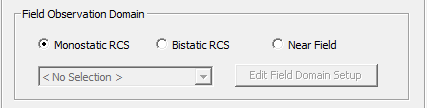
By default, a Far Field Setup is an Infinite Sphere, discussed below. By default the Near Field setup is a rectangle. For setup and use for Near Field setups, see Overlay of Contour Plot of Near Field Rectangle. - RCS Type: SBR+ supports assigning an Incident Plane wave for calculating RCS. If you have assigned an Incident Plane wave, the options include the RCS Type as Monostatic or Bistatic. If you select Monostatic, you do not need to create an infinite sphere.If you select have assigned both an SBR+ region and an Incident Plane wave, and select Bistatic as the RCS Type, the Far Field Observation domain fields are enabled, and the Far Field Radiation Sphere Setup dialog appears as follows, allowing you to create an infinite sphere.
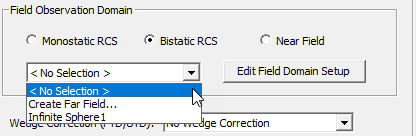
You can create far field, or edit an existing Far Field Infinite Sphere in the drop down list by selecting it and by clicking Edit Field Domain Setup.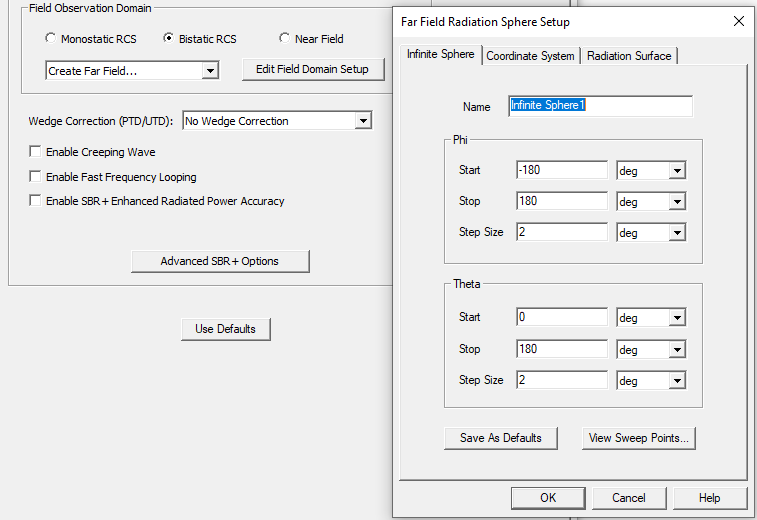
If you have created one or more infinite spheres, these are listed on the dropdown. You can edit an existing Far Field Infinite Sphere by clicking Edit Field Domain Setup.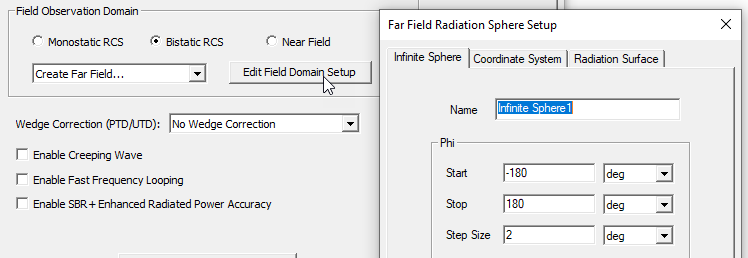
- Enable Creeping Wave: For a description of the requirements and circumstances when you might enable Creeping Waves, see Creeping Wave for Antenna Placement on Curved Surfaces in SBR+ Simulation or Creeping Wave for RCS Analysis of Curved Surfaces in SBR+ Simulation.
- Skip SBR+ Solve During Adaptive Passes option. SBR+ regions are not being mesh adapted and SBR+ solutions have no impact on field solutions on FEM or IE regions. However, SBR+ does impact stopping criteria in some cases such as coupling between two separate source antennas. Therefore, to speed up mesh adaption, you can choose to not solve SBR+ regions until source regions have converged in isolation. However, SBR+ does impact stopping criteria in some cases in the form of cache expression such as coupling between two separate source antennas or far field pattern. In such cases, SBR+ solve could not be skipped. Moreover, SBR+ solve will always be launched when maximum number of passes is reached regardless of source region convergence. If you have selected Skip IE Region Solve During Adaptive Passes, you must also select Skip SBR+ Solve During Adaptive Passes.

-
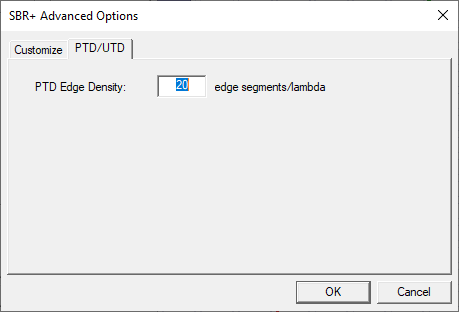
The Wedge Correction (PTD/UTD) simulation settings allow for the inclusion of additional wedge diffraction phenomenology that can improve the accuracy of SBR+ simulations. You can opt out of using the PTD/UTD settings, or select PTD Correction or PTD Correction + UTD Rays. Selecting one of the PTD Correction options enables a field for specifying PTD Edge Density.
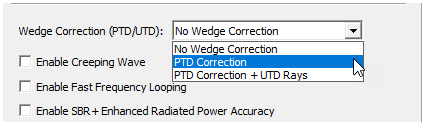
The PTD and UTD wedge features are only deployed for metallic wedges with line-of-sight visibility from the source (Tx) location. If either adjacent surface of the wedge is non-PEC and not within the tolerance for PEC-like, or if the entire edge segment is not visible to the source, the wedge will be ignored in the SBR+ simulation and for visual ray tracing (VRT)
For SBR+ simulations, the Physical Theory of Diffraction (PTD) and Uniform Theory of Diffraction (UTD) features can account for additional phenomenology not well predicted by plain SBR due to truncation of uniform Physical Optics (PO) currents at sharp angular discontinuities (“wedges”) on metallic surfaces and blockage of SBR’s Geometrical Optics (GO) rays. PTD is a numeric correction to the scattered fields radiated by PO currents near wedges. UTD launches bundles of edge-diffraction rays from directly illuminated portions of each wedge along the Keller cone. Once launched, the UTD rays behave exactly like regular SBR rays, propagating according to GO and painting PO currents at each bounce that contribute to the scattered field. The UTD rays often illuminate portions of the SBR scattering geometry that are never reached by SBR GO rays launched directly from the field source.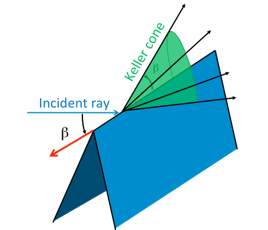
If you select one of the PTD Correction options you can then select the Advanced SBR+ Options button to Enable PTD/UTD (Wedge Diffraction) Options.
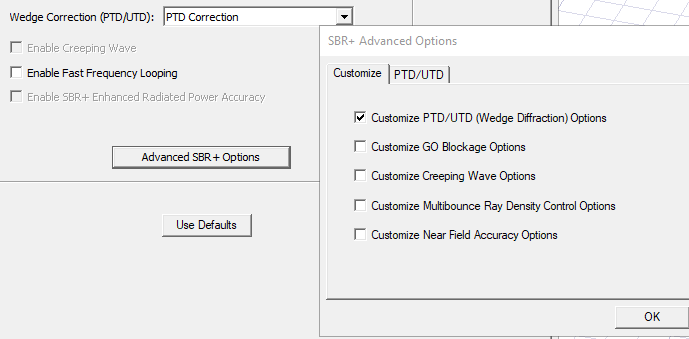
Enabling PTD/UTD (Wedge Diffraction) Options opens PTD/UTD tab for specifying PTD Edge Density.
-
Advanced Option for NF Accuracy Settings for SBR+
The NF Accuracy settings (Beta feature, NF Accuracy Controls for SBR+) provide access to methodology settings relating to cases where Tx antennas, Rx antennas, and near-field observation points are in proximity to the scattering geometry (i.e., the platform CAD model). When this feature is switched off, HFSS SBR+ uses default near-field accuracy settings that should be adequate for most situations, including close-proximity Tx/observer conditions that this feature is designed to tune.
-
Advanced Option for Multibounce Ray Density
By option you can select the Advanced SBR+ Options and enable Customize Multibounce Ray Density Control Options.
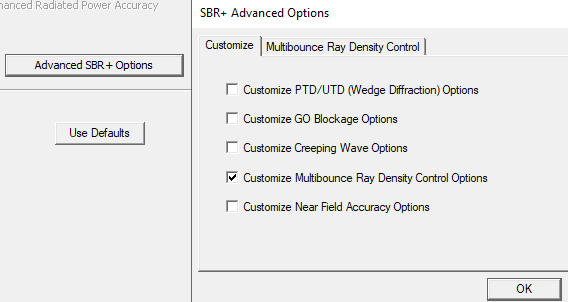
You can then select the Multibounce Ray Density Control tab.
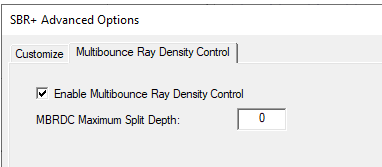
Use the checkbox to Enable Multibounce Ray Density Control and enter the maximum number of subdivisions to be used in the solve. Enabling the feature may increase the solve time.
The MBRDC Maximum Split Depth field value increases the number of spawned ray tracks on each ray bounce.The MBRDC algorithm is designed to achieve the ray density per wavelength criterion at any bounce depth. If a footprint at depth N in a ray track does not satisfy the ray-density criterion, the MBRDC algorithm attempts a refined ray shoot from an earlier bounce, just for the ray in question. The size of the triggering footprint informs the level of refinement. If the refined shoot is not successful in achieving the desired footprint size, or new footprints are too large, the MBRDC algorithm attempts further, recursive refinements. The MBRDC Maximum Split Depth setting limits how aggressively the refinement algorithm is applied by specifying the maximum number of split recursions. For this reason, linear increases in MBRDC Maximum Split Depth can yield a geometric progression in the total number of rays shot and associated solution time.
When both MBRDC and UTD are enabled, first-bounce UTD rays and bright points on wedges are recomputed during the MBRDC splitting process, but only the original raytrack is rendered up to the 1st bounce. Similarly, length-based ray filters are applied to the original UTD initial ray track up to 1st bounce rather than using the information in the additional MBRDC tracks. This is a known limitation.
-
Advanced Option for Geometrical Optics (GO) Blockage
SBR+ normally applies a physical optics (PO) blockage model where blockage effects emerge from partial cancellation of the incident field by the scattered field. PO blockage not only occurs in connection with the incident field from the Tx antennas, but also within the scattered field itself when reflected fields from the previous bounce are diminished by a blocking surface along the geometrical-optics (GO) reflection path at the current bounce by evaluating the scattering contribution of the incident ray field at that bounce.
In cases of significant blockage by a large obstruction, the PO blockage model requires accurate currents over the extent of the obstruction. Sometimes, this is hard to achieve in the ray tracing approximation. For example, the obstruction may not be well illuminated by direct rays from the Tx antenna or multi-bounce rays after an earlier reflection. An alternative is to use a GO blockage model where scattered field contributions are added to an observation point subject to a line-of-sight (LOS) blockage check performed by the ray tracer. In some cases, this is more accurate than the default PO blockage formulation, while in others it is less accurate. GO blockage also entails a non-trivial computational cost, as the blockage check with the ray tracer must be performed for each observation angle (or point) for each ray hit point.
In addition to GO Blockage for SBR and UTD ray tracks, this feature is also available for PTD and CW.
Limitations for GO Blockage:
GO Blockage formulation is suited specifically for SBR+ ray tracks, including UTD ray tracks. While GO Blockage for CW and PTD has been implemented for the first time in this release, results can be surprising and/or inaccurate, as a limitation of the methodology.
Summary Workflow for GO Blockage:
Click the Advanced SBR+ Options button to open the SBR+ Advanced Options window. On the Enable tab, Check GO Blockage Options to enable the GO Blockage tab.
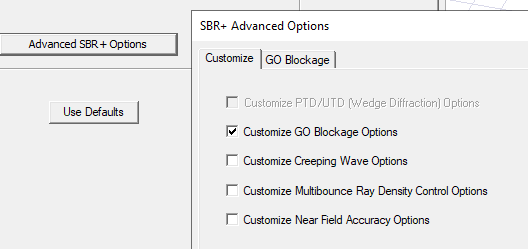
On the GO Blockage tab, you have check box options to enable or disable GO Blockage and enable or disable Surface Self-block.
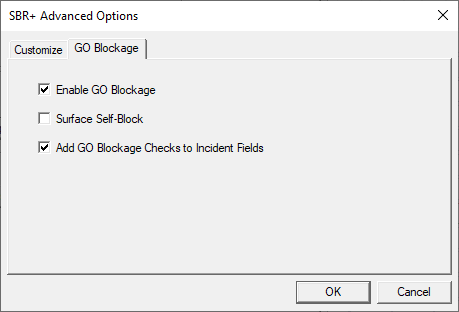
Surface Self-Block: if enabled, the surface where the footprint is radiated from is used for blockage check, that is, anything below the surface with respect to the incoming ray is not in line of sight. If the setting is disabled, the footprint surface is not used for blockage checks (anything below the surface with respect to the incoming ray is in line of sight), but other surfaces are used for blockage.
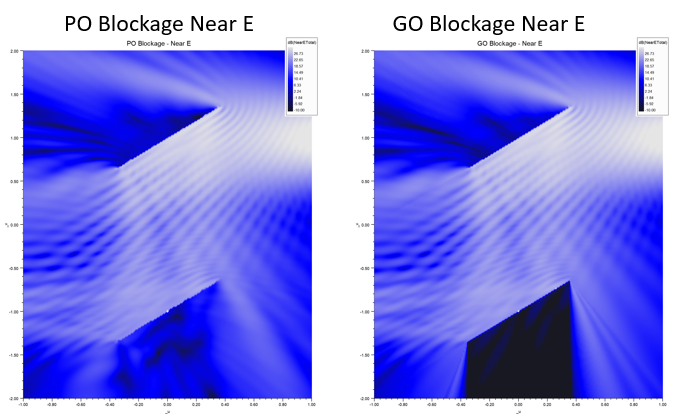
For example, consider a parametric beam antenna illuminating a series of plates.
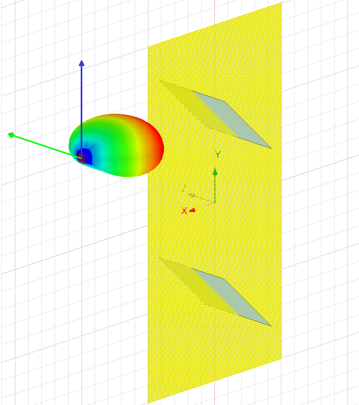
In the plots, the shadows behind the plates are much more pronounced with GO Blockage enabled, but the fields have non-physical discontinuities.
- Enable SBR+ Self Coupling computation capability for driven designs means that the diagonal S-param term takes into consideration the SBR+ scattering effect, and is more accurate. For a discussion of SBR coupling see, Select Tx/Rx Antennas for SBR+ Solutions.