


Safety requirements must be allocated to elements of the safety architecture. By this allocation it is defined, which elements are responsible for the realization of a particular requirement. Furthermore, in some safety standards the architecture elements will obtain or need to align the safety integrity level from the requirement(s) assigned to it (e.g. ASIL level in ISO 26262). As a consequence, for these standards the tool will be known which conditions imposed on the design and development of the architecture element (e.g. according to the rules of independence in ISO 26262).
Please note, in order to perform the allocation of requirements of course a system/function model has to be created first.
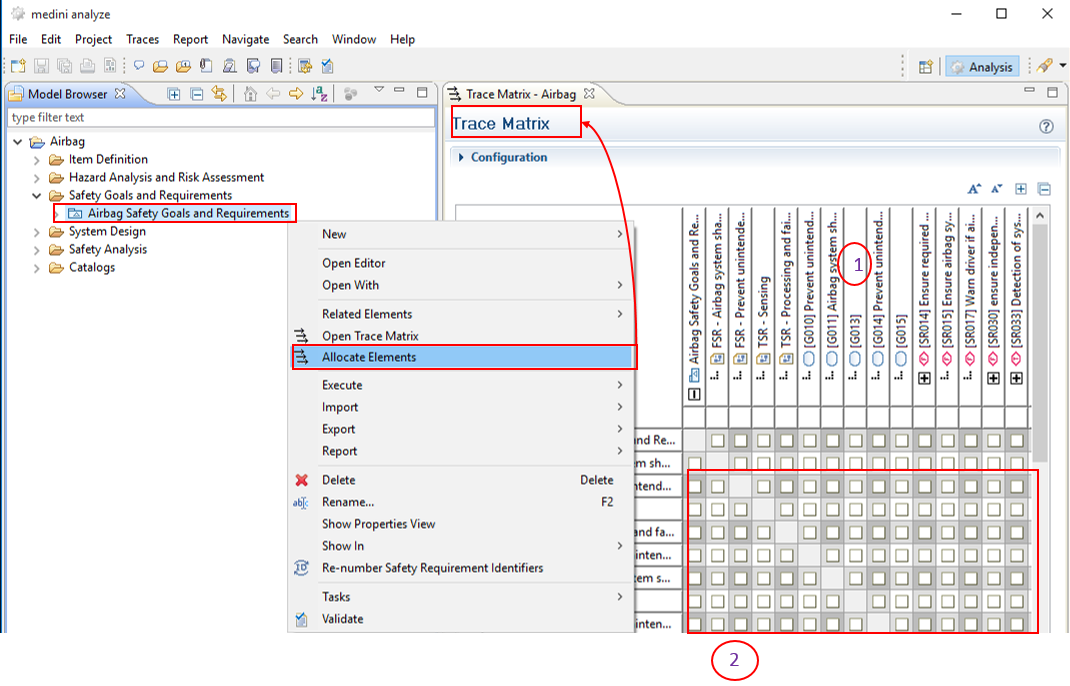
In medini analyze, the allocation of safety requirements is done via an allocation matrix. Choose "Allocate Elements" from the context menu of the "Safety Goals and Requirements" package. In the upcoming dialog select the system/function model or software model which will be used for the allocation.
As a result a matrix opens, containing as rows resp. columns the elements of the safety requirement model(s) and the elements of the selected HW/SW model(s). Click into the cells of the matrix to create or delete an allocation relation between the elements corresponding to the row and column of that cell.
Once an allocation of a requirement to an system model element has been established, it is possible to navigate between the requirement and the system model element by using the "Related Elements" sub-menu of the context menu of either the requirement or the system model element.
Traceability is also possible between the elements of the safety requirement model and elements of any other package in the same medini analyze project. For more details on creating, managing, deleting and using traces see Traceability.