


VM-LSDYNA-SOLVE-051
VM-LSDYNA-SOLVE-051
Natural Frequencies of a Circular Plate
Overview
| Reference: | Blevins, R.J. (1979). Formula for Natural Frequency and Mode Shape. Van Nostrand Reinhold Company Inc., p. 241, table 11-1: Circular Plates, case 3. |
| Analysis Type(s): | Implicit Vibration Analysis |
| Element Type(s): |
2D Quadrilateral Shell Elements |
| Input Files: | Link to Input Files Download Page |
Test Case
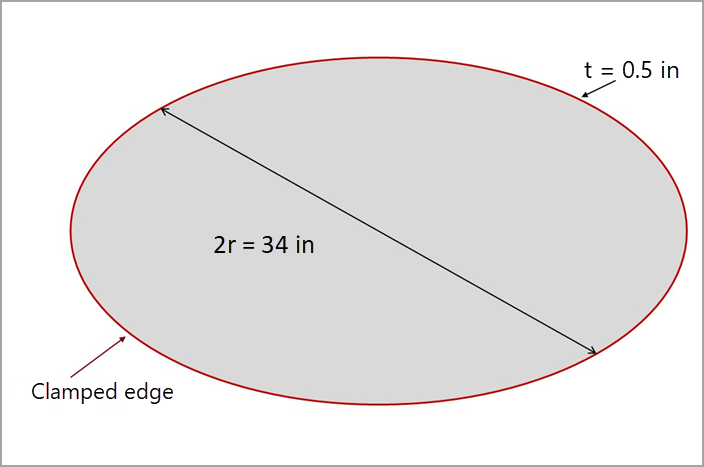
This test case models the vibration of a circular plate with its edge subjected to a
clamped condition. The objective is to validate the natural frequencies  of the first three modes of vibration (j = 0, 1, 2) for the first harmonic
(i = 0). The circular plate has a radius of 17 in and a thickness of
0.5 in. Figure 177
illustrates the domain dimensions and boundary conditions.
of the first three modes of vibration (j = 0, 1, 2) for the first harmonic
(i = 0). The circular plate has a radius of 17 in and a thickness of
0.5 in. Figure 177
illustrates the domain dimensions and boundary conditions.
This problem is also presented in test case VM181 in the Mechanical APDL Verification Manual.
The following table lists the material and geometric properties of the test case.
| Material Properties | Geometric Properties |
|---|---|
|
Young’s modulus ( Poisson's ratio ( Density ( |
Radius ( Thickness ( |


Analysis Assumptions and Modeling Notes
For a thin flat circular plate of homogeneous, linear elastic material, the natural frequency of the plate can be calculated as:
 | (25) |
where
 is a dimensionless parameter is a dimensionless parameter |
 is the plate radius is the plate radius |
 is the plate thickness is the plate thickness |
 is the mass per unit area is the mass per unit area |
 is the Young's modulus is the Young's modulus |
and  is the Poisson's ratio is the Poisson's ratio |
For a clamped edge condition, the dimensionless parameters for the first three modes of
vibration (j = 0, 1, 2) and the first harmonic (i = 0) are:  = 10.22,
  = 39.77, and
  = 89.10. Therefore, the natural frequencies for the first three modes are:
 = 172.64 Hz,
  = 671.79 Hz, and
  = 1505.07 Hz.
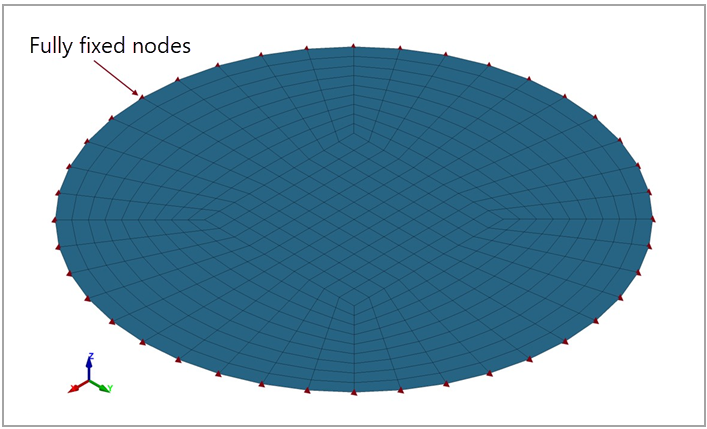
One part is defined to represent the circular plate, meshed with 2D quadrilateral elements. The plate elements use a fully integrated shell formulation with higher accuracy (ELFORM=-16) and an elastic material card (*MAT_ELASTIC) with the properties listed in the table above. The nodes corresponding to the edge of the plate are grouped using *SET_NODE_LIST, and the keyword *BOUNDARY_SPC_SET is used to define the constraint of this node set (translational and rotational constraint about the three axes). The keywords *CONTROL_IMPLICIT_GENERAL (IMFLAG=1), *CONTROL_IMPLICIT_DYNAMICS (IMASS=0), and *CONTROL_IMPLICIT_EIGENVALUE (NEIG=15) are used to activate the implicit eigenvalue static analysis with fifteen eigenvalues to be extracted.
Results Comparison
The visualization of the first mode can be performed by reading the
d3eigv file generated for the modal analysis. The first three modes of
vibration (j = 0, 1, 2) for the first harmonic (i = 0) are the first, sixth, and fifteenth
modes respectively, in the current model. To quantify the error between the theoretical and
LS-DYNA results, the natural frequencies  ,
,  and
and  of the circular plate and their relative errors are calculated and shown in
the following table. This comparison verifies the agreement between the natural
frequencies.
of the circular plate and their relative errors are calculated and shown in
the following table. This comparison verifies the agreement between the natural
frequencies.
| Results | Target | LS-DYNA Solver | Error (%) |
|---|---|---|---|
Natural Frequency  (Hz) (Hz) | 172.64 | 173.05 | 0.24 |
Natural Frequency  (Hz) (Hz) | 671.79 | 674.38 | 0.38 |
Natural Frequency  (Hz) (Hz) | 1505.07 | 1512.94 | 0.52 |