


VM-LSDYNA-SOLVE-049
VM-LSDYNA-SOLVE-049
Natural Frequency of a Spring-Mass System
Overview
| Reference: | Thomson, W. T. (1971). Vibration theory and applications (3rd impression). Prentice-Hall, Inc., p.6, Example 1.2-2. |
| Analysis Type(s): | Implicit Vibration Analysis |
| Element Type(s): | Mass Element, One-Dimensional Discrete Element |
| Input Files: | Link to Input Files Download Page |
Test Case
The finite element simulation presented in this test case models a spring-mass system comprised of an instrument set on a rubber mount. The objective is to verify the accuracy of the LS-DYNA solver by validating the system's natural frequency against theoretical values for an identical scenario.
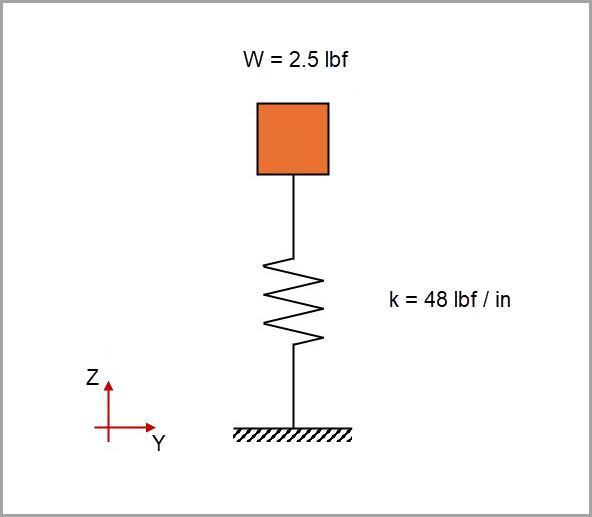
Figure 172 provides a schematic of the test case, showing an instrument with a weight of 2.5 lbf set on a rubber mount system with a stiffness of 48 lbf/in. The spring length is arbitrarily defined as 1.0 in, and the other end of the rubber mount is clamped.
The table that follows shows the corresponding material and geometric properties. This test case uses the following system of units: length in in, time in s, mass in lbf-s2/in, force in lbf, and pressure in psi.
This problem is also presented in test case VM45 in the Mechanical APDL Verification Manual.
| Material Properties | Geometric Properties |
|---|---|
|
Spring length (l) = 1 in |
Stiffness constant of the spring (k) = 48 lbf/in Weight of the instrument (W) = 2.5 lbf |
Analysis Assumptions
The natural frequency of a spring-mass system can be calculated using the following formula:
 | (23) |
where
 is the stiffness constant of the spring is the stiffness constant of the spring |
and  is the concentrated mass is the concentrated mass |
The weight of the concentrated mass (W = 2.5 lbf) can be divided by the acceleration due to gravity (g = 386 in/s2) to obtain the mass (m = 0.006477 lbf-s2/in). For the current test case, the natural frequency of the system is therefore 13.701 Hz.
Modeling Notes
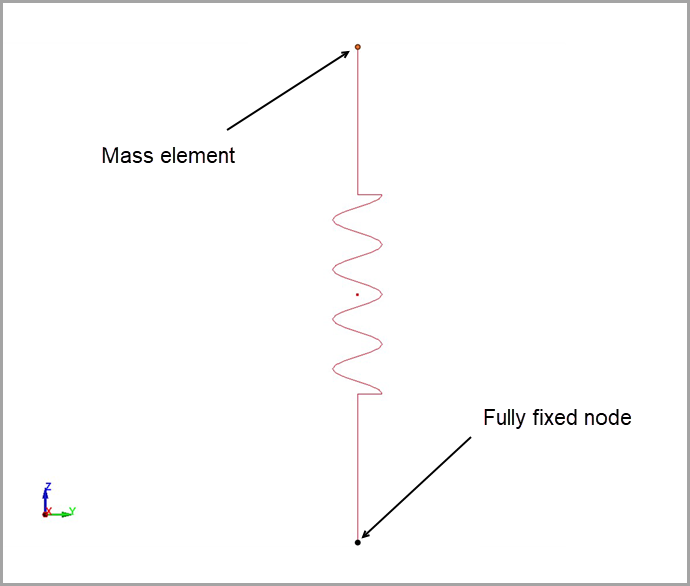
The spring is defined using one part one part meshed with a 1D discrete element. This element has a length of 1 in and uses an elastic spring material card (*MAT_SPRING_ELASTIC) with stiffness of 48 lbf/in. A mass element of 0.006477 lbf-s2/in is defined for the top node of the structure using *ELEMENT_MASS. The keyword *BOUNDARY_SPC_NODE is used to define the motion constraints of both nodes. The keywords *CONTROL_IMPLICIT_GENERAL (IMFLAG=1), *CONTROL_IMPLICIT_DYNAMICS (IMASS=0), and *CONTROL_IMPLICIT_EIGENVALUE (NEIG=1) are used to activate the implicit eigenvalue, static analysis with on eigenvalue to be extracted.
Results Comparison
The visualization of the fundamental mode can be performed by reading the d3eigv file, generated for the modal analysis. To quantify the error between the theoretical and LS-DYNA results, the natural frequency of the spring-mass system and its relative error are calculated and shown in the following table. This comparison verifies the agreement between the two results.
| Results | Target | LS-DYNA Solver | Error (%) |
|---|---|---|---|
| Fundamental Natural Frequency (Hz) | 13.701 | 13.701 | 0.00 |