


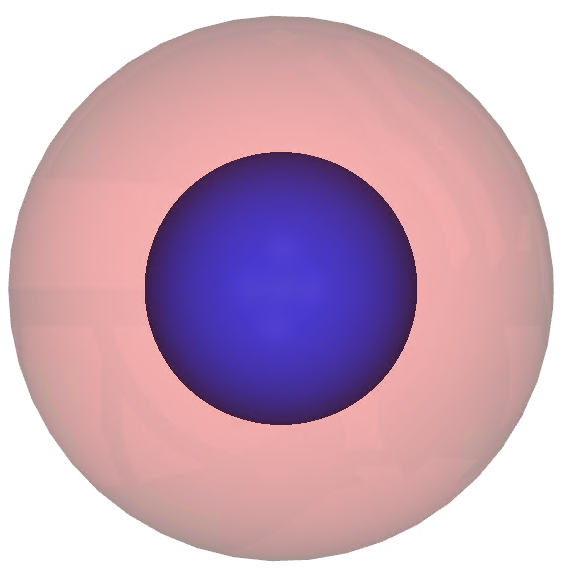
In this verification case, two concentric spheres exchange heat due to radiation. The spheres are separated by a non-participating medium and their surfaces are considered to be opaque, gray, and diffuse. The outer sphere is modeled as a boundary with a constant and uniform high temperature of 2000 K and the inner sphere is modeled as a particle with an initial temperature of 300 K. The two spheres are shown in Figure 2.7: Two concentric spheres exchanging heat due to radiation.. For technical details, refer to the documentation for the Thermal Radiation module. This ready-to-use module can be downloaded from the Ansys Customer Portal.
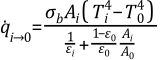
The net radiation exchange between two surfaces can be expressed analytically for some cases, depending on the radiation view factor and the surfaces areas ratio. For the case of two concentric spheres, the net radiation may be expressed as follows:
 | (2–4) |
where:
 is the radiation heat transfer rate between the spheres.
  , which is the Stefan-Boltzmann constant.
 Ti is the inner sphere's surface temperature.
To is the outer sphere's surface temperature.
 is the thermal emissivity of the inner sphere.
  is the thermal emissivity of the outer sphere.
 Ai is the area of the inner sphere.
Ao is the area of the outer sphere.
The equations shown in the last section can be resolved and equivalent results can be calculated by Rocky considering the same input data and boundary conditions. The input parameters for this verification case setup are presented in Table 2.3: Verification case input parameters..
Table 2.3: Verification case input parameters.
| Parameter | Value | Unit |
|---|---|---|
|
Physical Model: | ||
| Thermal Model | Enabled |
- |
| Gravity (X) | 0 |  |
| Gravity (Y) | 0 |  |
| Gravity (Z) | 0 |  |
|
Wall Geometry (Outer Sphere): | ||
| Diameter | 100 |  |
| Triangle Size | 12.5 |  |
|
Solid Properties (Wall Geometry - Outer Sphere): | ||
| Constant Surface Temperature | 2000 |  |
| Material Density | 7850 |  |
| Material Specific Heat | 500 |  |
| Material Emissivity | 1.0 | - |
|
Solver Parameters: | ||
|
Simulation Duration |
30 |
|

This verification case makes use of an external module called Thermal Radiation, which enables additional Rocky solver capabilities. This ready-to-use module can be downloaded from the Rocky Customer Portal. The module parameters considered for this case are presented in Table 2.4: Thermal Radiation module parameters..
Table 2.4: Thermal Radiation module parameters.
| Parameter | Value | Unit |
|---|---|---|
| Module Version | 20.0 | - |
| Geometries Screening Distance | 10 |  |
| Particles Screening Distance | 10 |  |
| Start Time | 0 |  |
| Stop Time | 30 |  |
After running the Rocky case as specified, the results can then be compared to the analytical values. Here, the evolution of the inner sphere's (the particle's) temperature over time is shown in Figure 2.8: Comparison of temperature for the inner sphere and the analytical solution [K].. The numerical solution given by Rocky presents strongly correlated values to those obtained by the analytical expression.
![Comparison of temperature for the inner sphere and the analytical solution [K].](graphics/comparison_temperature.png)
The absolute and relative errors for the inner sphere's (the particle's) temperature are compared in Figure 2.9: Absolute and relative errors for the results shown in the previous image.. The maximum absolute error for the temperature is around 1.5 K. The maximum relative error is around 0.11% K.
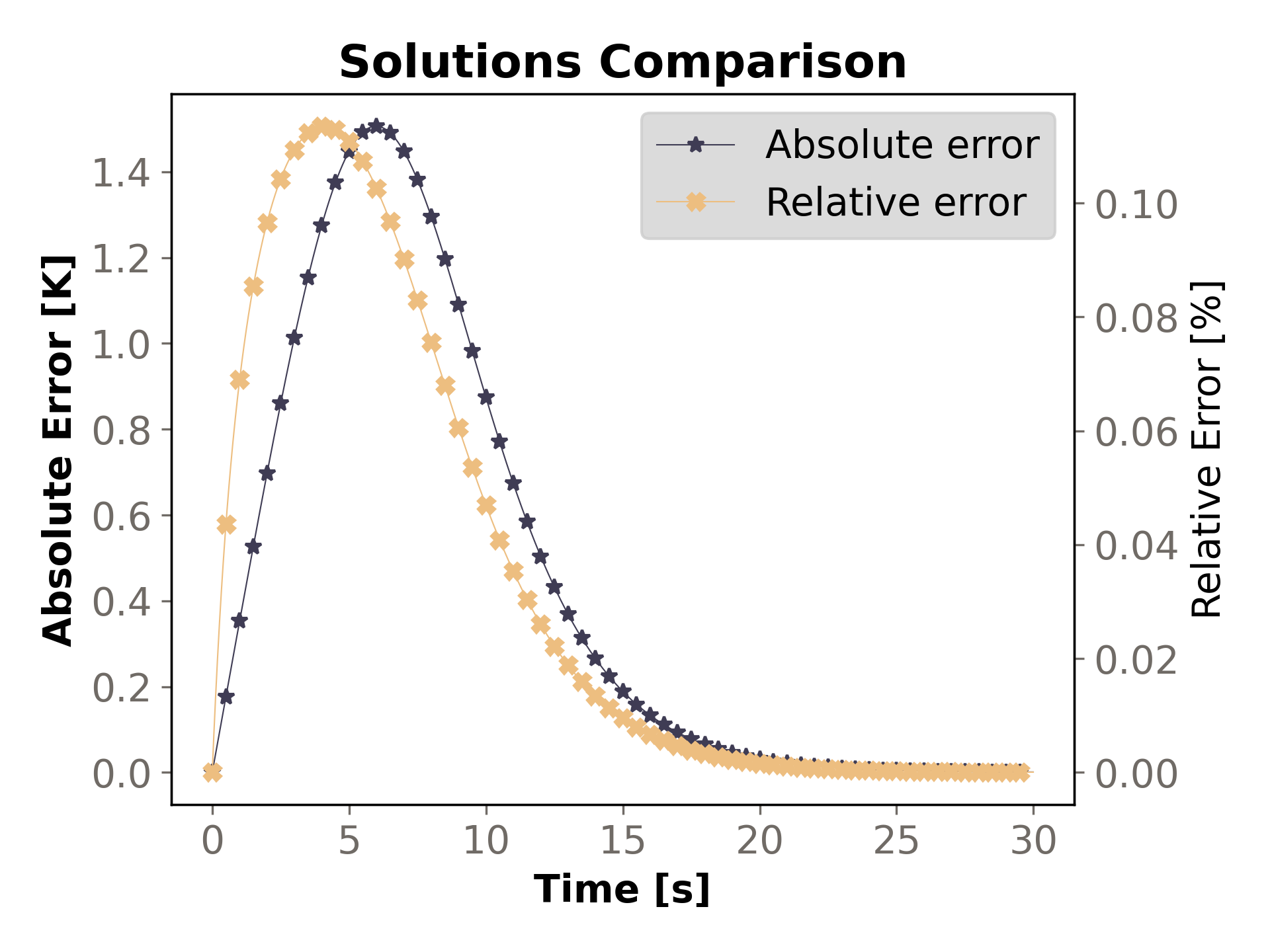
Table 2.5: Temperature target lists the value for the final temperature. This includes the target value calculated by the analytical expression as compared to the value calculated by Rocky. A Ratio of 1.0 here shows a strong correlation between the results.