


You use this analysis to couple electromagnetic field analysis with electric circuits. You can couple electric circuits directly to current source regions of the finite element domain. The coupling is available in 2D as well as 3D analysis and includes stranded (wound) coils, massive (solid) conductors, and solid source conductors. Typical applications for stranded coils include circuit-fed analysis of solenoid actuators, transformers, and electric machine stators. Bus bars and squirrel-cage rotors are examples of massive conductor applications.
To do a coupled electromagnetic-circuit analysis, you need to use the general circuit element (CIRCU124) in conjunction with one of these element types:
| PLANE233 -- 2D 8-Node Electromagnetic Solid |
| SOLID236 -- 3D 20-Node Electromagnetic Solid |
| SOLID237 -- 3D 10-Node Electromagnetic Solid |
The analysis may be static, harmonic (AC), or transient, and follows the same procedure described in the Low-Frequency Electromagnetic Analysis Guide. The circuit coupling is linear in that conductors are assumed to have isotropic linear material properties, and the formulation is matrix-coupled. Nonlinearities may exist in the electromagnetic domain to account for material saturation.
For stranded coils and massive conductors modeled with PLANE233 , SOLID236, or SOLID237 elements, the CIRCU124 elements can be directly linked to the finite element domain.
The Circuit Builder is available to conveniently create circuit elements. See Using the Circuit Builder in the Low-Frequency Electromagnetic Analysis Guide for details.
The recommended method is to model the finite element domain with PLANE233, SOLID236, or SOLID237 elements and directly couple them to the CIRCU124 element through the VOLT degree of freedom.
This option couples an electric circuit to a solid source conductor as shown in a typical configuration in Figure 5.1: 3D Circuit Coupled Solid Source Conductor. A solid source conductor represents a solid conductor with a DC current distribution within the conductor walls. The solid conductor of the finite element region represents an equivalent resistance to the circuit. When hooked to an external circuit, the resulting solution determines the conductor DC current distribution, which is used as a source excitation for the electromagnetic field.
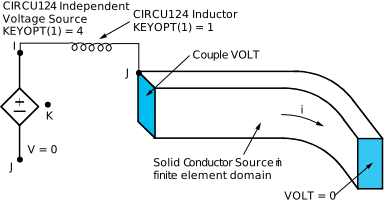
Circuit coupled solid source conductors can be used in static, harmonic, and transient analysis. However, the solution within the conductor itself is limited to a DC current distribution with no eddy current effects or back emf effects. The following elements offer the solid conductor source option:
| PLANE233, KEYOPT(1) = 1 (static) |
| SOLID236, KEYOPT(1) = 1 (static) |
| SOLID237, KEYOPT(1) = 1 (static) |
| PLANE233, KEYOPT(1) = 1 and KEYOPT(5) = 1 (harmonic and transient) |
| SOLID236, KEYOPT(1) = 1 and KEYOPT(5) = 1 (harmonic and transient) |
| SOLID237, KEYOPT(1) = 1 and KEYOPT(5) = 1 (harmonic and transient) |
The electromagnetic analysis options of SOLID236 and SOLID237 KEYOPT(1) = 1 use an electric scalar potential (VOLT) that is compatible with the following CIRCU124 circuit elements:
Components
| Resistor (KEYOPT(1) = 0) |
| Inductor (KEYOPT(1) = 1) |
| Capacitor (KEYOPT(1) = 2) |
| Mutual Inductor (KEYOPT(1) = 8) |
Sources
| Independent Current Source (KEYOPT(1) = 3) |
| Independent Voltage Source (KEYOPT(1) = 4) |
| Voltage Controlled Current Source (KEYOPT(1) = 9) |
| Voltage-Controlled Voltage Source (KEYOPT(1) = 10) |
| Current-Controlled Voltage Source (KEYOPT(1) = 11) |
| Current-Controlled Current Source (KEYOPT(1) = 12) |
You can also use the solenoidal formulation with the diode element (CIRCU125). Because the elements are compatible, the CIRCU elements can be directly connected to the SOLID elements via the VOLT degree of freedom.
Often it is convenient to take a symmetry cut of a device to construct a finite element model. Coupled electromagnetic-circuit analysis can consider two types of symmetry: conductor symmetry and circuit symmetry.
Conductor symmetry - This type of symmetry involves modeling only part of a conductor due to symmetric behavior of the magnetic field. For example, you can model a C-shaped magnet with a single winding symmetrically placed about the return leg in half-symmetry. The real constants defined for the finite element conductor regions automatically handle symmetry sectors by requiring you to specify the full conductor area (real constant CARE, and also VOLU for 3D). The program determines from the conductor elements the fraction of the conductor modeled and appropriately handles the symmetry model. Also, for 2D planar problems you can specify the length of the device (real constant LENG) which the program handles appropriately.
Circuit symmetry - For coupled electromagnetic-circuit simulation, you must model the entire electric circuit of the device; however, you may be able to take advantage of symmetry in the finite element domain. For example, you may only need to model one pole of a rotating electric machine to obtain a finite element solution. However, you must model completely the circuit which accounts for all the slot windings in the full machine.