


This example modal cyclic symmetry analysis presents a simplified ring-strut-ring structure used in many rotating-machinery applications.
The component is a simplified fan inlet case for a military aircraft engine. As part of the design process for the assembly, you must determine the vibration characteristics (natural frequencies and mode shapes) of the inlet case.
The geometric properties for this analysis are as follows:
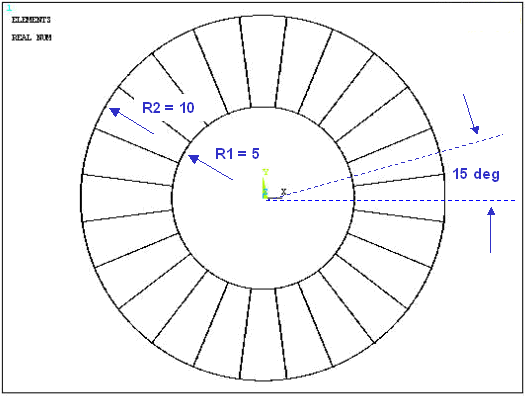
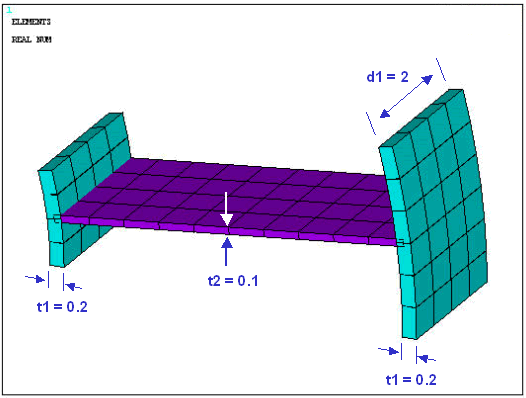
The material properties for this analysis are as follows:
| Young's modulus (E) = 10e6 |
| Poisson's ratio (υ) = 0.3 |
| Density = 1e-4 |
All applicable degrees of freedom are used for the cyclic symmetry edge-component pairs. The first six mode shapes for all applicable harmonic indices are requested.
Use this input file (input_cyclicExample01.dat, download: input_cyclicExample01.zip) to perform the example modal cyclic symmetry analysis. The file contains the complete geometry, material properties and solution options for the finite element model.
! Modal Cyclic Symmetry Analysis Example
! Ring-Strut-Ring Configuration

! Plot options
/plopts, minm, 0
/plopts, date, 0
/plopts, title, 0
/pnum, real, 1
/number, 1

/prep7

! Define geometry, mesh and boundary conditions or read cdb file
generateGeom = 1

*if, generateGeom, eq, 1, then
    ! Geometry parameters
    r1 = 5
    r2 = 10
    d1 = 2
    nsect = 24
    alpha_deg = 360 / nsect
    alpha_rad = 2*acos(-1) / nsect

    ! Coordinate system
    csys, 1

! Create keypoints, lines and areas
    ! Keypoints and lines
    k, 1, 0, 0, 0
    k, 2, 0, 0, d1
    k, 3, r1, 0, 0
    k, 4, r1, 0, d1
    l, 3, 4

    ! line rotation
    arotat, 1,,,,,,1,2,alpha_deg/2

    k, 7, r2, 0, 0
    k, 8, r2, 0, d1
    l, 7, 8
    arotat, 5,,,,,,1,2,alpha_deg/2
    arotat, 2,,,,,,1,2,alpha_deg/2
    arotat, 6,,,,,,1,2,alpha_deg/2

    a, 5, 6, 10, 9

! Mesh with shell-181 elements
    ! Meshing
    mshkey, 1
    et, 1, 181
    r, 1, 0.20 !thickness of the inner and outer rings
    r, 2, 0.1 ! thickness of the strut
    mp, ex, 1, 10e6
    mp, prxy, 1, 0.3
    mp, dens, 1, 1e-4
    esize, 0.5

    ! Area selection and attribute assignment
    asel,,,,1,4
    aatt,,1
    asel,,,,5
    aatt,,2
    allsel
    amesh, all

    ! Boundary conditions
    dk, 5, uz, 0

    ! Save database
    cdwrite, db, cyclicExample01, cdb
*else
    cdread, db, cyclicExample01, cdb,,,
*endif

/view, 1, 1, 1, 2
! Configure cyclic symmetry
cyclic
! Enable cyclic symmetry graphical expansion
/cycexpand,,on
eplot
! List cyclic status
cyclic, status
! List cyclic solver options
cycopt, status
finish

! Solve modal cyclic symmetry analysis
/solution
antype, modal
modopt, lanb, 6
mxpand, 6,,,yes
solve
fini

/post1
! Print eigen values
set, list
! Set results coordinate system to global cylindrical
rsys, 1
! Read results for load step 1, substep 6
set, 1, 6
! Plot tangential displacement contour
plns, u, y
! Read results for load step 13, substep 1
set, 13, 1
! Plot tangential displacement contour
plns, u, y
! Read results for load step 2, substep 5
set, 2, 5
! Plot tangential displacement contour
plns, u, y
fini
The following table describes the input listing and the steps involved in the example modal cyclic symmetry analysis in more detail.
| Step | Description | Command |
|---|---|---|
| 1. | Create mesh. | AMESH,ALL |
| 1. |
Specify a cyclic symmetry analysis and configure the database accordingly. | CYCLIC |
| 3. |
Activate cyclic symmetry graphical expansion. | /CYCEXPAND,,ON |
| 4. |
List the cyclic status. | CYCLIC,STATUS |
| 5. |
List the cyclic solution option settings. | CYCOPT,STATUS |
| 6. |
Solve the modal cyclic symmetry analysis. | |
| 7. |
Specify the global cylindrical coordinate system. | |
| 8. |
Read results for "load step 2 - substep 6 - harmonic index 0." | SET,2,6 |
| 9. |
Plot the tangential displacement contour. Executing this step causes the struts of the assembly to bend "in phase." | PLNSOL,U,Y |
| 10. | Read results for "load step 13 - substep 1 - harmonic index 12." | SET,13,1 |
| 11. |
Plot the tangential displacement contour. Executing this step causes the struts of the assembly to bend "out of phase." | PLNSOL,U,Y |
| 12. |
Read results for "load step 2 - substep 5 - harmonic index 1." | SET,2,5 |
| 13. |
Plot the tangential displacement contour. ---- This step completes the example modal cyclic symmetry analysis. Your results should match those shown in Figure 5.1: Example Modal Cyclic Symmetry Analysis Results. | PLNSOL,U,Y |
The results of your analysis should match those shown here:
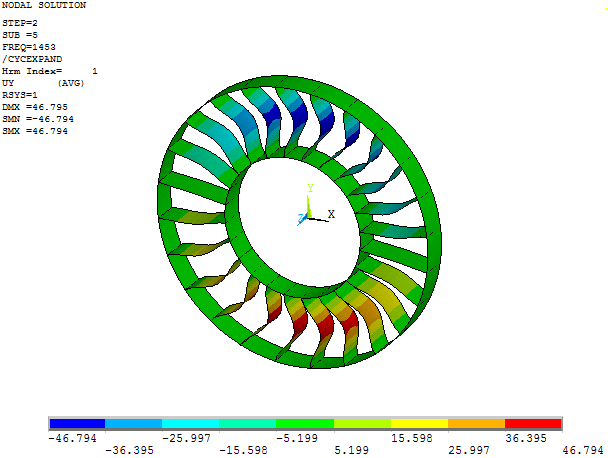
Note: Mode shape values may vary slightly depending on your computer system.
To view a traveling wave animation of your model, issue the ANCYC,24,,0.1 command. For more information, see Applying a Traveling Wave Animation to the Cyclic Model.