


Dynamic relaxation in LS-DYNA applies pre-loadings (like gravity or bolt pretension) prior to the main loading, such as a rapid event like a crash or a quasi-static ultimate capacity load case. Dynamic relaxation has its own time scale, starting at zero. When the dynamic relaxation phase is completed, and the normal phase begins, the time is reset to zero. Dynamic relaxation can be performed using either the explicit or implicit solver.
Dynamic relaxation in explicit analysis can perhaps be viewed as a fixed-point iterative solution, where a very large amount of damping is applied to obtain an approximate static equilibrium. One application for explicit dynamic relaxation is bolt pretensioning followed by implicit statics. This procedure can be efficient for bolt pretensioning, since the rigid body modes of the initially "loose" bolts are handled by the explicit dynamics. Ansys recommends minimizing gaps between parts that are to be pretensioned using explicit dynamic relaxation.
To activate explicit dynamic relaxation:
Add the keyword
*CONTROL_DYNAMIC_RELAXATION, and set IDRFLG = 1.Set SIDR = 1 or 2 on any load curve (
*DEFINE_CURVE).Use time step control (
*CONTROL_TIMESTEP) and stiffness damping (see Time Step Control and Mass Scaling in Explicit Analyses and Damping in Explicit Analysis for further details).
The explicit dynamic relaxation is completed either when the time
DRTERM is reached (*CONTROL_DYNAMIC_RELAXATION) or
when the ratio of current distortional kinetic energy to peak distortional kinetic
energy (the convergence factor) falls within the convergence tolerance
(DRTOL).
Dynamic relaxation can also be performed in implicit analysis:
Add the keyword
*CONTROL_DYNAMIC_RELAXATION, and set IDRFLG = 5, NRCYCK = 1. Also specify the time when the pre-loading is completed (DRTERM parameter). As in any nonlinear implicit analysis, Ansys recommends that you gradually ramp up the loadings also in implicit dynamic relaxation, to facilitate convergence.Set SIDR = 1 or 2 on any load curve (
*DEFINE_CURVE).
Note that if required, separate implicit control settings can be specified for the
dynamic relaxation phase, using the keywords *CONTROL_IMPLICIT_AUTO_DYN,
*CONTROL_IMPLICIT_DYNAMICS_DYN, and
*CONTROL_IMPLICIT_SOLUTION_DYN (this is not active in the provided
control card files).
Use the keyword *DATABASE_BINARY_D3DRLF (not active in the provided
control card files) to request output for 3D visualization from the dynamic relaxation
phase. This prompts LS-DYNA to write a sequence of binary databases called
d3drlf. similar to d3plot files.
See [17] for an overview of different bolt pretensioning techniques and [32] for a general overview of dynamic relaxation.
Note: Dynamic relaxation cannot be combined with the arc-length method (see Nonlinear Analysis Using the Arc-length Method) in current versions of LS-DYNA.
This example is similar to the one presented in Bolt Pretensioning. A bracket is connected to a base plate by four bolts, see the left image in the figure below. Bolt pretensioning is performed using explicit dynamic relaxation. Loading is applied at the free hole of the flange via a distributing coupling (*CONSTRAINED_INTERPOLATION). From t = 0
to t = 1, loading in the transverse direction is ramped up to 1 kN and then ramped down to zero at t = 2, and then from t = 2 to t = 3 loading in the longitudinal direction is ramped up to 1 kN and then down to zero at t = 4 (termination time). The example keyword file is bolts002.key.
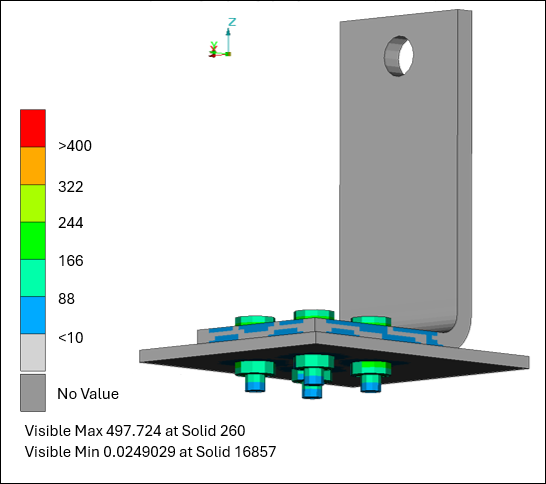
The first image below shows the geometry of the bracket (gray), base plate (purple) and bolts (silver). While the second illustrates the initial effective stress distrubution.
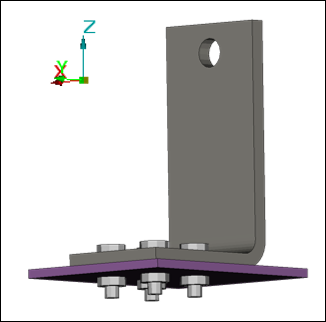
Figure 14.3: Initial effective stress distribution (at t = 0 of the normal phase, after explicit dynamic relaxation)
The section forces in the bolts are show in the next figure. The initial drop (by 1.7% in this case) in section force is due to the approximate character of the solution obtained by the explicit dynamic relaxation.
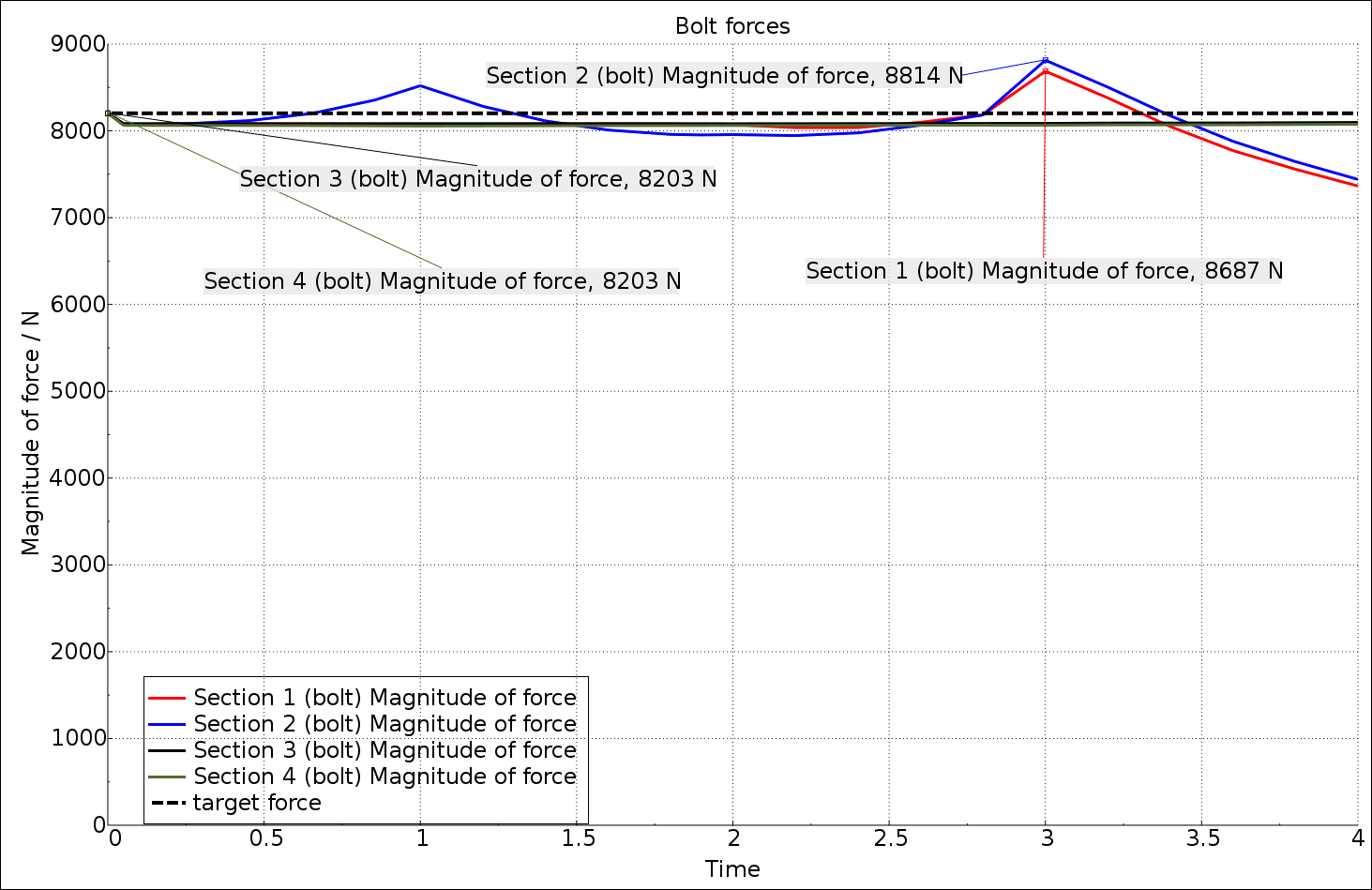
Note that the initial drop in section force indicates the approximate character of the explicit dynamic relaxation solution.