


In some cases, you can switch between implicit and explicit analyses. Examples of implicit-explicit switching include:
The implicit solver can get help from the explicit solver when convergence is difficult, for example due to material failure, by automatic switching.
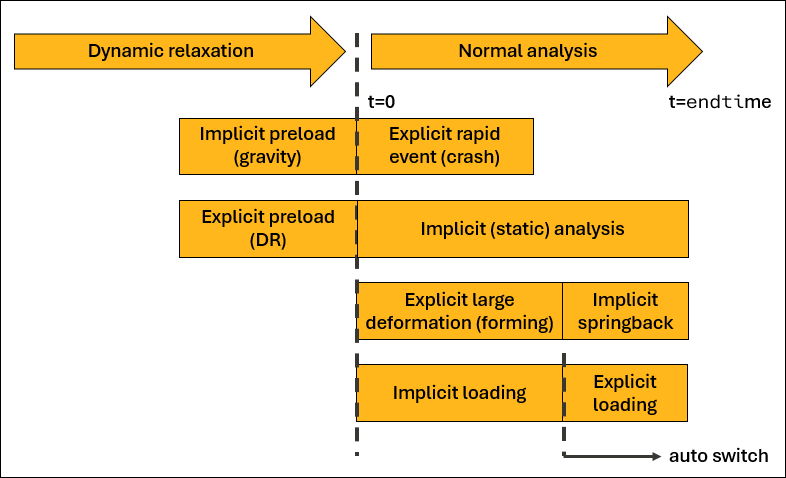
Alternatively, the implicit solver can be used during a pre-load phase followed by a rapid event, for example a crash analysis or a blast loading, or during a "post-load" phase for computing the elastic springback in a forming analysis.
Explicit dynamic relaxation, for example bolt pretensioning or press-fit, followed by implicit analysis is another example of implicit to explicit switching.
Switching an analysis entirely to use explicit time-integration (see Converting an Implicit Model for Explicit Analyses) can also be a troubleshooting tool. Visual inspection of results from an explicit analysis may give clues about convergence issues in an implicit analysis, for example if you accidentally used the wrong unit system when calculating the loading.
An overview of different possibilities for implicit/explicit switching is shown in the following figure.
When involving the explicit solver as a part of the solution, Ansys recommends using stiffness damping (see Damping in Explicit Analysis) to reduce high-frequency numerical noise, and also time step control (mass scaling) see Time Step Control and Mass Scaling in Explicit Analyses. The explicit solver always involves dynamic effects as a function of physical time. For details on how to set up different types of explicit analyses, see [22]. A review of different options for implicit/explicit switching is presented in the Webinar [38].
Example *.key Files
Key card files for the examples in this chapter can be downloaded from the Ansys website as described in Example Files for Implicit Analyses