


The following Forming Plasticity models are discussed in this section:
- 6.7.1. Bilinear Transversely Anisotropic Hardening
- 6.7.2. Multilinear Transversely Anisotropic Hardening
- 6.7.3. Bilinear FLD Transversely Anisotropic Hardening
- 6.7.4. Multilinear FLD Transversely Anisotropic Hardening
- 6.7.5. Bilinear 3 Parameter Barlat Hardening
- 6.7.6. Exponential 3 Parameter Barlat Hardening
- 6.7.7. Exponential Barlat Anisotropic Hardening
This material model is most commonly used for sheet metal forming of anisotropic materials.
It is a fully iterative anisotropic plasticity model available for shell and 2–D elements only. In this model the yield function given by Hill[ 3 ] is reduced to the following for the case of plane stress:

The anisotropic hardening parameter, R, is defined by the ratio of the in-plane plastic strain rate to the out-of-plane plastic strain rate:

| Name | Symbol | Units | Notes |
|---|---|---|---|
| Yield Strength | Stress | ||
| Tangent Modulus | Stress | ||
| Anisotropic hardening Parameter | None |
This material behavior is written as *MAT_TRANSVERSELY_ANISOTROPIC_ELASTIC_PLASTIC .
This material model is most commonly used for sheet metal forming of anisotropic materials.
It is a fully iterative anisotropic plasticity model available for shell and 2-D elements only. In this model the yield function given by Hill[ 3 ] is reduced to the following for the case of plane stress:

A load curve parameter is defined for the relationship between the effective yield stress and the effective plastic strain.
| Name | Symbol | Units | Notes |
|---|---|---|---|
| Anisotropic hardening Parameter | None |
This material behavior is written as *MAT_TRANSVERSELY_ANISOTROPIC_ELASTIC_PLASTIC .
This material model is used for simulating the sheet metal forming of anisotropic materials. Only transversely anisotropic materials can be considered. For this model, the dependence of the flow stress with the effective plastic strain is modeled by defining a yield stress and a tangent modulus. In addition, you also define a forming limit diagram. This diagram will be used to compute the maximum strain ratio that the material can experience.
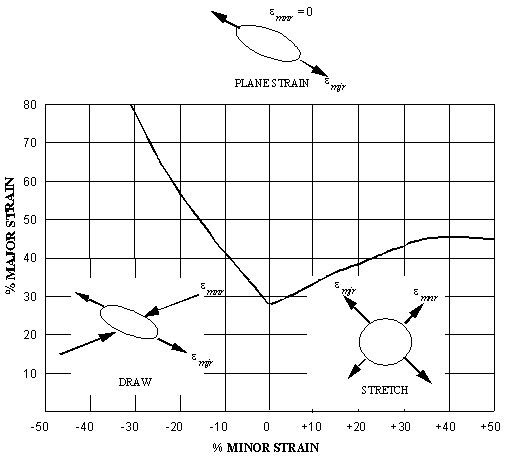
This plasticity model is only available for shell and 2-D elements. The model directly follows the plasticity theory introduced in the Transversely Anisotropic Elastic Plastic model described earlier in this section. You can refer to that model for the theoretical basis.
| Name | Symbol | Units | Notes |
|---|---|---|---|
| Yield Strength | Stress | ||
| Tangent Modulus | Stress | ||
| Anisotropic hardening Parameter | None |
This material behavior is written as *MAT_FLD_TRANSVERSELY_ANISOTROPIC .
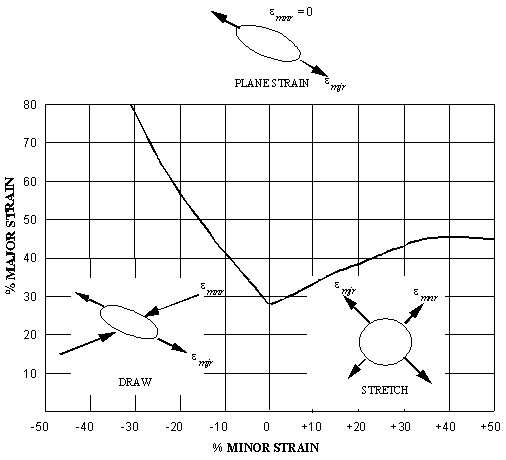
This material model is used for simulating the sheet metal forming of anisotropic materials. Only transversely anisotropic materials can be considered. For this model, the dependence of the flow stress with the effective plastic strain is modeled using a curve. In addition, you also define a forming limit diagram. This diagram will be used to compute the maximum strain ratio that the material can experience.
This plasticity model is only available for shell and 2-D elements. The model directly follows the plasticity theory introduced in the Transversely Anisotropic Elastic Plastic model described earlier in this section. You can refer to that model for the theoretical basis.
| Name | Symbol | Units | Notes |
|---|---|---|---|
| Anisotropic hardening Parameter | None |
This material behavior is written as *MAT_FLD_TRANSVERSELY_ANISOTROPIC .
This is an anisotropic plasticity model developed by Barlat and Lian[ 1 ] used for modeling aluminum sheets under plane stress conditions. Both exponential and linear hardening rules are available. The anisotropic yield criterion for plane stress is defined as:

where σ Y is the yield stress, a and c are anisotropic material constants, m is Barlat exponent, and K 1 and K 2 are defined by:
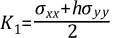
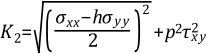
Here, h and p are additional anisotropic material constants. For the exponential hardening option, the material yield strength is given by:

where k is the strength coefficient, ε 0 is the initial strain at yield, ε p is the plastic strain, and n is the hardening coefficient. All of the anisotropic material constants, excluding p which is determined implicitly, are determined from Barlat and Lian width to thickness strain ratio (R) values as shown:
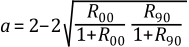
c = 2 – a
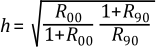
The width to thickness strain ratio for any angle Φ can be calculated from:
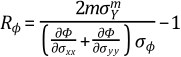
The hardening rule is linear and requires input of yield strength and tangent modulus, in addition to the Barlat exponent.
This material behavior is written as *MAT_3-PARAMETER_BARLAT .
The theory is identical to the bilinear 3 parameter Barlat model, but for this material model the hardening rule is exponential. It requires input of the hardening constant K, and hardening exponent, in addition to the Barlat exponent.
This material behavior is written as *MAT_3-PARAMETER_BARLAT .
This is an anisotropic plasticity model developed by Barlat, Lege, and Brem[ 2 ] used for modeling material behavior in forming processes. The anisotropic yield function Φ is defined as:

where m is the flow potential exponent and S i are the principal values of the symmetric matrix S ij .
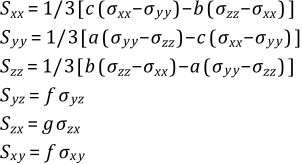
where a, b, c, f, g, and h represent the anisotropic material constants. When a=b=c=f=g=h=1, isotropic material behavior is modeled and the yield surface reduces to the Tresca surface for m = 1 and the von Mises surface for m = 2 or 4. For this material option, the yield strength is given by:

where k is the strength coefficient, ε P is the plastic strain, ε 0 is the initial strain at yield, and n is the hardening coefficient. The stress-strain behavior can be specified at only one temperature.
This material behavior is written as *MAT_BARLAT_ANISOTROPIC_PLASTICITY .