


Background
Materials are not able to withstand tensile stresses which exceed the material's local tensile strength. The computation of the dynamic motion of materials assuming that they always remain continuous, even if the predicted local stresses reach very large values, will lead to unphysical solutions.
A model has to be constructed to recognize when tensile limits are reached to modify the computation to deal with this and to describe the properties of the material after this formulation has been applied.
Several different modes of failure initiation can be represented in the explicit dynamics system.
Element failure in the explicit dynamics system has two components, failure initiation and post failure response.
Failure Initiation
A number of mechanisms are available to initiate failure in a material (see properties Plastic Strain Failure, Principal Stress Failure, Principal Strain Failure, Tensile Pressure Failure, Johnson-Cook Failure). When specified criteria are met within an element, a post failure response is activated.
Post Failure Response
After failure initiation in an element, the subsequent strength characteristics of the element will change depending on the type of failure model.
Instantaneous Failure
Upon failure initiation, the element deviatoric stress will be immediately set to zero and retained at this level. Subsequently, the element will only be able to support compressive pressures.
By default, tensile failure models will produce an instantaneous post failure response.
The following Failure models are discussed in this section:
Plastic strain failure can be used to model ductile failure in materials. Failure initiation is based on the effective plastic strain in the material. The user inputs a maximum plastic strain value.
If the material effective plastic strain is greater than the user defined maximum, failure initiation occurs. The material instantaneously fails.
Note: This failure model must be used in conjunction with a plasticity or brittle strength model.
Principal stress failure can be used to represent brittle failure in materials.
Failure initiation is based on one of two criteria
Maximum principal tensile stress
Maximum shear stress (derived from the maximum difference in the principal stresses)
Failure is initiated when either of the above criteria is met. The material instantaneously fails.
If this model is used in conjunction with a plasticity model, it is often recommended to deactivate the Maximum Shear stress criteria by specifying a large value. In this case the shear response will be handled by the plasticity model.
| Name | Symbol | Units | Notes |
|---|---|---|---|
| Maximum Tensile Stress | Stress | User must input a positive value. Default = +1e+20 | |
| Maximum Shear Stress | Stress | User must input a positive value. Default = +1e+20 |
Principal strain failure can be used to represent brittle or ductile failure in materials.
Failure initiation is based on one of two criteria
Maximum principal tensile strain
Maximum shear strain (derived from the maximum difference in the principal strains)
Failure is initiated when either of the above criteria is met. The material instantaneously fails.
If this model is used in conjunction with a plasticity model, it is often recommended to deactivate the maximum shear strain criteria by specifying a large value. In this case the shear response will be treated by the plasticity model.
| Name | Symbol | Units | Notes |
|---|---|---|---|
| Maximum Principal Strain | None | User must input a positive value. Default = +1e+20 | |
| Maximum Shear Strain | None | User must input a positive value. Default = +1e+20 |
The Johnson-Cook failure model can be used to model ductile failure of materials experiencing large pressures, strain rates and temperatures.
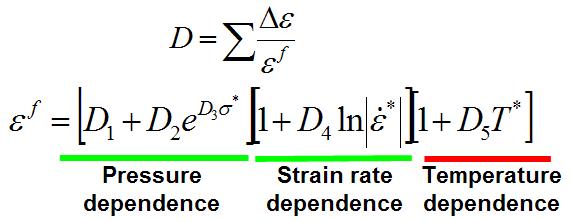
This model is constructed in a similar way to the Johnson-Cook plasticity model in that it consists of three independent terms that define the dynamic fracture strain as a function of pressure, strain rate and temperature:
| Name | Symbol | Units | Notes |
|---|---|---|---|
| Damage Constant D1 | D1 | None | |
| Damage Constant D2 | D2 | None | |
| Damage Constant D3 | D3 | None | |
| Damage Constant D4 | D4 | None | |
| Damage Constant D5 | D5 | None | |
| Melting Temperature | Temperature |