


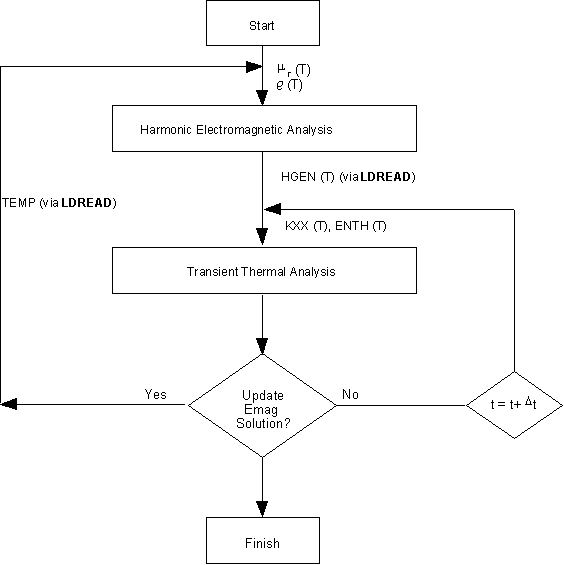
This transient induction heating problem demonstrates a solution sequence alternating between an electromagnetic harmonic analysis and a transient heat transfer analysis with restarting:
The element PLANE13 used in this example has been archived. For more information, see Feature Archive.
A very long steel billet undergoes surface heat treating by rapidly raising the temperature of the billet surface by means of an induction coil. The coil is placed in close proximity to the billet surface and is excited by a large alternating current at high frequency. The AC current induces heat in the billet, most notably at the surface, which quickly raises the surface temperature.
A simplified geometry considers only a finite length strip of the long billet, essentially reducing the problem to a one-dimensional study as shown in Figure 3.6: Axisymmetric 1D Slice of the Induction Heating Domain.
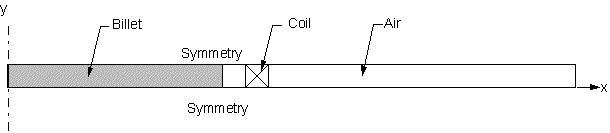
The billet will heat up to over 700°C. This temperature dependency of the material properties must be considered for both the thermal problem and the electromagnetic problem. You must solve the problem sequentially, first doing an AC harmonic electromagnetic analysis and then a transient thermal analysis. In addition, you must repeat the electromagnetic analysis at various time intervals to correct for temperature dependent properties which will affect the solution and hence the heating load to the billet. Figure 3.7: Solution Flow Diagram shows the solution flow diagram.
Procedure:
Set up the electromagnetic analysis as follows:
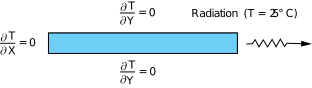
Define the electromagnetic element types, material properties, and real constants as shown below. Note that the billet surface will be used to define a surface effect element for thermal radiation, and it is handled differently than the solid regions.
Assign boundary conditions and loads as shown below.
Set up the thermal analysis as follows:
Cycle between a harmonic electromagnetic analysis and a transient thermal analysis in a *DO loop:
Resume the electromagnetic database and parameters.
Read in the temperatures and body-force loads for material property evaluation via LDREAD from the results of the thermal analysis.
Solve the electromagnetic harmonic analysis.
Save the electromagnetic database.
Change the element types from electromagnetic to thermal as well as KEYOPT options. Specify the null element type in the air and coil region (assume the heat transfer analysis only considers the billet).
Read in the Joule heat generation rate via LDREAD from the results of the electromagnetic analysis.
Solve the thermal transient for a preset time increment (Δt).
Post-process the problem results.

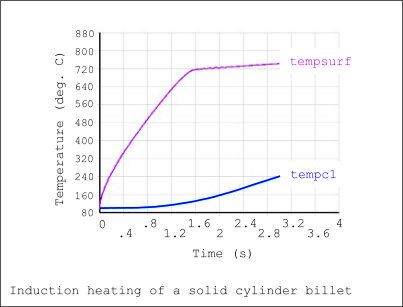
The following figure shows the temperature results obtained in this analysis.
All text prefaced with an explanation point (!) is a comment.
/batch
/prep7
shpp,off
/title, Induction heating of a solid cylinder billet
/com,
et,1,13,,,1             ! PLANE13, axisymmetric, AZ degree of freedom
et,2,13,,,1
et,3,151,,,1,1,1        ! SURF151, thermal, radiation
r,3,0                   ! Real constant set for SURF151
row=.015                ! outer radius of workpiece
ric=.0175               ! inner radius of coil
roc=.0200               ! outer radius of coil
ro=.05                  ! outer radius of model
t=.001                  ! model thickness
freq=150000             ! frequency (Hz.)
pi=4*atan(1)            ! pi
cond=.392e7             ! maximum conductivity
muzero=4e-7*pi          ! free-space permeability
mur=200                 ! maximum relative permeability
skind=sqrt(1/(pi*freq*cond*muzero*mur)) ! skin depth
ftime=3.0   	 ! final time
tinc=.05                ! time increment for harmonic analysis
time=0                  ! initialize time
delt=.01                ! maximum delta time step
emunit,mks       	! set magnetic units

! electromagnetic material properties
mp,murx,1,1             ! air relative permeability
mp,murx,3,1             ! coil relative permeability
mptemp,1,25.5,160,291.5,477.6,635,698   ! temps for relative permeability
mptemp,7,709,720.3,742,761,1000
mpdata,murx,2,1,200,190,182,161,135,104 ! steel relative permeability
mpdata,murx,2,7,84,35,17,1,1
mptemp
mptemp,1,0,125,250,375,500,625          ! temps for resistivity
mptemp,7,750,875,1000
mpdata,rsvx,2,1,.184e-6,.272e-6,.384e-6,.512e-6,.656e-6,.824e-6
mpdata,rsvx,2,7,1.032e-6,1.152e-6,1.2e-6 ! steel resistivity
! thermal material properties
mptemp
mptemp,1,0,730,930,1000         ! temps for conductivity
mpdata,kxx,2,1,60.64,29.5,28,28
mptemp
mptemp,1,0,27,127,327,527,727   ! temps for enthalpy
mptemp,7,765,765.001,927
mpdata,enth,2,1,0,91609056,453285756,1.2748e9,2.2519e9,3.3396e9
mpdata,enth,2,7,3.548547e9,3.548556e9,4.3520e9
mp,emis,2,.68                   ! emissivity
! finite element mesh
rectng,0,row,0,t        ! billet
rectng,row,ric,0,t      ! air-gap
rectng,ric,roc,0,t      ! coil
rectng,roc,ro,0,t       ! outer air
aglue,all
numcmp,area
ksel,s,loc,x,row        ! select keypoints at outer radius of workpiece
kesize,all,skind/2      ! set meshing size to 1/2 skin depth
ksel,s,loc,x,0          ! select keypoints at center
kesize,all,40*skind     ! set meshing size
lsel,s,loc,y,t/2        ! select vertical lines
lesize,all,,,1          ! set 1 division through thickness
lsel,all
asel,s,area,,1
aatt,2,1,1              ! set attributes for billet region
asel,s,area,,3
aatt,3,1,2              ! set attributes for coil region
asel,s,area,,2,4,2
aatt,1,1,2              ! set attributes for air region
asel,all
mshape,0,2d
mshk,1
amesh,1                 ! mesh billet area
lsel,s,loc,y,0
lsel,a,loc,y,t
lsel,u,loc,x,row/2
lesize,all,.001
lsel,all
amesh,all               ! mesh remaining areas
n                       ! create space node for SURF151
*get,nmax,node,,num,max
lsel,s,loc,x,row
type,3
real,3
mat,2
lmesh,all            ! mesh billet outer radius with SURF151
*get,emax,elem,,num,max
emodif,emax,3,nmax   ! modify element to add space node for radiation
et,3,0               ! reset type 3 to null element

! magnetic boundary conditions
nsel,s,loc,x
d,all,az,0           ! apply flux-normal b.c.
nsel,all
esel,s,mat,,3
bfe,all,js,,,,15e6   ! apply current density to coil
esel,all

finish

nsteps=ftime/tinc
*do,i,1,nsteps   ! solution *do loop

time=time+tinc       ! increment time

/filnam,induc
*if,i,ne,1,then
 parsav,scalar
 resume
 parres,new
*endif

/solu
antyp,harm
harfrq,150000

*if,i,eq,1,then
 tunif,100           ! initial temperature
*else
 ldread,temp,last,,,,therm,rth    ! read thermal analysis temps
*endif
nsub,1
kbc,1
solve                ! solve harmonic analysis
finish

save,induc,db

/filnam,therm
/prep7
et,1,55,,,1               ! PLANE55 thermal element, axisymmetric
et,2,0                    ! null element type for coil and air region
et,3,151,,,1,1,1          ! SURF151 element for radiation
keyopt,3,9,1
r,3,1,5.67e-8             ! form factor, Stefan-Boltzmann constant
finish

/solu
antype,trans
toffst,273
tunif,100                     ! initial uniform temperature
d,nmax,temp,25                ! ambient temperature
cnvtol,heat,1                 ! convergence tolerance
kbc,1                         ! step loads
trnopt,full
autos,on                      ! auto time-stepping
deltim,1e-5,1e-6,delt,on      ! time step control
outres,basic,all              ! save all load step information
finish

/solu
parsav,scalar        ! save parameters before multiframe restart
*if,i,gt,1,then
 antype,trans,rest            ! thermal restart
*endif
parres,new           ! restore parameters after multiframe restart
time,time                     ! time at end of thermal run
esel,s,mat,,2                 ! select billet region
ldread,hgen,,,,2,induc,rmg    ! apply Joule heating load from emag
solve
finish

*enddo                        ! end of solution looping
finish

/post26                       ! time-history postprocessor
nsol,2,1,temp,,tempcl        ! store temp at billet centerline
nsol,3,2,temp,,tempsurf      ! store temp at billet outer diameter
prvar,2,3
/axlab,x,Time (s)
/axlab,y,Temperature (deg.C)
plvar,2,3                     ! plot temperature rise over time
fini