
Electrothermal Flow For Power Electronics
When simulating the PCBs of power electronics converters, most cases deal with Pulse Width Modulated (PWM) voltage and current sources. From these cases, it is impossible to configure a DC IR setup that both accurately represents power losses and satisfies the current balance in accordance with Kirchhoff's first law. Therefore, an advanced workflow is required to accurately estimate losses on PCB traces for power electronics.
Frequency Domain Workflow Using SIwave and Circuit
Complete the following steps for at least one period of power converter output frequency.
This workflow can be conducted using excitations from a Circuit/Nexxim source file or from a user-generated frequency dependent source file. Refer to the frequency dependent workflow to generate a frequency dependent source file.
- Set up a PCB design in SIwave.
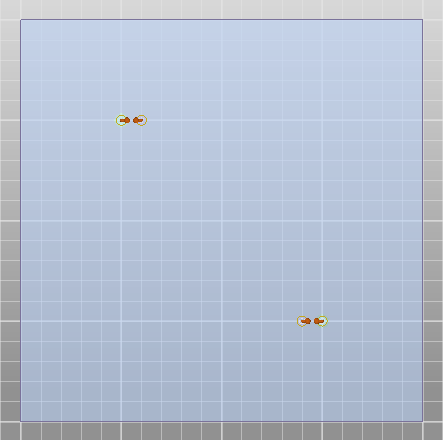
- Set up and run an SYZ simulation to compute and extract S-parameters.

- Save and Close the project.
- Open Electronics Desktop and
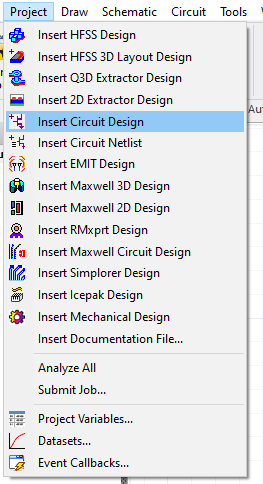
- Create an SIwave dynamic link in Circuit/Nexxim.
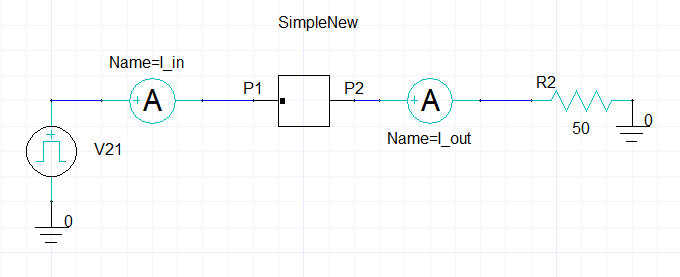
- Create an appropriate Circuit design (Refer to the Nexxim Design Examples).
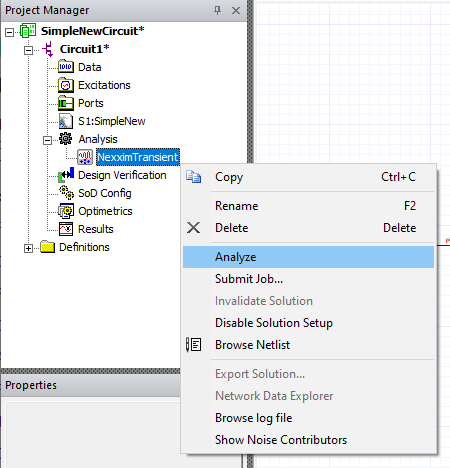
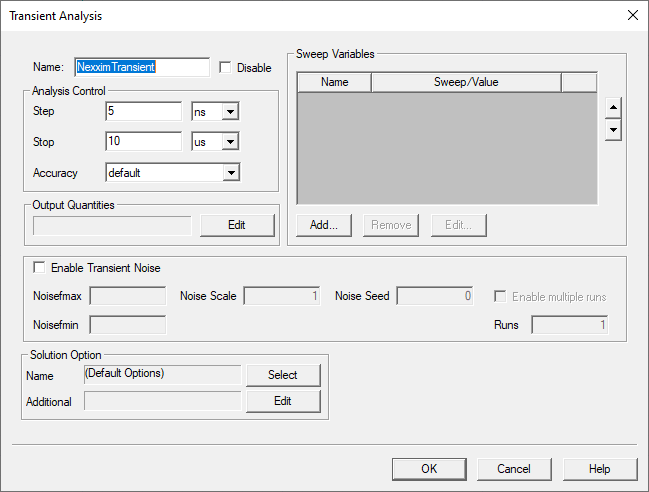
- Run a Nexxim Transient analysis with appropriate Step and Stop values.
 Note:
Note:SIwave uses Fourier Transform to convert a transient source into a frequency domain source. If users set a high Step variable during the transient analysis, simulation time may increase when run as a DC IR Drop simulation (i.e., step 10).
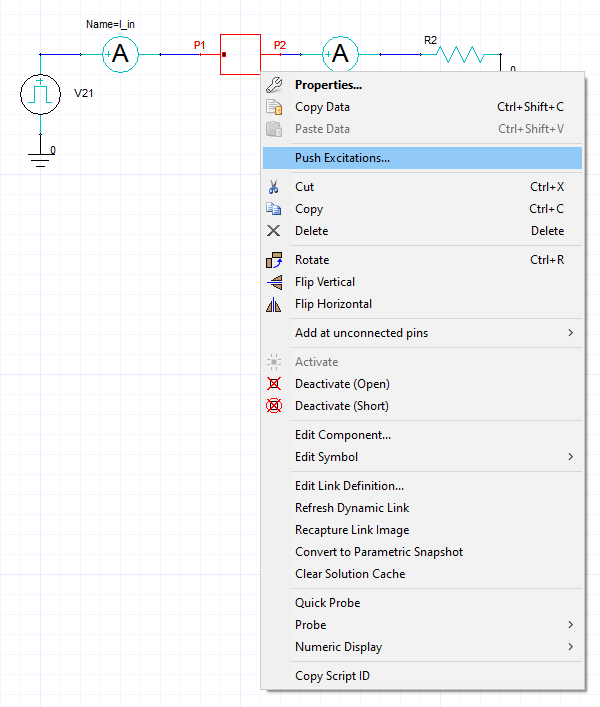
- Push the analysis excitations from Circuit/Nexxim to SIwave.
- Return to SIwave and reopen the project.
-
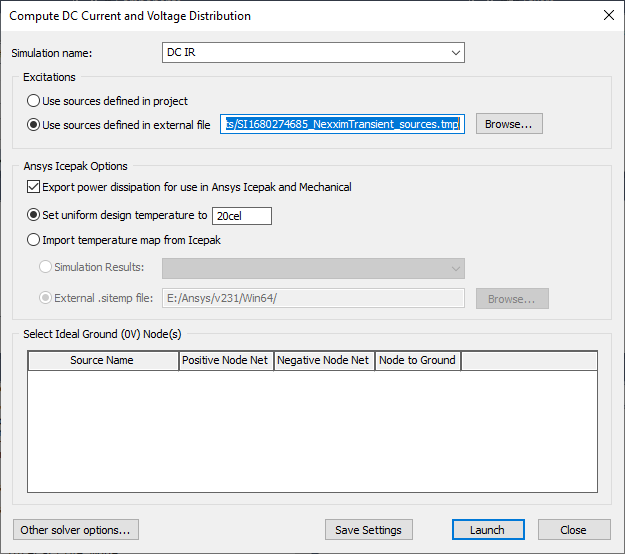
Create and run a DC IR Drop simulation. The excitation output from Circuit/Nexxim will be automatically used as the source file (e.g., 4685_NexximTransient_sources.tmp).
 Note:
Note:Passive components (e.g., capacitors and inductors) should be removed from the layout and modeled in the Circuit design.
-
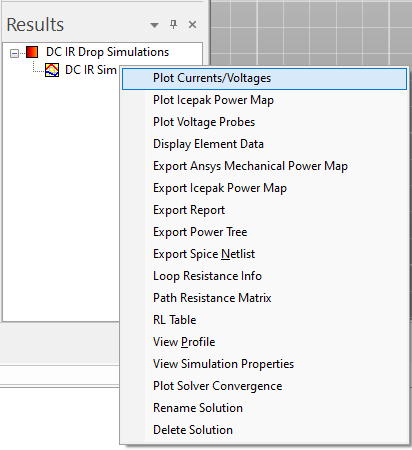
Once the DC IR Drop simulation is complete, navigate to the Results folder. Then right-click the completed simulation (e.g., DC IR) and select one or more of the following:
-
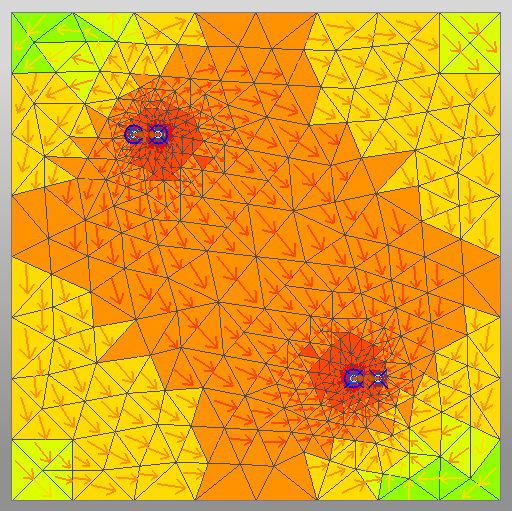
Plot Currents/Voltages
-
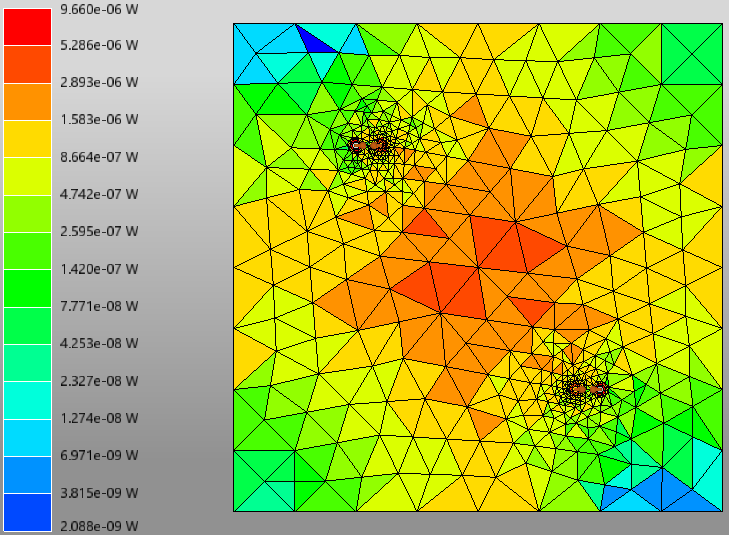
Plot Icepak Power Map
-
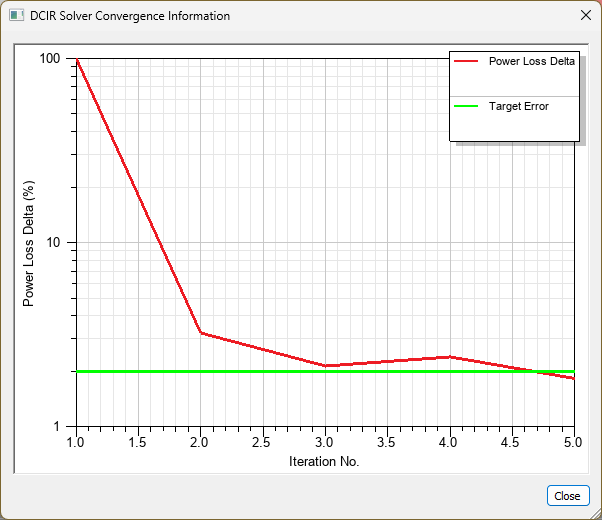
Plot Solver Convergence
-
Power loss is the total loss generated by the transient source. Current and voltage correspond with the value at time t= 0s.
Refer to Viewing DC IR Results in SIwave for more information.
Frequency Domain Workflow Using Frequency Dependent Current in SIwave DC IR Solver
Complete the following steps if users intend to use a frequency dependent source file. Generate the data for the frequency dependent current course by performing a Fourier transformation on a transient current obtained from a circuit simulation for at least one period of power converter output frequency.
-
Create a frequency dependent source file (i.e., a *.txt file), adhering to the following guidelines:
-
The file must contain the frequency domain excitations (i.e., Freq, Re, Im).
SOURCE_RESISTANCE <resistance value of the source (e.g., 5e7)> 0 -1 0 1e9 0 -1 5e9 -1 0 -
If there is more than one frequency dependent current source used for a DC IR setup in a project, all source files must contain the same frequency points.
-
-
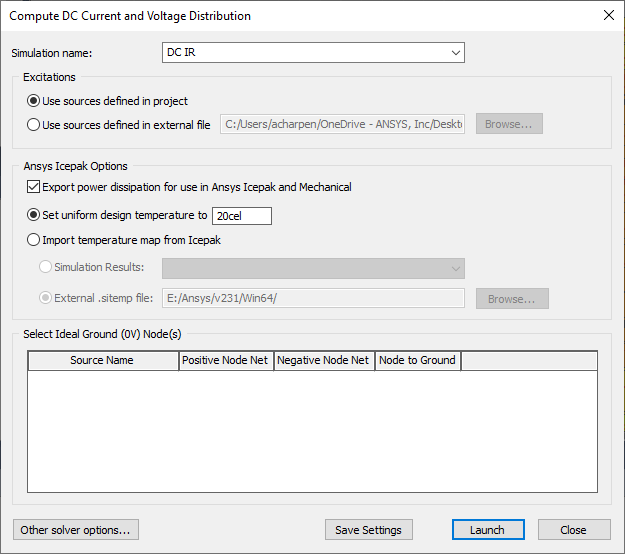
Return to step 10 in the Frequency Domain Workflow to run a DC IR simulation. At the Compute DC Current and Voltage Distribution window, ensure Use sources defined in project is selected.
Technical Notes: How Frequency-Dependent Resistance is Calculated for the DC IR Solver
If a project includes a DC IR setup with frequency-dependent current sources or excitations pushed from a Dynamic SIwave component in a Circuit Design, the frequencies from the current sources are used in an SYZ analysis, which is run as part of the DC IR simulation. Since the DC IR simulation does not compute frequency-dependent resistance (i.e., RAC), the SYZ analysis computes the RAC. The resistance from the DC IR analysis (i.e., RDC) and the RAC from the SYZ analysis are used to calculate the power loss generated by the AC current source.
Utilizing DC correction to compute the exact DC point (i.e., the ZDC matrix generated by the DC IR solver), the simulation will then compute the power loss density for each frequency point with constant resistance obtained from the SYZ analysis. The final frequency-dependent power loss is the sum of the points generated by each current source using Re and Im current values at different frequencies, incorporating the ratio of the power loss calculated by RAC and RDC.
In summation, for DC point, power loss is computed by the DC IR solver as

where I0 is DC current and Rdc is resistance at DC point, calculated by the DC IR solver. The AC solver yields an equivalent resistance matrix that is used to compute power loss as

where Rfn is equivalent to the resistance matrix of the model at the frequency fn, ln_re and ln_im are vectors of real and imaginary parts of the current sources at the frequency fn. If a coefficient (e.g., kn) is defined as  , the AC power loss at the frequency fn can be rewritten as

where Pn_Rdc is the AC power loss at the frequency fn computed with constant resistance Rdc, leading to  . Since both Pn_Rf and Pn_Rdc can be computed for the frequency fn, utilizing the AC solver (i.e., SYZ analysis) and the DC IR solver, kn can be computed for all frequencies. Finally, the coefficient kn is incorporated into the current sources as
  . The power loss result of modified current sources accounts for frequency dependent resistance behavior.
The ZDC matrix is the result of DC port simulation, which has different mesh refinement logistics from the DC IR simulation. In order to ensure agreement of power loss results calculated by equivalent resistance and results calculated by DC IR simulation, it is appropriate to have similar mesh (e.g., the same mesh is ideal), so the DC port and DC IR simulations run the same number of iterations. The number of iterations is beholden to the DC Port simulation automatically as part of the analysis.
Version 2025 R1 and Beyond
Prior to version 2025 R1, when computing power loss on the design, the DC IR solver considers capacitors open elements and inductors zero impedance elements. Starting with version 2025 R1, if the design contains frequency-dependent or time domain sources, the DC IR solver treats capacitors and inductors as active elements when solving the problem and computing power loss in the design.
When addressing frequency-dependent sources in DC IR, a parasitic resistor of 10 MΩ is introduced in parallel with each capacitor, and a parasitic resistor of 9 µΩ is added in series with each inductor.
The parasitic capacitance of inductors and resistors, as well as the parasitic inductance of capacitors, are ignored during simulation. Any parasitic resistor values specified in the UI for capacitors and inductors are overridden by the DC solver with the values mentioned above.
The impedance of capacitors and inductors is calculated as in AC mode:


where ZC and ZL represent the impedance of the capacitor and inductor, respectively; C and L are the capacitance and inductance, and f is the frequency under study. The impedances of capacitors and inductors are ignored at DC (i.e., f=0.0).
For designs that include RLC components, the DC IR solver uses the constant resistance of the metal at DC to compute power loss. To optimize computation time, the Schur complement method is used to solve the matrix system when frequency-dependent or time domain sources are involved.