SIwave-PSI Best Practices: Port Setup
Broadband, 3D simulations require good definition and modeling of ports. Port concepts widely differ between simulation tools, even when called by the same name. To produce results that are true to physical reality, simulation models must account for the field distribution and the actual location of ports.
A port consists of a positive and a negative terminal, each generally identified by a pin or a group of pins. When analyzing a package, it is often convenient to locate internal ports at solder bumps and at solderballs. To produce realistic 3D analysis of such ports, PSI solver offers the following port types:
|
Port Type |
Description |
Recommendation |
|
Undefined |
Defaults to Coaxial-Open at solder ball and bumps. Defaults to Lumped for all others. |
|
|
Coaxial-Open |
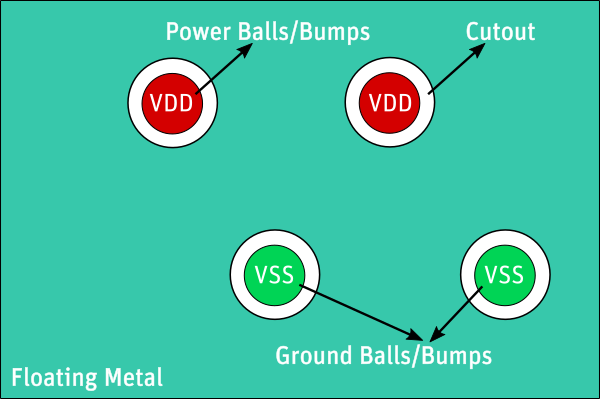
A floating metal with antipads at positive and negative terminals is used (Fig. 1). |
Recommended at solder bumps and balls, if ports do not share a common negative terminal. |
|
Coaxial-Short |
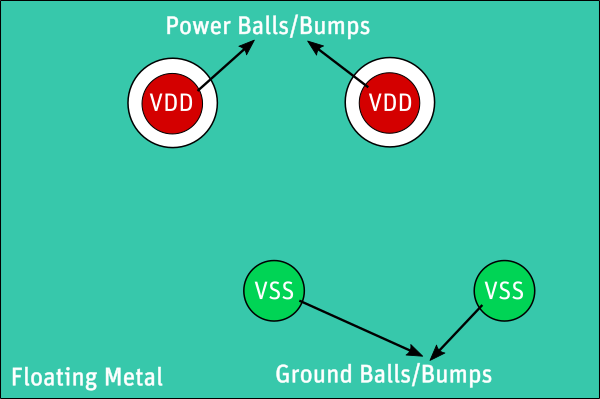
A floating metal with antipads at positive terminals is used. All of the negative terminals shorted to the metal (Fig. 2). |
Recommended at solder bumps and balls, if ports share a common negative terminal. |
|
Lumped |
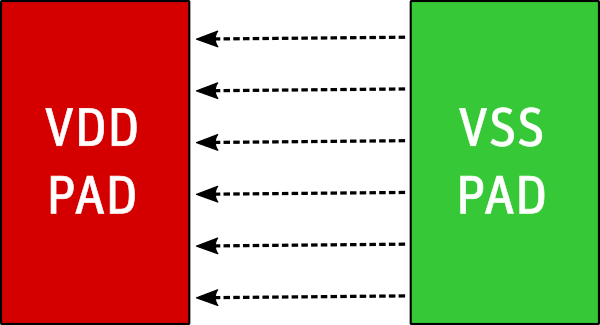
Excites the port as a line(s) connecting the pins (Fig. 3). |
Recommended for ports defined directly on the metal pads or shapes, and when the port length is small (< 60um). |
|
Gap |
A port of finite width derived from its pad is enforced (Fig. 4). |
Recommended for ports defined on rectangular pads, such as decaps, signal pads, etc. |
Using Coaxial ports increases the computational complexity and the run time. In view of this, for situations where a large number (thousands) of solder bumps are grouped to define a port, it is recommended to use Lumped type. This setup gives good accuracy without compromising the run time as the presence of large pins groups doesn’t warrant the Coaxial ports.
The following figure shows a Coaxial Open Port, with cutouts around negative terminals.
The following figure shows a Coaxial Short Port, with negative terminals shorted to the metal.
The following figure shows a Lumped port field excitation.
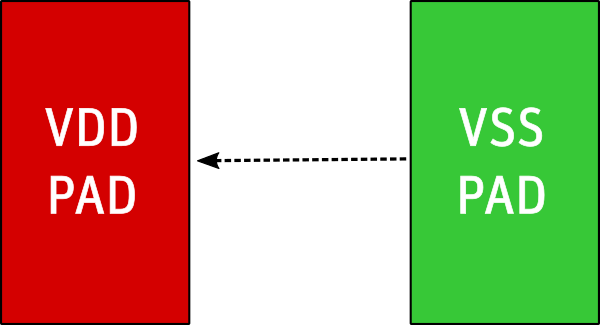
The following figure shows a Gap port, with field excitation spread over an area.