
Exporting the W-element
After you have used the Layer Stackup Wizard to calculate impedance, differential impedance, or trace width/pitch, the Export W-Element window allows you to set up aggressor traces around a victim trace and export the corresponding w-element.
To configure a w-element export:
- Access the Export W-element window one of two ways:
- From the Layer Stackup Wizard, click Export W-element.
- From the Advanced tab, click W-element Analysis.
The Export W-Element window appears.
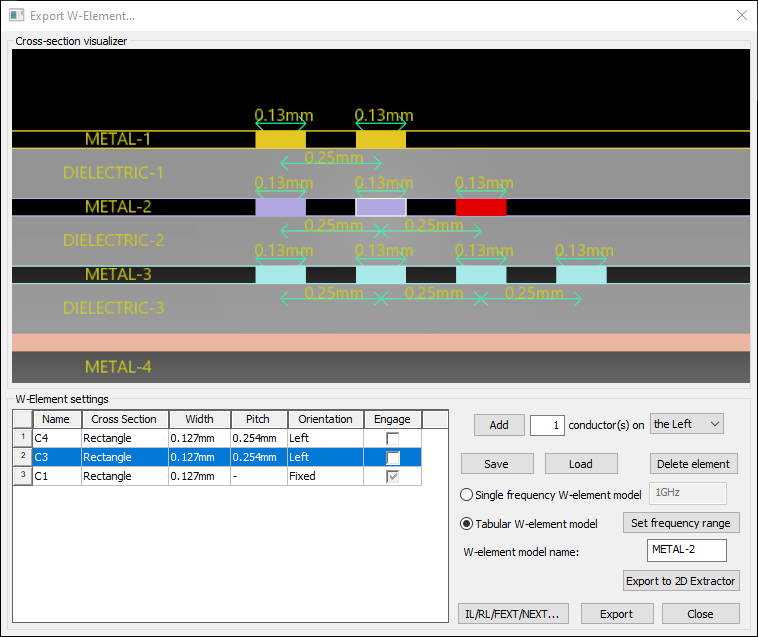
The Cross-section Visualizer displays a graphical representation of the W-Element Settings, including dielectric blocks and the top and bottom reference layers.
- Click a conductor in the visualizer or select it from the list in the W-Element Settings area.
The grid displays the following for each conductor:
- Name – conductor name.
- Cross Section – indicates the shape of the cross section.
- Width – can be edited here directly, or imported from the Layer Stackup Wizard by selecting Use width/pitch in W-element.
- Pitch – can be edited here directly, or imported from the Layer Stackup Wizard by selecting Use width/pitch in W-element.
- Orientation – fixed, left, or right.
- Engage – enabling this check box engages the conductor in IL/RL/FEXT/NEXT simulations.
The following options are available:
- Add – Enter the number of aggressors to add, and use the drop-down menu to select whether to add them on the right, left, or on both sides. Then click Add.
Note:
If you previously enabled CPW settings during trace width, impedance, or differential impedance calculation, your options will be limited.
- If you selected Left plane spacing, aggressors may only be added to the right of a victim trace.
- If you selected Right plane spacing, aggressors may only be added to the left of a victim trace.
- Delete Element – Click to remove an element.
- Single Frequency / Tabular Model – Select Single frequency and enter the frequency in Hz, or select Tabular and click Set frequency range to set up a range of frequencies.
- W-Element Model Name – If appropriate, enter a new model name for the w-element.
- Export to 2D Extractor – generates a VB script to export the selected layer’s cross-section to 2D Extractor. Generating this script launches a prompt asking if you want to run the script in Electronics Desktop.
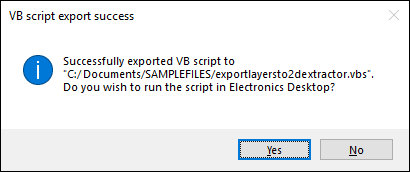
The layer thickness, conductor width, pitch, etching, conformal coat thickness are all defined using design variables.
Consult the Q3D Extractor/2D Extractor help for instructions on running an analysis in 2D Extractor.
- Click IL/RL/FEXT/NEXT to compute insertion/return loss and time domain crosstalk.
- Make your appropriate selections, then click Export.
The Select Spice File to Export window appears.
Note:If you selected Tabular W-element model but did not specify the frequency range, the Frequency Sweep Dialog appears. You must specify the frequency range before you can save.
- Browse to a save location, name your file, and click Save.
The file is saved in Spice (*.sp) format.