
Produce Derivatives for Selected Variables
The Derivatives tab of the Solution Setup window allows you to produce derivatives of S-parameters and related matrix quantities, such as Y or Z. The solver can also output partial derivatives of E and H over radiation surfaces. You can then create reports to calculate the partial derivative of the far fields using of E and H over the radiation surfaces based on the same formulation as far fields. Thus the tuned far fields are derived from the nominal fields and the partial derivative of the far fields.
Far field tuning supports:
- Incident Wave
- Linked Field
- Voltage Source
- Current Source
- Magnetic Bias
Note:
Sensitivity analysis of a design variable associated with the magnetic bias region assumes that the magnetic bias field does not change. In some cases, this assumption may not be appropriate and requires user discretion to ensure its applicability, especially for non-uniform ferrite models.
You can select design properties and project variables as variables of differentiation. If your design has appropriate candidate variables, the Derivatives tab of the Solution Setup window lists them. Enable the derivative calculation(s) by selecting the appropriate Use check boxes.
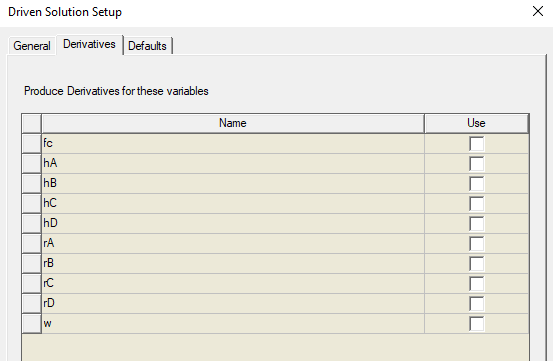
You can view the computed derivatives in the Reporter. You can also use them through the Tune Reports command for interactive exploration of small variations in the design without the need to solve again.
This feature has the following limits:
- HFSS Transient projects do not support derivatives.
- HFSS Eigenmode projects do not support derivatives.
- Derivatives are not computed in a ports-only solution.
- Derivatives are supported in projects with non-port excitations, including incident waves, linked fields, voltage or current sources.
- Parameters of differentiation may not affect Floquet ports.
- Parameters of differentiation many not affect de-embedded Lumped ports.
- Derivatives are not supported for any solution employing Domain Decomposition Method (DDM), which includes FE-BI radiation boundaries, IE Regions, Finite Arrays.
Units for Calculated Derivatives
The derivatives calculated by HFSS are dependent on the units of the design parameters. For example, if the design parameter p is originally defined with units of millimeters, then the value of the derivative gives the (linearized) change in the output quantity when p is varied by one unit (1 mm). If the units of p are changed to an equivalent value in micrometers, and the derivative is recomputed, then it will appear to drop in magnitude by a factor of 1000 because it now represents how much the output changes when p is varied by one unit (now 1 micrometer.) Therefore, when reporting derivative values it is necessary to record the units of the output quantity as well as the units for the variable of differentiation.