
Assign Lumped Ports for Modal Solutions
While assigning lumped ports for modal solutions, you will be prompted to set the complex full port impedance which must be non-zero, set the non-negative resistance, and finally define the integration line for the single mode. You can assign lumped ports in 3 different ways:
- Selecting a Face or Sheet and Manually Drawing an Integration Line
- Selecting Two Linear Edges that Do Not Intersect
- Selecting a Face and a Linear Edge
Selecting a Face or Sheet and Manually Drawing an Integration Line
The steps are as follows:
- Select
a surface to which you want to assign the port and click HFSS>Excitations>Assign>Lumped
Port to bring up the Lumped Port: General dialog box.
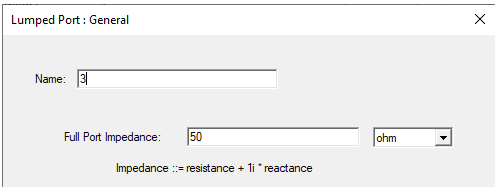
- Define the complex Full Port Impedance
in the text field.
The format is "<real_part> + <complex_part>*i ohm", for example 50ohm + (-5ohm) * 1i Note:
The reference impedance is meant to represent the component modeled by the lumped port. You can assign a variable to these values, (for example " resistance + (reactance) * 1i"). This variable can be dependent on the frequency, which allows use of a dataset for frequency dependent impedance, (for example, pwl(ds1,freq) + (pwl(ds2,freq)) * 1i).
- Click Next to display the Lumped Port: Modes dialog
box.
Note:
The field Number of Modes is not editable because only one mode is allowed.
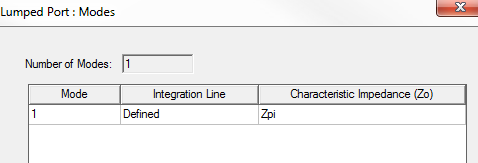
- Integration line must be drawn for a lumped port.
The Characteristic Impedance (Zo) column shows the Zpi method usually used to calculate the characteristic impedance. If Zpi is zero, HFSS uses Zpv.
For definitions of how HFSS defines these values, see Calculating the Zpi , and Calculating the Zpv.
Click Next and the Post Processing settings appear.
For designs with only lumped ports or a combination of lumped and circuit ports, the Advanced Solution Setup, Options tab includes an option to use Enhanced low frequency accuracy.
Selecting Two Linear Edges that Do Not Intersect
An integration line will be automatically drawn from the second linear edge selected to the first. The steps are as follows:
- Set the selection mode to Edge or Multi, select the edge to which you want to assign the port and click HFSS>Excitations>Assign>Lumped
Port to bring up the Lumped Port: General dialog box.
- Define the complex Full Port Impedance
in the text field.
The format is "<real_part> + <complex_part>*i ohm", for example 50ohm + (-5ohm) * 1i Note:
The reference impedance is meant to represent the component modeled by the lumped port. You can assign a variable to these values, (for example " resistance + (reactance) * 1i"). This variable can be dependent on the frequency, which allows use of a dataset for frequency dependent impedance, (for example, pwl(ds1,freq) + (pwl(ds2,freq)) * 1i).
- Click Next. An integration line is automatically drawn and the Post Processing settings appear.
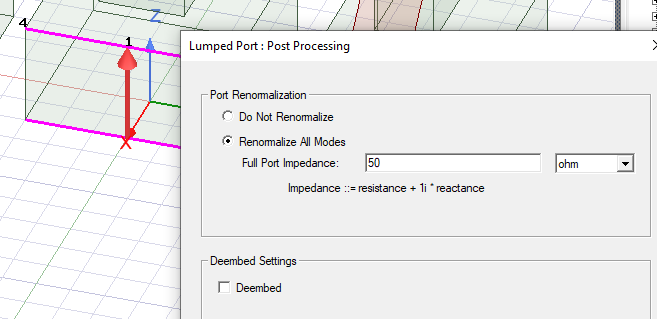
For designs with only lumped ports or a combination of lumped and circuit ports, the Advanced Solution Setup, Options tab includes an option to use Enhanced low frequency accuracy
Selecting a Planar Face and a Linear Edge
You can select exactly one linear edge and one planar face and create a lumped port to launch the dialog. For a modal lumped port, the Mode Page is skipped and an integration line is automatically created. As to the associated sheet created for the lumped port, if the edge intersects with the face, or the edge is vertical to the face, or most part of the edge cannot be projected on the face, an error message is issued. Otherwise, the 2 endpoints of the edge and the 2 projected point of the face are used to create a sheet that is vertical to the selected face.
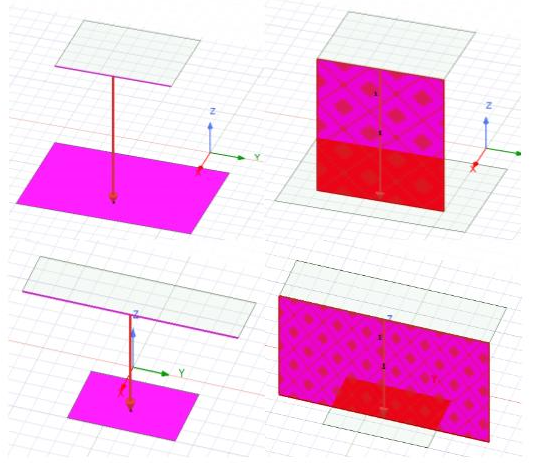
The steps are as follows:
- Select
a face and a linear edge where you want to assign the lumped port and click HFSS>Excitations>Assign>Lumped
Port to bring up the Lumped Port: General dialog box.
- Define the complex Full Port Impedance
in the text field.
The format is "<real_part> + <complex_part>*i ohm", for example 50ohm + (-5ohm) * 1i Note:
The reference impedance is meant to represent the component modeled by the lumped port. You can assign a variable to these values, (for example " resistance + (reactance) * 1i"). This variable can be dependent on the frequency, which allows use of a dataset for frequency dependent impedance, (for example, pwl(ds1,freq) + (pwl(ds2,freq)) * 1i).
- Click Next. An integration line is automatically drawn, and the Post Processing settings appear.
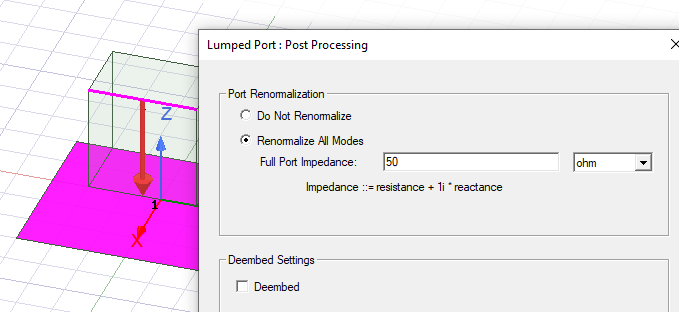
For designs with only lumped ports or a combination of lumped and circuit ports, the Advanced Solution Setup, Options tab includes an option to use Enhanced low frequency accuracy.