


Three different approaches are available in the literature to account for the boundaries existence and therefore compute the force transfer from these solid boundaries onto the SPH elements that model the fluid phase. One of the most well known approaches involves the placing of "ghost" SPH elements inside the walls, which follow the boundary's motion and can interact with regular SPH elements using regular SPH elements equations [10]. The main drawback is the difficulty of modeling complex geometries using these ghost elements, particularly for sharp edges and arbitrarily curved surfaces.
Another very common approach is the one proposed by Monoghan (2000) [1]that places highly repulsive elements on the boundaries' surfaces. Several formulations are available for the repulsive forces these frontier elements exert on SPH elements. The main drawback is that calculating the normal and tangential components of the element to the boundary surface is not an easy task with complex geometries [11].
The SPH method uses DEM-style interactions with the boundaries. When interacting with a boundary, the SPH element experiences normal and tangential forces. What is closer to the wall than the kernel radius have repulsive forces applied to them to prevent wall penetration. This normal repulsive force for the SPH-boundary contact is calculated using the linear spring-dashpot model, expressed as:
 | (2–49) |
where:
 is distance between the SPH element and the wall.
  is product of the SPH element size by the boundary distance normal
factor.
is product of the SPH element size by the boundary distance normal
factor.  is the normal velocity of the fluid element with respect to the wall.
  is the elastic coefficient, computed according to equation Equation 2–50.
  is the viscous damping coefficient defined by Boundary Damping Factor, which is a method parameter with a default value of
0. (by default no damping is used when computing the normal force due to SPH elements and
walls interactions.)
is the viscous damping coefficient defined by Boundary Damping Factor, which is a method parameter with a default value of
0. (by default no damping is used when computing the normal force due to SPH elements and
walls interactions.)
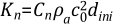
The elastic coefficient  is computed as:
 | (2–50) |
where:
 is the material speed of sound defined by Sound
Speed, which is a method parameter.
is the material speed of sound defined by Sound
Speed, which is a method parameter.  is the SPH element density.
  is the initial SPH elements spacing.
  is the Boundary Stiffness Factor, which
is a method parameter with a default value of 0.5.
is the Boundary Stiffness Factor, which
is a method parameter with a default value of 0.5.
The tangential force exerted on the SPH elements is zero if Free Slip is selected as the Boundary Type or viscous forces are calculated based on the relative tangential velocity between the wall and the SPH elements, ifNo Slip Laminar is selected as the Boundary Type.
If No Slip Laminar is selected, the tangential force is computed as:
 | (2–51) |
where:
 is the distance from the SPH element to the wall.
  is the tangential component of the relative velocity of a SPH element in
relation to the wall.
is the tangential component of the relative velocity of a SPH element in
relation to the wall. is the initial SPH elements spacing.
  is the dynamic viscosity of the fluid.
  is the boundary distance tangential factor, and the user can modify the
value of this parameter through the Advanced SPH option on Rocky UI.
is the boundary distance tangential factor, and the user can modify the
value of this parameter through the Advanced SPH option on Rocky UI.
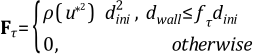
Otherwise, when the No Slip Turbulent is selected, the tangential force is computed with the expression:
 | (2–52) |
where:
 is the shear velocity or friction velocity.
The shear velocity or friction velocity is obtained from the expression:
 | (2–53) |
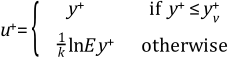
Where,  is a dimensionless velocity which is obtained by solving the so-called
logarithmic law of the wall:
is a dimensionless velocity which is obtained by solving the so-called
logarithmic law of the wall:
 | (2–54) |
Where:
 is the von Karman constant.
 is an empirical constant, whose value depends on the roughness of the
wall. The value considered in the software corresponds to a smooth surface.
is an empirical constant, whose value depends on the roughness of the
wall. The value considered in the software corresponds to a smooth surface. is a dimensionless distance of a SPH element to the wall.
 is the dimensionless thickness of the viscous sub-layer. The software
considers
is the dimensionless thickness of the viscous sub-layer. The software
considers  .
.
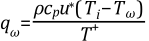
When the thermal option is enabled, the turbulent wall heat transfer rate is computed using:
 | (2–55) |
where  is a dimensionless temperature:
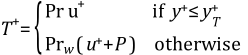 | (2–56) |
where P is a term defined by [2] as:
 | (2–57) |
In the expressions above,
 and
and  are the Prandtl number and the wall Prandtl number,
respectively.
are the Prandtl number and the wall Prandtl number,
respectively. is the dimensionless thickness of the thermal sub-layer.
 and
and  are the wall temperature and the temperature of a SPH element
interacting with the wall.
are the wall temperature and the temperature of a SPH element
interacting with the wall. is the van Driest constant for a smooth wall.
Note: When SPH elements are placed at both sides of a wall, elements from both sides may interact with each other, by exerting forces and exchanging heat, if the distance between them is smaller than a kernel radius. In order to avoid these interactions, an additional wall should be included to represent a thickness. When doing this, those walls must be at a distance of at least a kernel radius in order to prevent any interaction