


AMENV
AMENV, TGAS, HGAS, RADOPT, EMIS, SBC
Specifies the build-environment thermal boundary conditions in an additive manufacturing analysis.
TGASTemperature of the gas in the build enclosure.
HGASConvection coefficient from the part to the enclosure gas.
RADOPTFlag to enable radiation losses from the part to the enclosure. Allowed values: 0 (No radiation, default), 1 (Enabled).
EMISSurface emissivity value for radiation losses. This value must be between 0 (no radiation) and 1 (perfect blackbody emitter). A value is required if radiation is enabled.
SBCStefan-Boltzmann constant in consistent unit system. If the value is not provided, the solver unit system (defined with /UNITS) is used to define the constant in consistent units. The value defaults to a number in the following table, depending on your unit system. The value must be supplied if using a custom /UNITS,USER unit system.
Stefan-Boltzmann constant default values Unit system Default value MKS or SI units 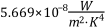
CGS units 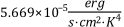
MPA units 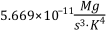
µMKS units 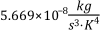
BFT units 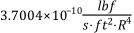
BIN units 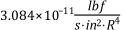
Notes
If using the power-bed fusion process (AMTYPE,PBF), the convection and radiation (if enabled) are applied only to the top of a newly laid layer.
If using the directed-energy deposition process (AMTYPE,DED), the convection and radiation (if enabled) are applied to the top of a newly laid layer and to the sides of the part already built.
No convection or radiation boundary conditions are applied to the plate, although you can define them manually (SF and related commands).
When radiation is enabled (AMENV, TGAS,,RADOPT,, ), heat losses from radiation are applied only during the build and cooldown process steps (AMSTEP,Sequence = BUILD and COOLDOWN). Radiation heat losses are calculated with gray body assumptions, and the
surrounding gas is assumed to be equal to TGAS. Ansys recommends increasing the number of steps between layers (AMSTEP command) for increased accuracy of the radiation effects.
This command is also valid in PREP7.
For more information, including a list of the elements and commands used in an additive manufacturing analysis, see Additive Simulation in the Mechanical Application in the Powder Bed Fusion Simulation Guide.