


When a surface tension model is selected, it enables the simulation of interfacial phenomena, showing its effects on fluid-fluid and fluid-solid interactions, such as how liquid behaves when poured into a container, rests on surfaces, or flows around objects.
The momentum equations for Newtonian Smoothed Particles are:
 | (3–27) |
When surface tension is enabled, the corresponding force becomes part of the
 term.
term.
There are three different models available for Surface Tensions in the software: Continuum Surface Force (CSF), Constant Surface Stress (CSS) and Pairwise Potential.
This model approaches surface tension as a continuous body force distributed over the interface.
A scalar color function  is used to identify the fluid interface. The force is then computed
proportionally to the interface's curvature and normal vector.
is used to identify the fluid interface. The force is then computed
proportionally to the interface's curvature and normal vector.
In the CSF model, the surface tension contribution to the total acceleration is computed from:
 | (3–28) |
The  term is the surface tension force per unit volume, defined as:
 | (3–29) |
Where:
 is the force per unit area.
 is the surface delta function, used to locate the force near the
interface.
is the surface delta function, used to locate the force near the
interface.
The term is a force acting normal to the interface, corresponding to the net
surface tension force due to the local curvature. It acts to smooth regions of high
curvature in an attempt to reduce the total surface area, thus reducing surface energy.
This term is expressed as:
 | (3–30) |
Where:
 is the Surface Tension Coefficient.
 is the curvature at the interface.
 is the unit normal vector to the interface.
The normal vector  is computed from:
 | (3–31) |
Where:
 is the color function gradient, which distinguishes the interior
form free-surface elements.
is the color function gradient, which distinguishes the interior
form free-surface elements. is the jump of the color function
  at the interface.
For single-phase SPH, the normalized interface normal vector at element
 is approximated as:
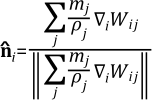 | (3–32) |
Where:
- is the index of the element where the normal vector is being
evaluated.
 refers to all neighboring elements within the kernel radius of
.
refers to all neighboring elements within the kernel radius of
. is the mass of element .
 is the density of element .
 is the gradient of the kernel function with respect to the
position of element .
is the gradient of the kernel function with respect to the
position of element .
This formulation allows to compute the curvature at element as:

And define the surface delta function as:

Including surface tension imposes new time step restrictions for WCSPH. As surface tension acts as an additional force, it may create additional compressibility constraints.
Although surface tension is obtained from a simple workflow, it does not strictly conserve momentum and the volumetric force at interface becomes singular as resolution is increased (Morris, 2000) [15].
To avoid computing the surface curvature explicitly, the CSS model reformulates the
surface tension as the divergence of a surface stress tensor  , relying on the color gradient.
The surface tension force at element is expressed as:
 | (3–33) |
The surface stress tensor is obtained from:
 | (3–34) |
Where:
- is the surface tension coefficient.
 is the color function.
 is the gradient of the color function at element .
 is the identity tensor.
The surface tension force can be discretized in SPH form as:
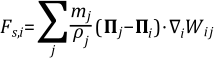 | (3–35) |
This formulation avoids the need to calculate curvature directly, provides a smoother force distribution and improves accuracy near interfaces.
The SPH Pairwise Surface Tension model was developed considering the approach described by Kondo et al. (2007)[14], which uses inter-SPH element potential forces to simulate the cohesive interactions that are between elements, and adhesive interactions that are between fluid elements and walls.
The model is based on a potential function of the form:
 | (3–36) |
where:
 is the cohesive potential function, which defines the cohesive
energy between SPH elements based on their separation distance
is the cohesive potential function, which defines the cohesive
energy between SPH elements based on their separation distance  .
. is the interaction potential function, describing the interaction
between SPH elements.
is the interaction potential function, describing the interaction
between SPH elements. is a proportionality constant that determines the strength of the
interaction.
is a proportionality constant that determines the strength of the
interaction.
The cohesive force between two SPH elements  and
and  is defined by the following equation:
 | (3–37) |
Where:
 is the cohesive force between SPH Elements
  and
and  .
.
 is the gradient of the cohesive potential function.
 is a constant that controls the strength of the cohesive
force.
is a constant that controls the strength of the cohesive
force. is the derivative of the potential function with respect to the
distance
is the derivative of the potential function with respect to the
distance  .
. is the relative position vector between SPH elements
  and
and  .
. is the magnitude of the distance between SPH elements
 and
and  .
.
The equation Equation 3–37 describes the
attractive or repulsive force between SPH elements based on their relative distance. The
direction of the force is along the vector  , and its magnitude is governed by the derivative of the potential
function and the constant
, and its magnitude is governed by the derivative of the potential
function and the constant  .
.
The adhesive force between an SPH element and a wall (triangle) is defined by the following equation:
 | (3–38) |
Where:
 is the adhesive force between an SPH element and a wall.
 is the gradient of the cohesive potential function between an SPH
element and a wall.
is the gradient of the cohesive potential function between an SPH
element and a wall. is the distance between an SPH element and a wall.
 is the derivative of the cohesive potential function between an SPH
element and a wall.
is the derivative of the cohesive potential function between an SPH
element and a wall. is the normal vector of the triangle.
 is the constant that controls the strength of the cohesive forces
between walls and SPH elements, defined by the following equation:
is the constant that controls the strength of the cohesive forces
between walls and SPH elements, defined by the following equation: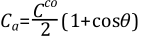
(3–39)
Where
 is the contact angle, discussed in the Geometry Parameters section,
and
is the contact angle, discussed in the Geometry Parameters section,
and  is the constant that controls the strength of the cohesive
force.
is the constant that controls the strength of the cohesive
force.
When Pairwise Potential is selected for Surface Tension Type, two additional parameters are required for wall geometries, located in the Wall | SPH tab - the Surface Tension Contact Angle and the Capillary Friction Coefficient.
Surface Tension Contact Angle: is the angle between a free surface and a wall when equilibrium conditions have been reached. The concept of contact angle is closely related to the notion of wettability. When the contact angle with a solid surface is less than 90 degrees, the liquid is said to be a wetting fluid, while contact angles between 90 degrees and 180 degrees characterize a non-wetting liquid in relation to the given solid surface. The wettability and the contact angle are dependent on the balance between intermolecular forces acting on the fluid next to a solid wall. The adhesive forces between the liquid and the solid would make the liquid spread over the solid surface, however, that effect is counteracted by the cohesive forces that keep the fluid molecules bonded to each other. A definite contact angle will be formed between the free surface and the solid surface as a result of the equilibrium of those intermolecular forces. Therefore, when a given contact angle value is prescribed, a given ratio between adhesive and cohesive forces is being indirectly set. In fact, this the way that the contact angle is enforced when the Pairwise Potential surface tension model is being used, in which the surface tension effect is introduced as a result of the action of inter-element cohesive and adhesive forces.
Allowed values: 0 - 180
Important:
Prescribed contact angles will be reproduced in simulations only in semi-static conditions.
Contact angles below 30 usually are not accurately represented in simulations due to the discrete nature of SPH.
Capillary Friction Coefficient: The Capillary Friction is a parameter that defines how much of the adhesive force between an SPH element and a surface (triangle) is converted into capillary friction force.
Where:
 is the pairwise potential model adhesive force between a
triangle and an SPH element that depends on the contact angle
is the pairwise potential model adhesive force between a
triangle and an SPH element that depends on the contact angle  .
.  is the capillary friction force that is proportional to
 and
and  is the capillary friction coefficient.

The dynamics of free surfaces are strongly affected by the refinement level of SPH elements. The finer the elements, the more dissipative the effect of surface tension.
This effect can be improved with the increase of the kernel distance factor. For some applications, in order to keep similar resolution, increasing the kernel distance factor may require decreasing the element size.
Pairwise Potential is the recommended alternative for most viscous driven flows.