


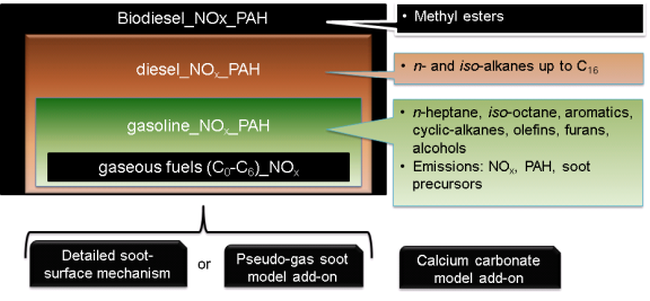
The hierarchical structure of the full mechanisms is depicted in Figure 2.1: Hierarchy of the full mechanisms in the Model Fuel Library. The full mechanisms for the gas-phase reactions are described below.
GaseousFuels_C0-C6_NOx: This mechanism is designed for combustion simulations involving gaseous fuels, such as syngas, natural gas, etc. The mechanism includes the essential "core" chemistry that involves reactions of species with carbon number 4 (C4) and smaller. The core mechanism is the most critical component of all the mechanisms, because most components, even the large heavy components, break down during combustion and create smaller species that then undergo reactions included in the core mechanism. This mechanism can predict CO and hydrocarbon emissions up to benzene. The component mechanism for soot-precursor species, except for PAH, are included. The submechanisms for NOx emissions and sulfur emissions are also included. This mechanism also contains reactions of the additives methanol, ethanol, n-butanol, tetrahydrofuran, DME, and MTBE. This mechanism has 1532 species and 10469 reactions.
Gasoline_NOx_PAH: This mechanism is a superset of and therefore inherits all the capabilities of the GaseousFuels_C0-C6_NOx mechanism. In addition, it has reactions for components for gasoline surrogates. These include n-alkanes components up to 'C7,' iso-alkanes up to C8, olefins up to C6, all aromatic components, all cycloalkane components, and other components for formulating a gasoline surrogate, as listed in the mechanism ratings in the Model Fuel Library Validation Manual. The submechanism for ETFE is included. This mechanism also includes the PAH chemistry that is necessary for use with soot models. This mechanism has 3173 species and 22,857 reactions.
Diesel_NOx_PAH: In addition to the capabilities of the Gasoline_NOx_PAH mechanism, larger alkanes useful for formulating surrogates for diesel and jet fuels are included in this mechanism. These include n-Alkanes up to C20 and the iso-alkanes: iso-dodecane (C12H26) and heptamethylnonane (C16H34). This mechanism has species 6297 and 72,685 reactions.
Biodiesel_NOx_PAH: This is the superset of all the mechanisms in the MFL database. This mechanism extends the capabilities of the Diesel_NOx_PAH mechanism to modeling biodiesel and biodiesel/diesel blends. The components included are methyl esters that range from the small component, methylbutanoate, to heavy components, such as methyl linolenate, as listed in the mechanism ratings in the Model Fuel Library Validation Manual. This mechanism has 10,436 species and 88,327 reactions.
Electrolyte: This mechanism is designed for lithium-ion battery thermal runaway applications. It includes the gas-phase combustion chemistry of the electrolytes ethylene carbonate (EC), dimethyl carbonate (DMC), diethyl carbonate (DEC), and ethyl methyl carbonate (EMC). The mechanism has 227 species participating in 1551 reactions.