


The current version of Rocky offers two approaches to perform the two-way coupling between the particles and the fluid:
Multiphase coupling - This coupling approach relies on the Eulerian multiphase model of Fluent, where Rocky particles are represented by a further dedicated phase. The multiphase approach supports an arbitrary number of fluid phases.
Single-phase coupling - In this coupling approach, the effect of the Rocky particles over the fluid is achieved by setting the domain in Fluent by occupying volume on each cell and adding exchange terms in the Fluent DPM Flow Blocking formulation.
Rocky automatically chooses between the multiphase or the single-phase approach based on the Fluent case that is imported by the two-way coupled simulation. The following sections explain in detail both coupling approaches.
When the Multiphase Model is set to Eulerian in the Fluent case, Rocky models the fluid according to the following sections.
The fluid phases are described by the classical Navier-Stokes equations averaged in volume [41]. The averaged mass conservation equation is given by:
 | (2–5) |
whereas the averaged momentum conservation equation is written as:
 | (2–6) |
where  stands for the fluid volume fraction,
  is the shared pressure,
  is the fluid density,
  is the fluid phase velocity vector and
  is the stress tensor of the fluid phase, defined as:
 | (2–7) |
In Equation 2–6
 represents the source term of momentum from interaction with the
particulate phase, calculated according to the expression:
represents the source term of momentum from interaction with the
particulate phase, calculated according to the expression:
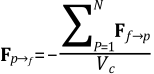 | (2–8) |
Where  is the computational cell volume, N is the number
of particles inside the computational cell volume and
is the computational cell volume, N is the number
of particles inside the computational cell volume and  accounts for the forces generated by the fluid on the particles,
calculated according to the equations in section Particle-fluid interaction forces .
accounts for the forces generated by the fluid on the particles,
calculated according to the equations in section Particle-fluid interaction forces .
In order to describe energy conservation, a separate enthalpy equation is written for each fluid phase, according to:
 | (2–9) |
where  is the specific enthalpy of the fluid phase,
  is the heat flux and
  is the heat exchange between the fluid and particulate phases.
The heat exchange with the particulate phase is calculated according to the equation:
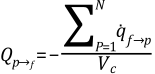 | (2–10) |
where  is the heat transfer rate between the fluid and particle, the
calculation for which is shown in section Heat transfer between fluid and particle.
is the heat transfer rate between the fluid and particle, the
calculation for which is shown in section Heat transfer between fluid and particle.
When the Multiphase model is turned off in the Fluent case, Rocky adapts the Fluent setup to treat the DEM particles as DPM particles that occupy volume in the cells and to assign to the fluid phase momentum and energy source terms (that account for fluid-particle interactions) calculated by Rocky during coupled simulations. The fluid phase volume fraction distribution of the domain is a function of the concentration of the solid phase as the simulation progresses.
Considering a single-phase flow through and assuming that there is no mass transfer between phases, the averaged mass conservation equation of the fluid phase is given by:
 | (2–11) |
where  is the porosity of the medium. Likewise, the averaged momentum
conservation equation is:
is the porosity of the medium. Likewise, the averaged momentum
conservation equation is:
 | (2–12) |
and the averaged energy conservation equation is:
 | (2–13) |
As the single-phase coupled simulation runs, Rocky software computes the fluid phase volume fraction of each cell by:
 | (2–14) |
where  is the local volume fraction of the solid phase at the current time
step.
is the local volume fraction of the solid phase at the current time
step.
During a single-phase coupled simulation, Rocky performs the following actions in Fluent so equations Equation 2–11, Equation 2–12 and Equation 2–13 are affected by the particle phase:
Updates the fluid volume fraction in Fluent according to Equation Equation 2–14;
Applies
 in Fluent as a momentum source term to account for the interaction
between the fluid and particle phases (drag and non-drag fluid forces).
in Fluent as a momentum source term to account for the interaction
between the fluid and particle phases (drag and non-drag fluid forces). Applies
 in Fluent as an energy source term to account for the convective
heat transfer between particles and fluid.
in Fluent as an energy source term to account for the convective
heat transfer between particles and fluid.