


Nonlinear wave excitation forces can be determined by the perturbation approach, with the wave amplitude as a small parameter, as discussed in Second Order Wave Excitation Forces.
When the multi-directional wave elevation is generally represented by Equation 2–28 and Equation 2–29, the first order wave excitation force and moment, i.e. the sum of the Froude-Krylov and diffracting forces and moments, can be simply written as
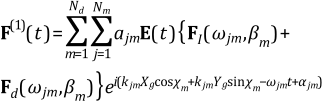 | (13–28) |
where  is the Euler rotation matrix defined by Equation 1–7 at a time
  ,
, 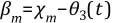 is the relative heading angle
of the m-th sub-directional wave
(relative to the structure, where
is the relative heading angle
of the m-th sub-directional wave
(relative to the structure, where  is the instantaneous yaw angle
of the structure), and
is the instantaneous yaw angle
of the structure), and  is the total first order wave excitation
force induced by an unit amplitude incident wave with frequency
is the total first order wave excitation
force induced by an unit amplitude incident wave with frequency  and wave direction
  . The components of this excitation force
are expressed in Equation 4–48 and are calculated
by a hydrodynamic diffraction analysis (Aqwa-Line) prior to the
present time domain analysis.
. The components of this excitation force
are expressed in Equation 4–48 and are calculated
by a hydrodynamic diffraction analysis (Aqwa-Line) prior to the
present time domain analysis.
From Equation 5–20, the second order wave excitation force in the fixed reference axes is given by
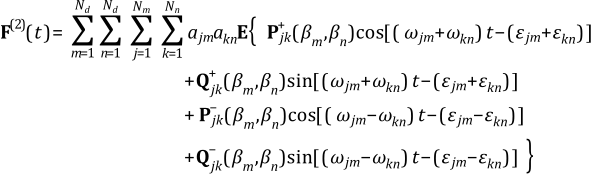 | (13–29) |
where  and
and  .
.
Substituting the first and second order wave forces into Equation 13–3, the following equation of motion is solved:
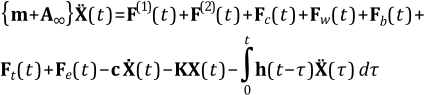 | (13–30) |
in which the total stiffness matrix  includes the
linear hydrostatic stiffness as well as all other stiffnesses, for
example from mooring lines or articulations,
includes the
linear hydrostatic stiffness as well as all other stiffnesses, for
example from mooring lines or articulations,  is the current hull drag force,
  is the wind drag force,
  is the nonlinear bilge
roll damping force,
is the nonlinear bilge
roll damping force,  is the mooring and articulation force, and
  represents additional
external forces. The wave drift damping coefficients are optionally
included in the damping matrix
represents additional
external forces. The wave drift damping coefficients are optionally
included in the damping matrix  .
.
The structure responses due to mean and slowly-varying wave
loads can be estimated from Equation 13–30 by
including only the low frequency drift forces, i.e. the difference
frequency terms of  in Equation 13–29.
If only the first order wave excitation force is involved in Equation 13–30, the wave frequency responses can be calculated.
Wave frequency response with slow drift can be analyzed from Equation 13–30 by including the first order wave excitation force together with the difference frequency second order drift forces.
The sum frequency second order force and moment components without directional coupling effects can be considered when the first order wave excitation force and both the difference frequency and sum frequency second order forces are included. The sum frequency second order force may only be included if the full quadratic transfer function (QTF) option has been applied in the hydrodynamic diffraction analysis (Aqwa-Line) prior to this time domain analysis.