


The method employed for computing transverse (interlaminar) shear stresses of FSDT-based shell elements is based on the work by Rohwer ([ 29 ]) and Rolfes ([ 30 ]). The transverse shear stresses are calculated from the three dimensional equilibrium equations of elasticity:
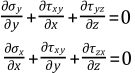 | (3–14) |
In order to calculate the shear stresses from the equilibrium equations, the in-plane stresses need to be derived first and then integrated with respect to the thickness coordinate:
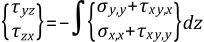 | (3–15) |
In-plane stresses are piecewise continuous functions, so the integration must be done in parts. Applying the stress-strain relation for in-plane stresses, Equation 3–15 takes the form
 | (3–16) |
where:
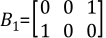
|
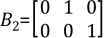
|
Strain derivatives in Equation 3–16 can also be transformed to give an expression in terms of force derivatives by applying the constitutive equations. In order to calculate the stresses straight from the shear forces, some additional assumptions have to be made.
The influence of the in-plane force derivatives is neglected, that is
 | (3–17) |
Strain derivatives then reduce to the form
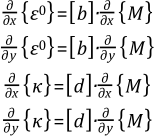 | (3–18) |
where  and
and  are the laminate compliance matrices.
The actual displacement fields are further simplified by assuming two separate cylindrical bending modes. The moment derivatives then reduce to the simple resultant shear forces:
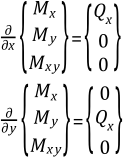 | (3–19) |
Applying Equation 3–17, Equation 3–18, and Equation 3–19 to Equation 3–16 yields:
 | (3–20) |
This simplifies to:
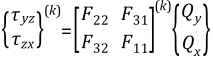 | (3–21) |
where  are the components of
the 3 x 3 matrix
are the components of
the 3 x 3 matrix  . The components of the
  matrix are piecewise continuous,
second order functions of
matrix are piecewise continuous,
second order functions of  determined by:
 | (3–22) |
where:

|

|
The functions  and
and  are defined by the continuity of stresses at the
layer interfaces:
are defined by the continuity of stresses at the
layer interfaces:
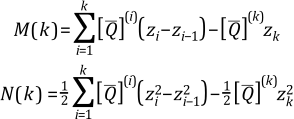 | (3–23) |
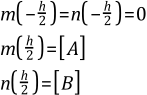
It can be seen that the functions  and
and  of Equation 3–22 give the laminate stiffness
matrices
of Equation 3–22 give the laminate stiffness
matrices  and
and  at the lower surface of the laminate and zero at
the top surface of the laminate:
at the lower surface of the laminate and zero at
the top surface of the laminate:
 | (3–24) |
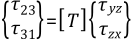
Therefore, the transverse shear stresses of Equation 3–21 become zero for the top and bottom surfaces and fulfill the boundary conditions of transverse shear stresses going to zero at the laminate surfaces.
In the local coordinate system the transverse shear stresses are:
 | (3–25) |
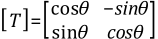
where the 2 x 2 transformation matrix  is
is
 | (3–26) |