


These properties are created when an LS-DYNA input file is imported using External Model. You can also add these properties directly to a material in Engineering Data by selecting them from the LSDYNA External Model - MAT or LSDYNA External Model - EOS sections of the Toolbox as shown in the following figure.
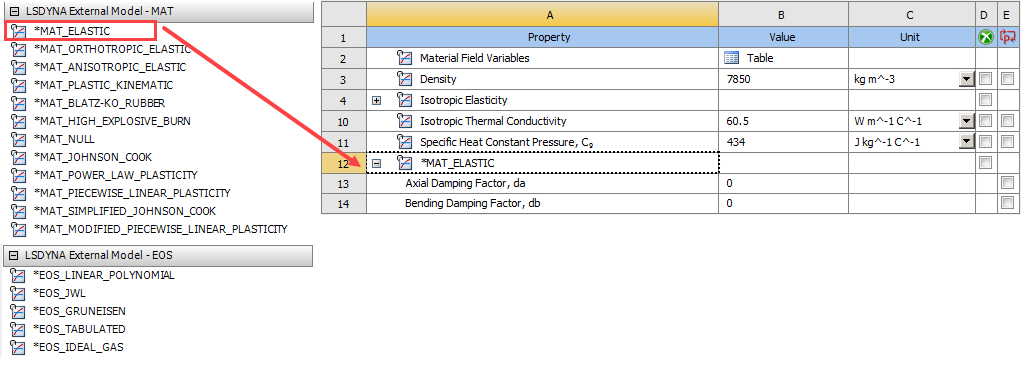
These properties are direct representations of the existing LS-DYNA material models, and enable additional fields for definition. Additional information can be found in LS-DYNA Keyword User's Manual Volume II , which describes these material models in detail.
Note: When the optional Viscoelastic cards are imported into Engineering Data from External Model a conversion is made to the Prony series terms. The Shear\Bulk Moduli are converted to Relative Moduli by applying the Initial Shear\Bulk Modulus as a scale factor, and the Damping Coefficients are converted to Relaxation Times by inversion.
|
Where:
|

Where:
|



When writing the solver input file from the LS-DYNA analysis system the conversion is made from Relative Moduli to Shear\Bulk Moduli and Relaxation Times to Damping Coefficients.


The Initial Shear Modulus for the Ogden Rubber Material Parameters formulation model is calculated using the definition in Ogden Hyperelasticity (TB,HYPER,,,,OGDEN) in the Material Reference. The other material models have a specific field in Engineering Data to define the Initial Shear\Bulk Modulus.
The Ogden Rubber Least Squares formulation model does not currently support Prony series.
This property requires that you also define Isotropic Elastic Elasticity and Density. It enables the definition of the Axial Damping Factor and Bending Damping Factor for Belytschko Schwer beams.
This material behavior is written as *MAT_ELASTIC (or *MAT_001) .
This material behavior is written as *MAT_ORTHOTROPIC_ELASTIC (or *MAT_002) .
This material behavior is written as *MAT_ANISOTROPIC_ELASTIC (or *MAT_002_ANIS) .
This property requires that you also define Isotropic Elasticity.
This material behavior is written as *MAT_PLASTIC_KINEMATIC (or *MAT_003) .
This material behavior is written as *MAT_BLATZ-KO_RUBBER (or *MAT_007) .
This material behavior is written as *MAT_JOHNSON_COOK (or *MAT_015) .
This property requires that you also define Isotropic Elastic Elasticity and Density.
This material behavior is written as *MAT_POWER_LAW_PLASTICITY (or *MAT_018) .
This property requires that you also define Isotropic Elastic and Density.
This material behavior is written as *MAT_PIECEWISE_LINEAR_PLASTICITY (or *MAT_24) .
This property requires that you also define Isotropic Elastic Elasticity and Density.
This material behavior is written as *MAT_SIMPLIFIED_JOHNSON_COOK (or *MAT_098) .
This property requires that you also define Isotropic Elastic Elasticity and Density.
This material behavior is written as *MAT_MODIFIED_PIECEWISE_LINEAR_PLASTICITY (or *MAT_123) .
This property requires that you also define Density.
This material behavior is written as *MAT_HIGH_EXPLOSIVE_BURN (*MAT_008).
This property requires that you also define Density.
This material behavior is written as *MAT_NULL (*MAT_009).
This material behavior is written as *EOS_LINEAR_POLYNOMIAL (*EOS_001) .
This material behavior is written as *EOS_GRUNEISEN (*EOS_004) .
This material behavior is written as *EOS_MURNAGHAN (*EOS_019). This EOS was designed to model incompressible fluid flow with SPH or ALE elements.
This material behavior is written as *EM_EOS_TABULATED1.
This property requires that you also define an EM_MAT. This property is not compatible with EM_MAT_003, EM_MAT_005, and EM_MAT_006. From Engineering Data you can only define an equation of state for conductivity.
This material behavior is written as *EM_MAT_001.
This property requires that you also define Elasticity, Density, Thermal Conductivity, and Heat Capacity.
This material behavior is written as *EM_MAT_002.
This property requires that you also define Elasticity, Density, Thermal Conductivity, and Heat Capacity.
This material behavior is written as *EM_MAT_003.
This property requires that you also define Elasticity, Density, Thermal Conductivity, and Heat Capacity.
This material behavior is written as *EM_MAT_004.
This property requires that you also define Elasticity, Density, Thermal Conductivity, and Heat Capacity.
This material behavior is written as *EM_MAT_005.
This property requires that you also define Elasticity, Density, Thermal Conductivity, and Heat Capacity.
This material behavior is written as *EM_MAT_006.
This property requires that you also define Elasticity, Density, Thermal Conductivity, and Heat Capacity.
This property requires that you also define Isotropic Elastic Elasticity and Density.
This material behavior is written as *MAT_CRUSHABLE_FOAM (*MAT_063).
This property requires that you also define Density. The optional viscoelastic constants cards will be written if the constants have been defined using the Prony Shear Relaxation properties in Engineering Data.
This material behavior is written as *MAT_SIMPLIFIED_RUBBER/FOAM (*MAT_181).
This property requires that you also define Density. The optional viscoelastic constants cards will be written if the constants have been defined using the Prony Shear Relaxation properties in Engineering Data.
This material behavior is written as *MAT_OGDEN_RUBBER (*MAT_077_O).
This property requires that you also define Density and Bulk Modulus. The optional viscoelastic constants cards will be written if the constants have been defined using the Prony Shear Relaxation and Prony Volumetric Relaxation properties in Engineering Data. The optional Shift Function fields can be defined using the Williams-Landel-Ferry Shift Function properties in Engineering Data.
This material behavior is written as *MAT_GENERAL_VISCOELASTIC (*MAT_076).
This property requires that you also define Isotropic Elastic Elasticity and Density.
This material behavior is written as *MAT_BILKHU/DUBOIS_FOAM (*MAT_075).
This property requires that you also define Density.
This material behavior is written as *MAT_FABRIC (*MAT_034).
This material behavior is written as *MAT_COMPOSITE_FAILURE_SHELL_MODEL.
This material behavior is written as *MAT_COMPOSITE_FAILURE_SOLID_MODEL.
This material behavior is written as *MAT_ENHANCED_COMPOSITE_DAMAGE.
This material behavior is written as *MAT_LAMINATE_COMPOSITE_FABRIC.
This material behavior is written as *MAT_ORTHOTROPIC _SIMPLIFIED_DAMAGE.
This material behavior is written as *MAT_ADD_DAMAGE_GISSMO.
To define a valid material in workbench, the following conditions must be true:
ECRIT must be greater than or equal to 0
FADEXP must be greater than or equal to 0
LCSRS must be a curve (table is not supported)
This material behavior is written as *MAT_ADD_EROSION.
To define a valid material in workbench, the following conditions must be true:
SIGVM must be greater than or equal to 0
MXEPS must be greater than or equal to 0
LCFLD must be a curve (table is not supported)
IDAM must be equal to 0