


The VLE model assumes that the characteristic time scale for the establishment of vapor-liquid equilibration is much shorter than other processes such as that of regular intra-phase chemical reactions and transport. This assumption implies that both forward and reverse rates of the phase-change process at the interface are fast compared to the intra-phase mass transfer rates in both the corresponding phases, that is, the liquid (bulk) phase and the gas phases.
The transport rate [mol/s] of the liquid species  from the liquid-bulk phase to the gas-liquid interface can be expressed
as
from the liquid-bulk phase to the gas-liquid interface can be expressed
as
 | (9–16) |
Where  and
and  are the molar concentration [mol/cm3] of the liquid
species
are the molar concentration [mol/cm3] of the liquid
species  in the liquid bulk and at the interface, respectively.
  [cm/s] is the mass transfer coefficient of species
  in the liquid phase and
  [cm2] is the area of the gas-liquid interface.
Similarly, the transport rate of the corresponding vapor species  from the interface to the bulk gas is
 | (9–17) |
The mass flow rate of species must be continuous at the interface. Therefore
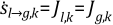 | (9–18) |
Because the phase equilibrium is always maintained at the gas-liquid interface, the liquid and the gas concentrations at the interface are correlated depending on the type of the liquid-bulk mixture.
Regular Liquid Mixture
When liquid-vapor equilibrium is established for a regular liquid species, its distribution in liquid and vapor phases is determined by Raoult's law, that is,
 | (9–19) |
 is the vapor pressure of a gaseous tar species at a given temperature.
  is the gas-phase mole fraction of species , and
  is the mole fraction (or bulk activity) of the corresponding bulk species in
the liquid-bulk phase on which it resides:
is the mole fraction (or bulk activity) of the corresponding bulk species in
the liquid-bulk phase on which it resides:
 | (9–20) |
where  is the total number of liquid species in the same liquid mixture as the
vaporizing species and
is the total number of liquid species in the same liquid mixture as the
vaporizing species and  is the molar concentration of liquid species
  in the liquid mixture. At the gas-liquid interface, Equation 9–19 can be rewritten as
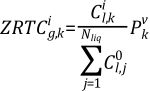 | (9–21) |
Or
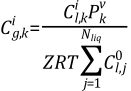 | (9–22) |
Z is the compressibility of the gas-phase mixture (for an
ideal gas, Z=1), R the
universal gas constant, and T the gas temperature next to the
interface. The vapor pressure of a liquid species is computed from the empirical correlations.
For example, measured vapor pressure of a condensable gas species is fitted to a function of temperature as
 | (9–23) |
The fitting parameters for the liquid species are given as part of the thermodynamic data.
Combining Equation 9–16 - Equation 9–18 and Equation 9–22
the (mass transport controlled) vaporization rate of species
can be found as
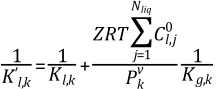
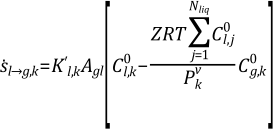 | (9–24) |
Where
 | (9–25) |
Diluted Solution
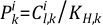
For a diluted solution, the vapor-liquid relationship at the interface is described by Henry's law
 | (9–26) |
 is the vapor/partial pressure of species at the interface and
  is the Henry's law constant of species .
According to the gas law, the partial pressure of a vapor species at the interface is related to its concentration as
 | (9–27) |
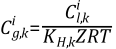
Therefore, the vapor concentration of species at the interface can be written as a function of its concentration in the
liquid phase as
 | (9–28) |
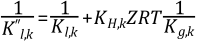
Accordingly, the transport-limited vaporization rate of species in a diluted solution becomes
 | (9–29) |
where
 | (9–30) |
The transformation between a liquid species and its vapor is specified by the Vapor-Liquid Equilibrium (VLE) reaction in the surface mechanism. Details of the VLE reaction format and rate parameters are given in Vapor-Liquid Phase Transfer in the Chemkin Input Manual .