


The following sections describe the different failure criteria for sandwich failure.
The Core Failure criterion predicts failure of core materials in sandwich structures due to
interlaminar shear ( ,
,  ) and normal stresses
  . It is assumed that core failure is highly dominated by the out-of-plane
stresses and therefore the in-plane terms are neglected. The normal stress
. It is assumed that core failure is highly dominated by the out-of-plane
stresses and therefore the in-plane terms are neglected. The normal stress  is only considered in the 3D formulation of the criterion. By default, the 2D
formulation is active.
is only considered in the 3D formulation of the criterion. By default, the 2D
formulation is active.
The failure criterion distinguishes between isotropic (isotropic-homogeneous) and orthotropic (orthotropic homogeneous and honeycomb) core materials. For isotropic cores, a simplified formulation of the Tsai-Wu is used [6]. For orthotropic materials, the maximum stress approach is implemented [18]. An isotropic-homogeneous core has othotropic stress limits in order to support the core failure criterion as described below. R, Q, and Zt / Zc are the strength limits with respect to the corresponding stress component.
Isotropic Core
 | (2–81) |
Orthotropic Core
 | (2–82) |
In previous releases of ACP, the core failure criterion was implemented differently. The previous implementation can still be evaulated using custom failure criteria.
Wrinkling of sandwich face sheets is a local instability phenomenon, in which the face sheets can be modeled as plates on an elastic foundation formed by the core. Simple formulas for estimating wrinkling stresses of sandwich face sheets under uniaxial load have been presented in the literature ([8] and [34]). Linear elastic material behavior is assumed. Possible interaction of the top and bottom face sheets is not considered.
In the following,  ,
,  , and
, and  refer to a coordinate system in which the
  -axis is in the direction of compression and the
  -axis is perpendicular to the face sheets. The subscripts F and C indicate the
face sheet and the core, respectively.
-axis is perpendicular to the face sheets. The subscripts F and C indicate the
face sheet and the core, respectively.
For sandwich laminates with homogeneous cores, the wrinkling stress of a face sheet is:
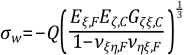 | (2–83) |
where the theoretical value of the wrinkling coefficient  is 0.825. The effects of initial waviness and imperfections of the face sheet
are normally accounted for by replacing the theoretical value of the wrinkling coefficient with
a lower value. it is recommended that you use the value
is 0.825. The effects of initial waviness and imperfections of the face sheet
are normally accounted for by replacing the theoretical value of the wrinkling coefficient with
a lower value. it is recommended that you use the value  as a safe design value for homogeneous cores ([8] and [34]).
The wrinkling stresses for sandwich laminates with honeycomb cores are estimated with the expression:
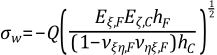 | (2–84) |
The theoretical value of  is 0.816, whereas a safe design value is
  ([
8
] and [
34
]).
([
8
] and [
34
]).
The prediction of wrinkling under multiaxial stress state is discussed in [ 34 ]. When in-plane shear stresses exist, it is recommended that the principal stresses are determined first. If the other of the two principal stresses is tensile, it is ignored and the analysis is based on the equations given above. When biaxial compression is applied, wrinkling can be predicted with an interaction formula. The condition for wrinkling is:
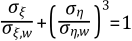 | (2–85) |
where  is the direction of maximum compression [
34
]. For orthotropic sandwich face sheets,
is the direction of maximum compression [
34
]. For orthotropic sandwich face sheets,  is more logically interpreted as the most critical of the two directions. The
wrinkling stresses
is more logically interpreted as the most critical of the two directions. The
wrinkling stresses  and
and  are computed from the formulas for uniaxial compression by considering the
compressive stresses in the
are computed from the formulas for uniaxial compression by considering the
compressive stresses in the  - and
- and  -direction independently.
The average face sheet stresses  ,
,  ,
, are obtained from the layer stresses of the face sheets. The following
procedure for the computation of reserve factors is then used independently for the top and
bottom face sheets.
are obtained from the layer stresses of the face sheets. The following
procedure for the computation of reserve factors is then used independently for the top and
bottom face sheets.
If the shear stress  of the face sheet is zero, the normal stresses
  and
and  are used directly in the prediction of wrinkling. Otherwise, the principal
stresses are determined first:
are used directly in the prediction of wrinkling. Otherwise, the principal
stresses are determined first:
 | (2–86) |
The orientation of the normalized principal stresses with respect to the xy-coordinate system is
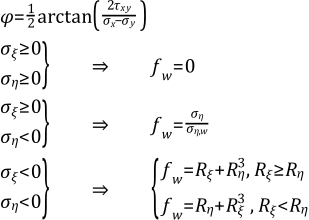 | (2–87) |
where:

|

|

|
Although formulated as a local failure criterion, shear crimping describes a form of general overall buckling failure. It applies to cases where the wavelength of the buckles is very small if compared with global buckling because of low core shear modulus. The crimping of the sandwich occurs suddenly and usually causes the core to fail in shear at the crimp. It may also cause shear failure in the bond between the facing and core. This kind of failure often appears because of a post-buckled state (out-of-plane deformations) when out-of-plane forces appear due to the deformations.

The critical shear crimping load proposed by Vinson ([36]) is
 | (2–88) |
where
 = allowable compressive force [force/length] = allowable compressive force [force/length] |
 = core thickness = core thickness |
 = shear modulus of the core in the loading direction = shear modulus of the core in the loading direction |
Vinson ([36]) assumed very thin face sheets so that their contribution to the critical shear crimping load can be disregarded. Experience shows that shear crimping can also occur in sandwich panels with relatively thick face sheets, especially in regions where the laminate stiffness changes abruptly or close to loadings. Therefore, other theories take the stiffness of the face sheets into account ([36]):
 | (2–89) |
where
 = distance between middle surfaces of face sheets [length]. = distance between middle surfaces of face sheets [length]. 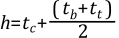 |
 = thickness of the bottom face sheet = thickness of the bottom face sheet |
 = thickness of the top face sheet = thickness of the top face sheet |
The critical shear crimping load is sensitive towards imperfections as shown by Léotoing ([15]). So a slightly adjusted formulation is implemented in ACP which provides maximum flexibility to configure the criterion to take application and material specific characteristics into account.
 | (2–90) |
 = weighting factor of the core term = weighting factor of the core term |
 = weighting factor of the face sheet term = weighting factor of the face sheet term |
The shear crimping factors and are derived from test data. The defaults for and are 1 and 0, respectively. So, by default, the critical shear crimping load in
ACP is equal to Equation 2–88 (Vinson) (for laminates where the face sheets
are much thinner than the core material). In case of = = 1, the predicted critical load is slightly different if compared with Equation 2–89 (Sullins), depending on the thickness ratio
between the face sheet and core.
For uniaxial compression the effort is:
 | (2–91) |
where  [force/length] is the in-plane laminate load. [force/length] is the in-plane laminate load. |
In the case of shear loading, the effort in Equation 2–91 is evaluated with respect to the principal
direction of loading. The material parameters of Equation 2–90 are rotated into the principal direction of
loading to get the allowable forces  and
and  with respect to the first and second principal directions of loading.
In the case of biaxial compression, the failure condition of shear crimping is the sum of the efforts in the first and second loading direction:
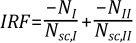 | (2–92) |
where  and and  are the first and second principal laminate loads, respectively. are the first and second principal laminate loads, respectively. |
In general, it is recommended you validate the numerical results with experimental measurements because the shear crimping failure mode is sensitive to imperfections and local effects (stiffness changes, for example).