


You can use the UDF Library Manager dialog box to load and unload multiple shared libraries in Ansys Fluent.
For more information, see the following sections:
To load a UDF library in Ansys Fluent, open the UDF Library Manager dialog box (Figure 5.6: The UDF Library Manager Dialog Box).
 Parameters & Customization → User
Defined Functions
Parameters & Customization → User
Defined Functions  Manage...
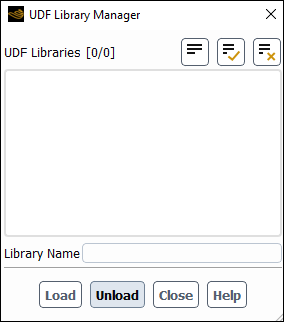
In the UDF Library Manager dialog box, type the name of the shared library in the Library Name field and click (Figure 5.6: The UDF Library Manager Dialog Box).
A message will be displayed in the console providing the status of the load process. For example:
 Opening library "libudf"...
  Library "libudf\win64\3d_node\libudf.dll" opened
    inlet_x_velocity
  Done.
indicates that the shared library named libudf was successfully
loaded and contains one UDF named inlet_x_velocity. In the
UDF Library Manager dialog box, the library name (for example,
libudf) will be added under UDF Libraries.
Repeat this step to load additional libraries.
Note: After you have loaded the UDF, if you click the button again, the UDF will be unloaded, compiled again, and then reloaded. This is useful if you decide to revise a UDF after it is loaded and want to use the revised version.
To unload a UDF library in Ansys Fluent, open the UDF Library Manager dialog box (Figure 5.7: The UDF Library Manager Dialog Box).
Parameters & Customization → User
Defined Functions Manage...
In the UDF Library Manager dialog box, highlight the shared library
name (for example, libudf) that is listed under UDF
Libraries (or type the Library Name) and click
(Figure 5.7: The UDF Library Manager Dialog Box).
After it is unloaded, the library (for example, libudf) will be
removed from the UDF Libraries list in the dialog box. Repeat this step
to unload additional libraries.