


For turbulence modeling, two options are available through Turbulence Type : Laminar (no turbulence) and LES (Large Eddy Simulation).
With this option no turbulence model is applied, therefore, it will be appropriate only for low Reynolds number flows. In this case, the Morris viscosity approximation [3] is more suitable.
While the laminar option is suitable for low Reynolds number flows, it does not capture the main features of the flow when turbulence is predominant. Using the concepts of Large Eddy Simulation (LES), the model proposed by Violeau and Issa (2007) [5] computes the effective viscosity, which replaces the constant value of molecular viscosity in the viscous acceleration term, as the sum of that viscosity and the turbulent viscosity:
 | (2–22) |
where  and
and  are the molecular and turbulent dynamic viscosities for element
a.
are the molecular and turbulent dynamic viscosities for element
a.
The turbulent viscosity  , is computed as:
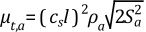 | (2–23) |
where  is the Smagorinsky constant, given by LES Smag.
Const., which is a method parameter with a default value of 0.2; and
is the Smagorinsky constant, given by LES Smag.
Const., which is a method parameter with a default value of 0.2; and
 is the characteristic length equivalent to the grid size, computed as:
 | (2–24) |
where  is given by LES Dist. Fact., which is a
method parameter with a default value of 2, and
is given by LES Dist. Fact., which is a
method parameter with a default value of 2, and  is the initial SPH elements spacing.
In Eq. Equation 2–23,  is the scalar mean rate-of-strain for element a, and
is calculated as:
is the scalar mean rate-of-strain for element a, and
is calculated as:
 | (2–25) |