


Material Solves
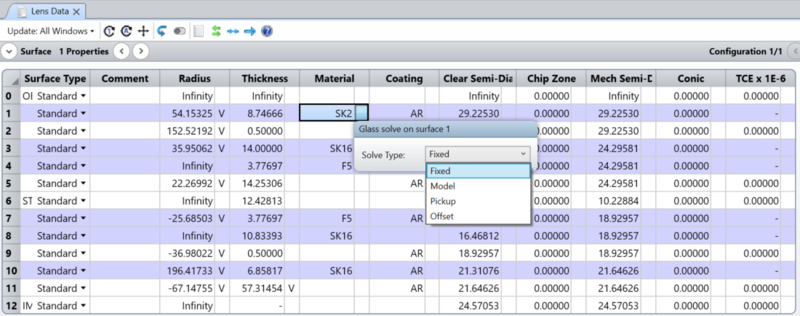
Model
The "Model" Material Solve is more like the "Variable" Radius/Thickness setting than a true solve. OpticsViewer will come up with a "model" glass by varying the index, Abbe number, and partial dispersion term at d-light to idealize dispersion of the glass. Using the Ctrl-Z shortcut on the Material column will also set the solve to "Model". The model glass data values can then be optimized using the standard optimization methods.
Unconstrained glass optimization usually will lead to very high index materials being selected. This is because surfaces with high refractivity (a large difference in index across the boundary) need less curvature than low refractivity surfaces to have the same optical power. Lower curvature surfaces introduce less aberration.
Unfortunately, high index materials are expensive, heavy, harder to fabricate, and may be brittle, delicate, or susceptible to stains and scratches. Also, very high index materials do not always exist; there are few glasses (for the visible spectrum) available with an index higher than about 1.9. The Abbe number also is limited to the range of roughly 20 to 80. Therefore, it is essential to limit the index and Abbe numbers to reasonable ranges during optimization. The partial dispersion deviation also must be limited in range.
Even with reasonable limitations, one disadvantage of the model glass method is that the optimized parameters and resulting index values may not correspond to any physically existing glass. Another disadvantage is that model glasses are only sufficiently accurate in the visible spectrum because the dispersion is idealized at d-light (.5875618 micrometers). Outside the visible wavelength range, such as in the ultraviolet or infrared, the model glass is not accurate and should not be used.
For more information on model glasses, see "Using model glasses".
Pickup
The glass pickup solve uses a value from another surface as the glass on the target surface. See also "Solve restrictions".
Offset
The offset solve allows a small change in index and/or Abbe number to be added to the index as computed by the dispersion formulas and the glass catalog dispersion data. The primary use of this solve is for tolerancing. There are two conditions for using the index and Abbe numbers in computing the change in index as a function of wavelength:
The minimum wavelength in use is greater than 0.3 micrometers and less than 2.5 micrometers
The dispersion data in the glass catalog must span the wavelength range of 0.4861327 to 0.6562725 micrometers.
If these conditions are met, then the change in index is given by the difference in the model glass index computed at the base index (Nd) and Abbe number (Vd) as compared to the offset Nd and Vd values. See the discussion of the "Model" glass for a discussion of the model glass properties. In equation form the index is:

where the function n() is the model glass function. Note this model will add a different index offset to the index at each wavelength. If the wavelength band criteria listed above is not met, then the index offset is added to all the base index values:

The Abbe offset is ignored in this case.
Next: