


AC Winding Losses
Note: Not yet available for Axial Flux Machines.
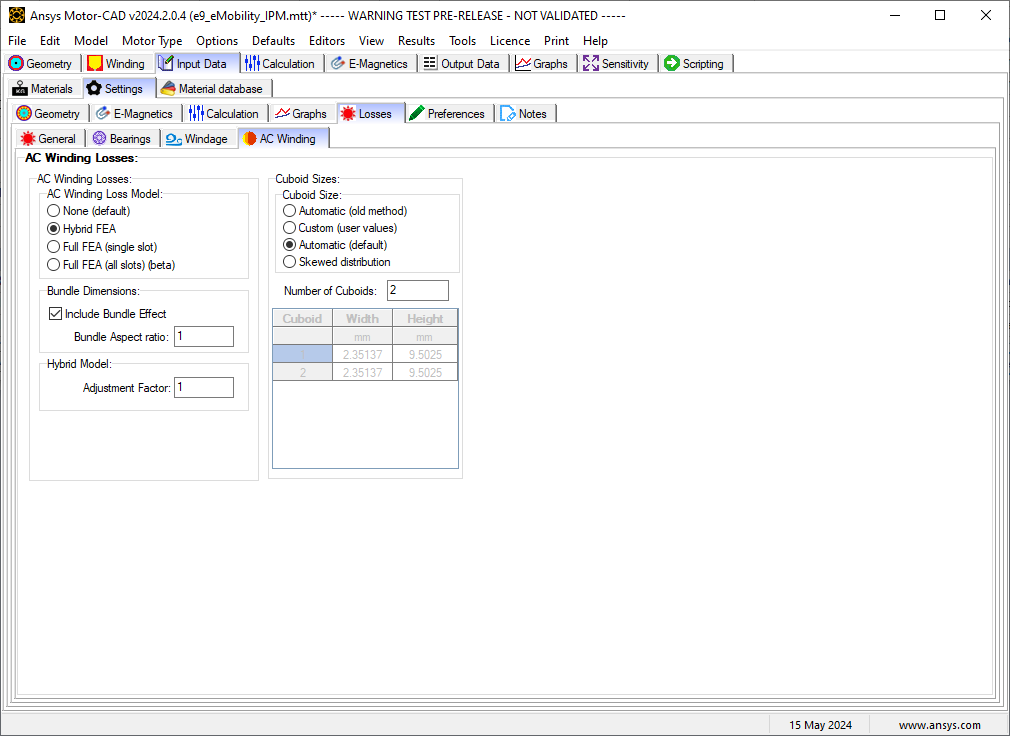
The AC Winding Loss model options in Motor-CAD are:
- None - no AC winding losses are calculated
- Hybrid FEA - AC winding losses are calculated from an equation based on the flux densities in the slot. See Hybrid FEA method method for more details.
- Full FEA (single slot) - AC winding losses are calculated from FEA solution with all conductors drawn in a single slot. Note: The calculation is done for a single slot to reduce the calculation time. The results are for the full machine. See Full FEA method (single slot) for more details.
- Full FEA (all slots) - AC winding losses are calculated from FEA solution with all conductors drawn in a single slot. This calculation will take significantly longer than the Full FEA (single slot) method, but losses are calculated with a higher accuracy than for the single slot case. The results are for the full machine. See Full FEA method (all slots) for more details.
See AC Winding Loss Settings for more information on the options available.
There is a comprehensive Tutorial titled: 'AC_Winding_Loss.pdf' which details the calculation of AC winding losses in Motor-CAD. The tutorial is installed with Motor-CAD and can be accessed from the main drop down menu under Help -> Tutorials.
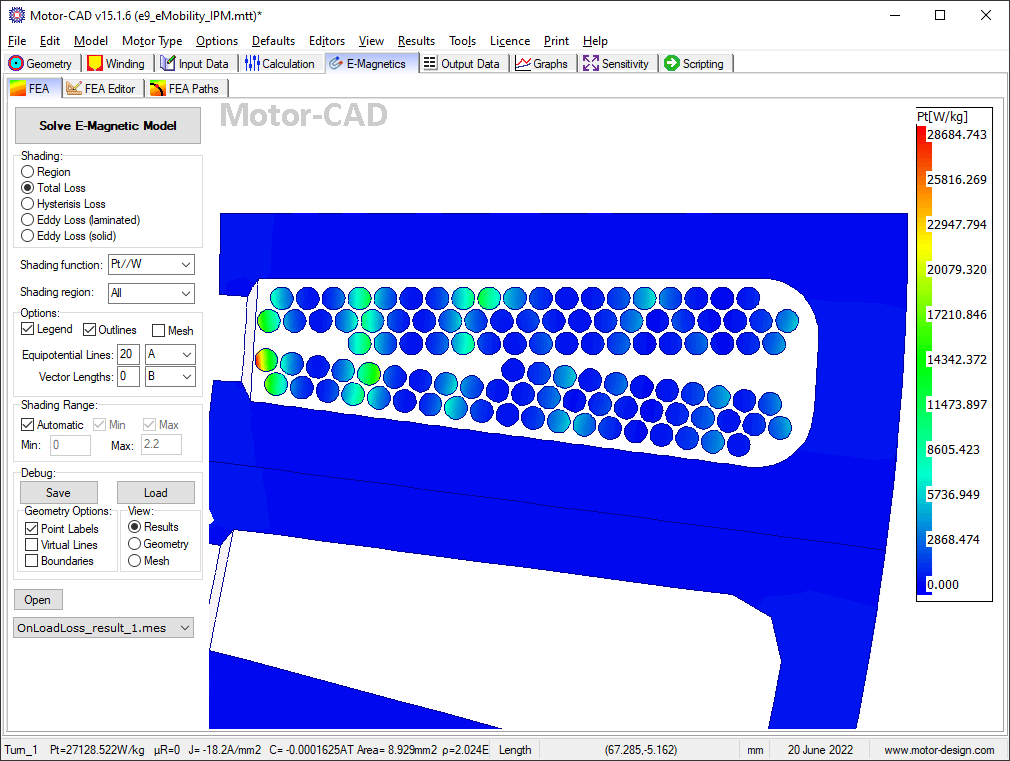
AC Winding losses are commonly taken account of in transformer design but are often neglected in electric machines. The proximity effect is the increase in ohmic loss due to high frequency currents in adjacent conductors. These give rise to eddy currents which cause a non-uniform current distribution over the conductors' cross section. The skin effect leads to a increase in the AC resistance and so an increase in the copper loss. The increase can be surprisingly large in high speed machines, with values of Rac/Rdc of up to 17 being reported in machines with rating of around 12000rpm [1], [2].
FEA analysis can be used to calculate the proximity effects:
[1] Rafal Wrobel, Phil Mellor, Neville McNeil, 'Analysis of Proximity Losses in a Brushless Permanent Magnet Motor, ISEF 2005, Baiona, Spain, 15-17 September, 2005
[2] Jack McCabe, Beating the Heat: Temperature Control of a High-Performance Spindle, MMS Online, www.mmsonline.com/articles/120104.html
See Hybrid FEA method and Full FEA method
See also Electromagnetics, General Losses, Bearing Losses,
For other model settings see Settings[Input Data Editor].