


Introduction to the main tools in Granta Selector
There are three main tools in Granta Selector: Browse, Search, and Chart/Select.
Browse
|
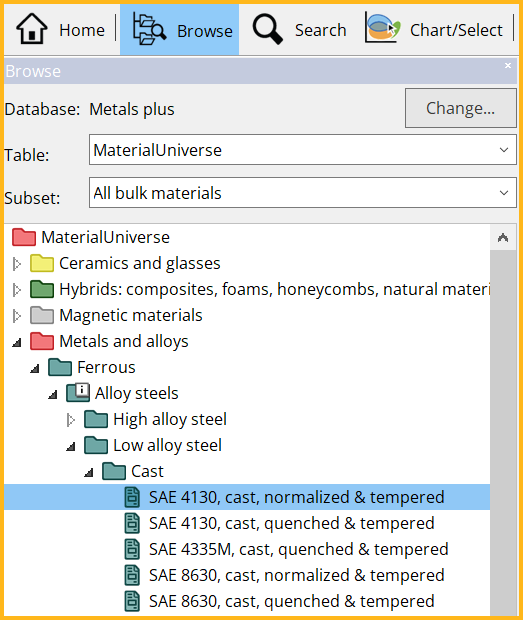
The Browse tree allows you to explore the database, drilling down into the database record hierarchy. Records in the database are presented in a hierarchical tree structure, table by table. At the top level of the tree are the main ‘families’ of materials. At the lowest level are specific materials. In the MaterialUniverse table (shown left), material records are organized into four broad ‘families’: ceramics and glasses, hybrid materials, metals and alloys, and polymers. Each family is made up of ‘classes’ (Ferrous, Precious metal alloys, for example) which may contain ‘sub-classes’ (Alloy steels, Low alloy steel, Cast) consisting of many ‘members’ (SAE 4130, for example). The categories and hierarchy presented in the Browse tree are specific to each data table: for example, in ProcessUniverse, the records contain process data rather than material data, and are organized by process type: Joining, Shaping, or Surface treatment. |
 |
Search
|
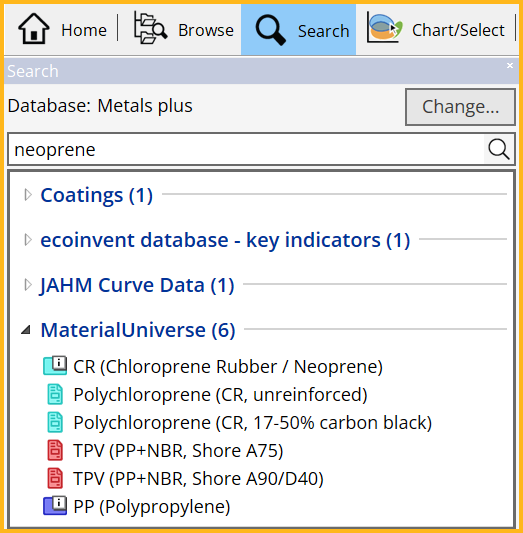
You can find materials or processing methods using a simple keyword search. Double-click a record in the Search results list to open its datasheet. The search term will be highlighted wherever it appears. You can also perform more advanced queries here, for example, using AND, OR and NOT, or searching for phrases ("steel alloy"). |
 |
Chart/Select
|
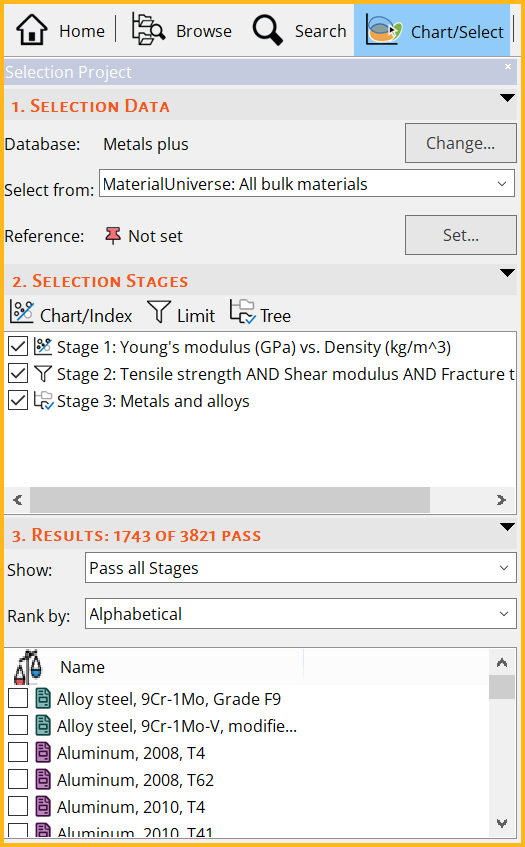
The central hub of Granta Selector is a powerful selection engine that identifies records that meet an array of design criteria and enables trade-offs between competing objectives. A simple, dialog-based user interface guides you through a systematic rational selection process, making it quick to apply the methods pioneered by Granta founder Professor Mike Ashby. Graphical tools enable you to make and present decisions. Explore materials space, focus on likely candidates, study trade-offs between cost, engineering performance, and eco behavior. Structured, repeatable methods ensure you make the right materials choice for your application, for example to optimize performance per unit of function, and to minimize cost. |
 |