
Exporting a Layout Component
Follow these steps to export a layout component from the Layout Editor.
- From the Layout Editor, select a layout component.
- Depending on whether the Ansys Electronics Desktop (AEDT)TM electronics systems design platform is running in General mode or IC mode, navigate to one of the following selections to open an explorer window:
- In General mode, navigate to Layout > Import > Layout Component.
- In IC mode, navigate to Layout > Export Layout Component.
-
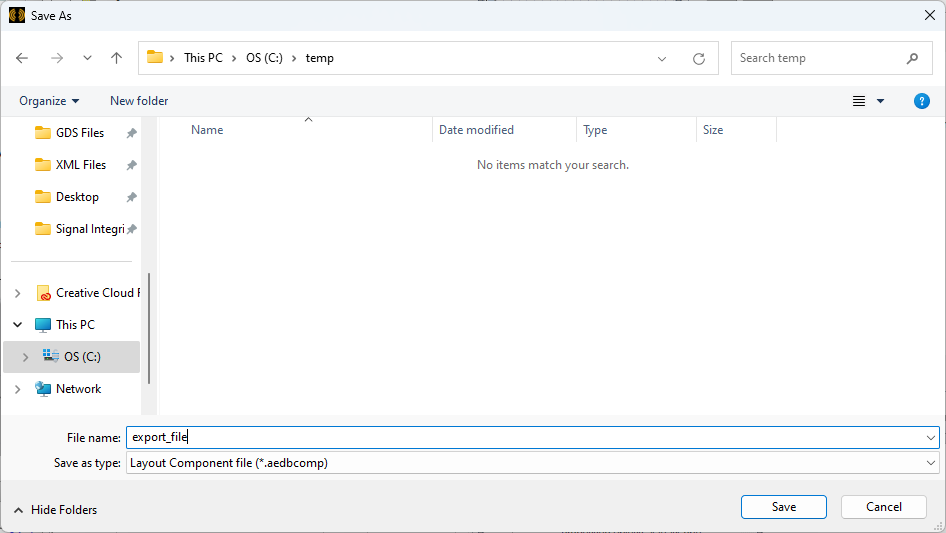
Navigate to an appropriate directory to save the exported layout component. Then enter a File name for the layout component and, if necessary, choose Layout Component file (*.aedbcomp) on the Save as type drop-down menu (selected by default).
-
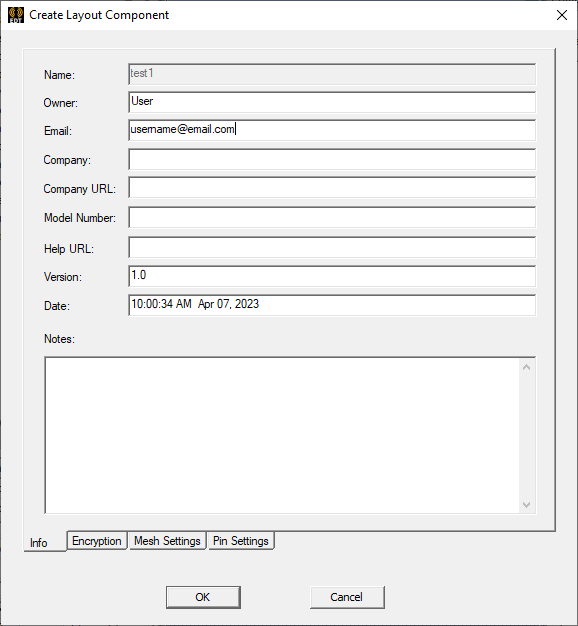
Click Save to close the explorer window and open the Create Layout Component window. The Create Layout Component window allows users to add meta data, encryption, and mesh settings to an HFSS 3D Layout design layout component before exporting it.
-
From the Info tab, enter metadata into the appropriate fields. The layout component's file name is shown in the Name field.
-
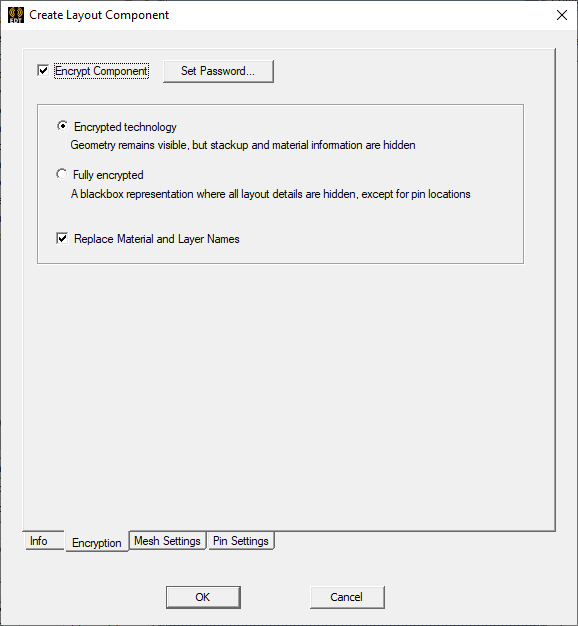
Click the Encryption tab. Use the Encryption tab to protect the layout component with two levels of security. Encryption is a common technique for encoding information in a manner that is very difficult for unauthorized users to decode. When these options are enabled for layout components, the contents of the layout component file are encrypted to protect them from external viewing or editing. Layout Components use the Advanced Encryption Standard (AES) with a 256-bit key and password-based key derivation.
Note:Once a layout component is encrypted and users click OK, encryption cannot be removed on the layout component. However, encryption strength can be increased (i.e., if the user chooses not to encrypt the layout component, the exported layout component can be re-imported and exported again as an Encrypted technology layout component. If the user exports the Encrypted technology layout component, the exported layout component can be re-imported and exported again as a Fully encrypted layout component.
-
From the Encryption tab, choose from the following options:
-
No encryption – remove the check on the Encrypt Component box.
-
Encrypted technology – geometry will remain visible, but stackup and material information is encrypted. The layout component may be editable. Click Set Password to open the Set Passwords window.
-
Fully encrypted – all data, except port locations, is hidden under a blackbox stencil. The layout component will remain uneditable. Click Set Password to open the Set Passwords window.
-
Replace Material and Layer Names – check the box to obfuscate all material and unique layer names (e.g., Dialetric_1 will be renamed Layer1 and the material column will be hidden from view).
It is not possible to edit a Fully encrypted layout component unless you choose Always or With User Password in the Allow Component Edit area, when you define the layout component.
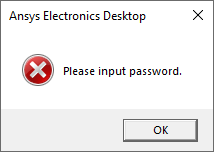
Note:If there is a check in the Encrypt Component box, the Set Passwords window will open if users attempt to leave the Encryption tab. Attempting to bypass the window will produce a Warning: Please input password. dialog box. This is true even if no encryption is selected. To leave the Encryption tab, uncheck the Encrypt Component box.
-
-
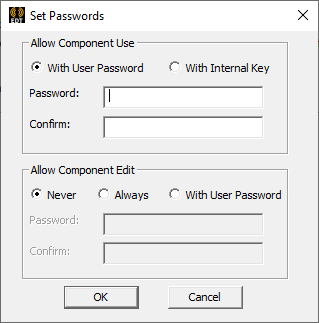
Click OK to open the Set Password window, enter and re-enter a password in the selected fields in the Allow Component Use area and decide whether future layout component editing is selected.
-
From the Allow Component Use area, choose from the following:
-
With User Password – the layout component can be exported as an .aedbcomp file and reopened in AEDT or other compatible software with the correct password.
-
With Internal Key – the layout component can be exported as an .aedbcomp file and reopened in (and only in) AEDT without a password.
-
-
If future layout component editing is required, from the Allow Component Edit area, choose from the following:
-
Never – once the Set Passwords window is closed, the layout component will no longer be editable.
-
Always – if future layout component editing is selected, and no further security is appropriate.
-
With User Password – if future layout component editing is selected, but some further security is appropriate. Enter and re-enter a password in the selected fields.
Note:Choosing Fully encrypteddeactivates the Allow Component Edit area. This level of encryption is a permanent state and the layout component will not be editable after the Create Layout Component window is finally closed.
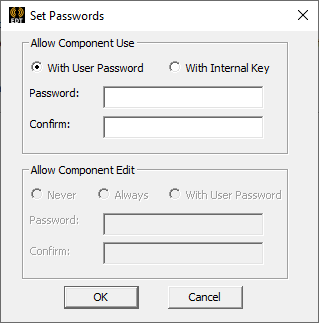
-
-
Click OK to save, close the Set Passwords window, and return to the Create Component window.
-
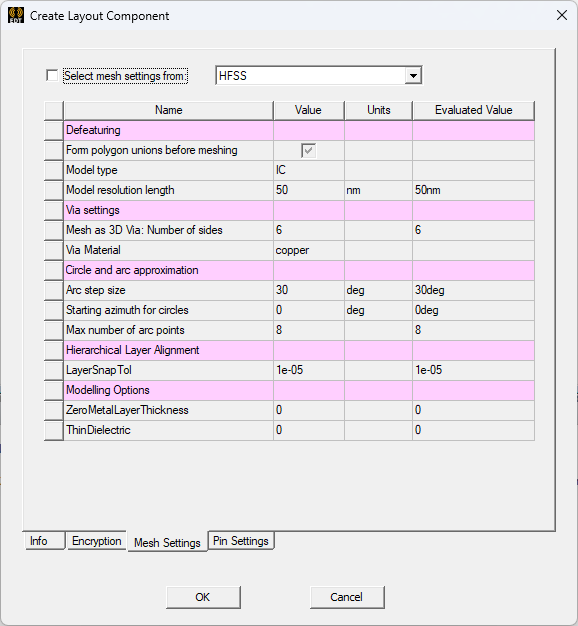
Click the Mesh Settings tab.
-
To save existing mesh settings with the exported layout component, check the Select mesh settings from box and make a selection from the drop-down menu.
-
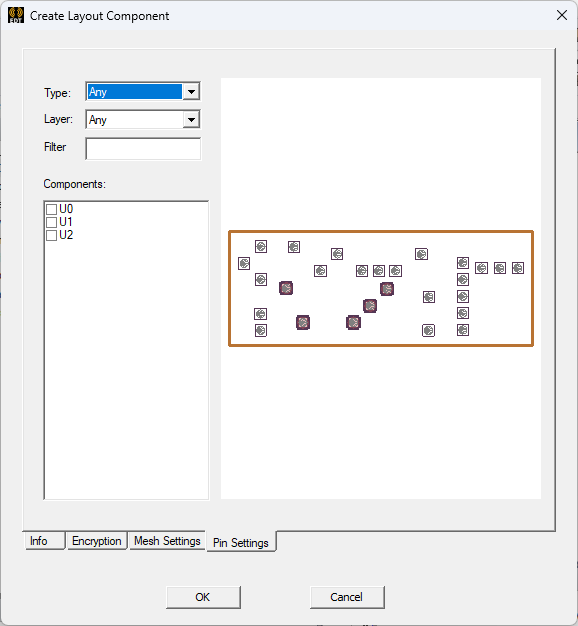
If Fully encrypted is selected on the Encryption tab, click the Pin Settings tab.
-
From the Pin Settings tab, choose from the following:
-
Use the Type and Layer drop-down menus, as well as manually entering Filter variables to filter the Layout Component list of available parts selected on the Layout Editor.
-
Components — check boxes adjacent to each layout component part to leave the layout component(s) exposed, despite full encryption. The exposed layout components are shown in preview window.
-
-
Click OK to export the layout component.
-
After the layout component is configured, click OK to add it to the active design.