
Voltage Controlled Switch (SW_V)
The voltage controlled switch comes in two flavors: with controlling port and without a controlling port. In either case a model data for the voltage controlled switch needs to be specified, similarly to the case of the diode and current controlled switches.
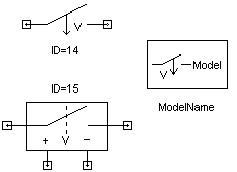
Right-click the voltage controlled switch model and select Properties. With the Parameter Values tab selected, specify the switch model name (in the MOD line) as well as the ID of the controlling element: either a voltmeter or a current source. In the later case the controlling quantity is the voltage across the current source. (Note that a voltmeter is a current source with zero current, i.e. an open circuit).
The voltage controlled switch with controlling port allows for the controlling quantity to be wired directly using connections with wires. In this case the reference for the voltage across the controlling port is displayed by "+" and "-" symbols and the two symbols are internally used as voltage reference.
In the model for the voltage controlled switch the following parameters are used:
- Ron is the resistance of the switch in the on state (0.001 ohms default value).
-
Roff is the resistance of the switch in the off state (1,000,000 ohms default value).
Note: Refer to Additional Considerations in the Sinusoidal Current Source topic for information on the effects of load resistance values in current calculations. - Von is the "on" value of the controlling voltage in volts. If V > Von, then R = Ron.
- Voff is the "off" value of the controlling voltage in volts. If V < Voff, then R = Roff.

where fcontrol(P) is a function describing the controlling signal, which is a time, position, or speed dependent current source or voltage source. Function G(P) clearly shows that the magnitude of the conductance is dictated by both the value of Ron and the magnitude of the control signal, while the time / position / speed dependency is dictated by the control signal itself.

where fcontrol(P) is a function describing the controlling signal, which is a time, position, or speed-dependent current source or voltage source. Function R(P) clearly shows that the magnitude of the conductance is dictated by both the value of Roff and the magnitude of the control signal, while the time / position / speed dependency is dictated by the control signal itself.