
Flux Linkage in Maxwell 3D (Transient)
The 3D transient solver using the T-W formulation, the turn density vector is defined as

where
Nk is the number of turns;
Sk is the cross-sectional area of winding k; and
t is a unit vector tangent to the direction of winding wires.
In practice, this turn density vector is derived from the introduced basis function of the source field, Hk, as

where Hk is the field corresponding to a 1 ampere current in winding k and is obtained by solving a conduction problem:

|

|

|
The turn density vector Jk corresponds to 1 ampere of net current in the winding k, and vanishes outside winding k. Thus, the induced voltage due to the total time derivative of flux linkage in winding k can be obtained by projecting the induced electric field -dA/dt onto the turn density vector Jk and integrating over the region of winding k:
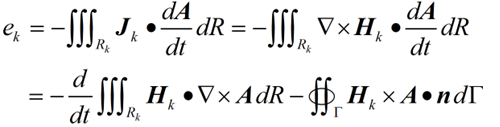
where Gis the boundary of a simply connected region, which is composed of the winding region Rk and the cutting region RS that is introduced to fill the holes of the winding to avoid multi-valued problem of scalar potential. In such a case, because Hk has zero tangential component on boundary G, the equation is

Then the induced voltage in winding k can be derived in terms of the H field as

and therefore, the flux linkage in winding k be derived by
