


For the first motion stage (free fall), the following equations govern the motion of the particle:
 | (2–6) |
 | (2–7) |
 | (2–8) |
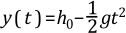
where y is the center of the particle with respect to the wall and g is the gravitational acceleration. The particle velocity v and position y are given by
 | (2–9) |
 | (2–10) |
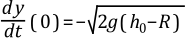
When the sphere's center position is equal to its radius, the free fall stage ends and the second motion stage begins. The particle-wall collision is treated using the linear spring-dashpot model such that force balance on the particle during contact is given by
 | (2–11) |
 | (2–12) |
 | (2–13) |
where  and
and  are the system natural frequency and the damping ratio, respectively. The
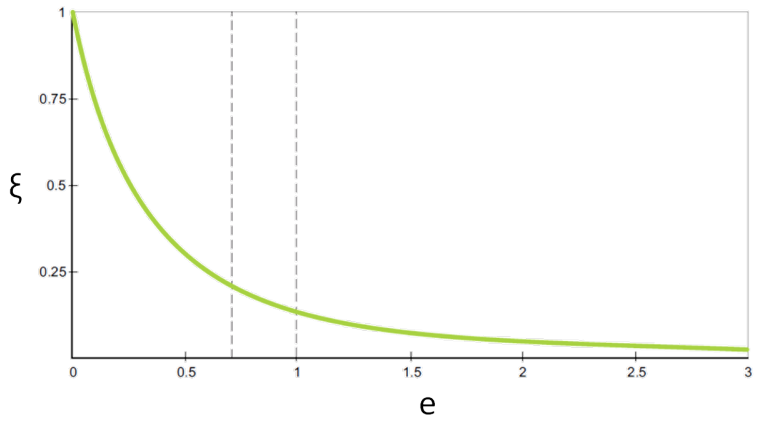
damping ratio is determined directly by the relation shown in the figure below. Refer to Rocky
DEM Technical Manual to see this relation formulation.
are the system natural frequency and the damping ratio, respectively. The
damping ratio is determined directly by the relation shown in the figure below. Refer to Rocky
DEM Technical Manual to see this relation formulation.
The normal spring coefficient is  and
and  is the particle mass. The initial particle velocity is obtained when the
particle center position is equal to its radius. The velocity and position of the particle
center during contact, regarding an underdamped system with
is the particle mass. The initial particle velocity is obtained when the
particle center position is equal to its radius. The velocity and position of the particle
center during contact, regarding an underdamped system with  , are given by
 | (2–14) |
 | (2–15) |
where  is the damped natural frequency.
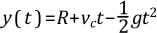
The third and last motion stage correspond to the ball rebound, which begins when the particle center position is equal to its radius. The force balance on the particle results in the following
 | (2–16) |
 | (2–17) |
 | (2–18) |
Therefore, the sphere's velocity v and center position y are given by
 | (2–19) |
 | (2–20) |