
Rx Spectral Profile
A Rx Spectral Profile completely defines the broadband susceptibility spectrum for each channel within the band. Each channel in a band shares the same operating parameters. However, different bands for a single radio may have different operating parameters. The spectra that EMIT computes are based on the parameters supplied for the bands and are referred to as parametric channels.
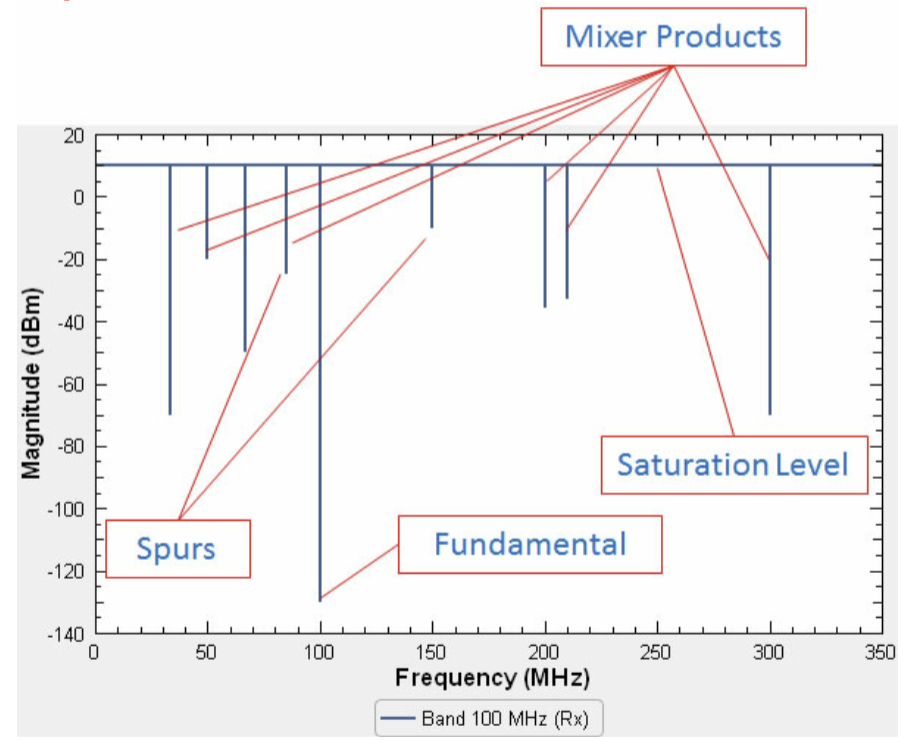
An example Rx channel spectrum is shown below. The spectrum consists of the fundamental (tuned channel), mixer products and other spurious responses (spurs). The shape of the spurs is taken to be rectangular and the shape of the fundamental is defined by the selectivity (defined below). The specifics on how to specify all of the Rx Band parameters is covered in the sections below.
Sensitivity Units: Power units used for specifying the radio's sensitivity.
Min. Receive Signal Pwr: The amplitude of the desired signal that this Band is attempting to receive. This value is often determined by performing a link budget analysis for a desired communication link. The units are those specified by the Sensitivity Units. It is important to note that this is the power at the Rx antenna port. This Min. Receive Signal Pwr does not get affected by any attenuation present in the Rx signal path between the Rx antenna and Rx input.
Noise Figure (DD-1494 Mode Only): The noise figure of the receiver.
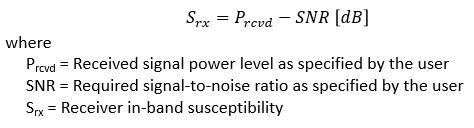
SNR at Rx Signal Pwr (dB): The SNR required for the receiver to decode the desired signal for a given bit error rate (BER). The basic susceptibility model of the Rx Band to in-channel interference is calculated by:
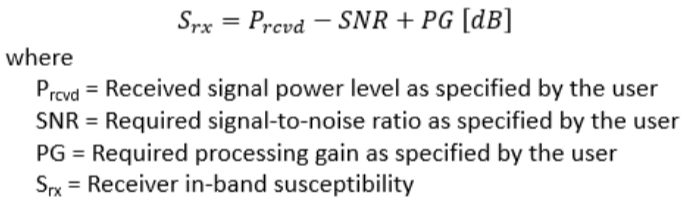
Processing Gain: The processing gain of a system, often defined as the ratio of the spread bandwidth to the despread (or baseband) bandwidth. The in-channel susceptibility model for an Rx Band with processing gain specified is calculated by:
Apply PG to Narrowband Only: By default, EMIT applies the Processing Gain to both the narrowband and broadband noise EMI Margins. If the Apply Processing Gain to Narrowband Only parameter is toggled to true though, then the processing gain will only apply to the narrowband EMI Margins.
SNR/SINAD at Sensitivity: This is equivalent to the SNR at Rx Signal Pwr specified above, with the terminology set to match that found on common DD-1494 forms.
Saturation Level: The maximum value of the Rx susceptibility envelope (see plot above where the saturation level is at 10 dBm).
Perform Rx Intermod Analysis: When enabled (True) this feature includes a nonlinear model internal to the radio to enable Rx generated intermodulation products to be computed. This analysis is included only for the current Band and different nonlinearities can be specified for different Bands of a single Radio. This feature permits a radio's nonlinear characteristics to be included in the radio model instead of requiring it to be modeled as external component as in previous versions of EMIT.
The Rx Internal Amplifier is designed so the nonlinear nature of the receiver's front end can be modeled in a manner similar to EMIT's general amplifiers. However, there are some key restrictions with the Rx Internal Amplifier. The Rx Internal Amplifier will not provide any gain to the signals nor will it add any noise to the spectra incident at the receiver's port. Additionally, the internal amplifiers are assumed to have infinite bandwidth and thus there is no shape factor and no "filtering" of any of the input spectra. Finally, all power incident on the receiver port is assumed to be transmitted through the port resulting in no reflected power, that is, infinite reverse isolation.
Amplifier Saturation Level: Specifies an input power level for which EMIT will consider the amplifier saturated. When an amplifier is saturated, EMIT flags it as such in the results and does not trace the input signal any further. The saturation level cannot be set lower than the 1-dB Point.
1-dB Point Ref. Input: The amplifier's 1-dB compression point referred to the input of the amplifier.
IP3, Ref. Input:The amplifier's third order intercept point referred to the input of the amplifier.
Max Intermod Order: Specifies the highest order of intermodulation product that EMIT will calculate for the amplifier.