
Gaussian Beam
Gaussian Beam is an analytical excitation wave and is represented by the fundamental transverse Gaussian mode (or  ). It is defined in the global coordinate system (
 origin point) in the following properties:
- Excitation Location that also doubles as the phase reference point (
 point).
- Propagation vector
 where
 is a unit vector defining the propagation direction
 is the propagation constant for a free-space wavelength (
 ), and
 is the refraction index of the surrounding medium. In the case of Spherical Vector Input Format, the unit vector can be defined as a range of incident (
 ) and (
 ) angles.
- Incident
 Vector components: Theta and Phi for Spherical Vector Input Format (X, Y, and Z) for Cartesian Vector Input Format. Values (only the real parts of entered values are considered) are further automatically normalized by the solver.
- Beam Width at the Focal Point
 (waist radius, radial distance from the axis where the field magnitude decreases to
 of the axial value) that defines the divergence of the beam.
The phasor notation of the Gaussian Beam electric field (propagation along  direction) is given by:

Where:
 and
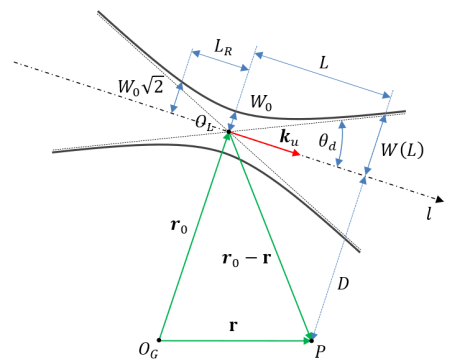
 are the Excitation Location and its radial-vector in the Global Coordinate System.
 and
 are the observation point and its radial-vector in the Global Coordinate System.
 is a unit-vector defining the propagation direction.
- The axis of the beam
 is defined by
 and
 .
 is the radius distance from the axis (at the axial distance
 ) where the field magnitude decreases to
 of the axial value.

 is the Beam Width at the Focal Point (waist radius). It is not recommended to set
 .
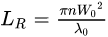
 is the Rayleigh distance where width of the beam is
 times larger than the waist radius

 .
 is the axial distance from the Excitation Location
 to the observation point (
 ).

 is the radial distance from the beam axis
 o the observation point
 (central radius).

 is the divergence angle of the beam, and it can express (approximately) in radians for relatively large
 values such as:

-
 is the unit vector of the electric field at the Excitation Location
 .

 is a complex magnitude of the electric field at the Excitation Location
 (post-processing value from the Edit Sources UI). It is treated as 1 V/m during the simulation process.
 is the wave number for a free-space wavelength
 , where
 is the refraction index of the surrounding medium.
 is the radius of the beam’s wavefronts curvature at the axial distance
 :

 is the Gouy phase at the axial distance
 :

Far-field half-power beamwidth can be estimated as:

Total Power in a cross-section of the Gaussian Beam::
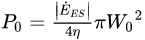
Where  is the wave impedance of the medium, it can be also noticed that 86.5% of the total power is contained in the beam up to the central radius of W, 99% – up to the central radius of 1.5W, and 99.99% – up to the central radius of 2.2W.
References
Paul F. Goldsmith, "Gaussian Beam Propagation," in Quasioptical Systems: Gaussian Beam Quasioptical Propagation and Applications, IEEE, 1998, pp.9-38, doi: 10.1109/9780470546291.ch2.