
The Phi Mesher
The Phi mesher is a layout‑based meshing technology available in the HFSS 3D Layout interface. This advanced meshing technology is capable of rapidly generating an initial mesh, ensuring faster simulations that can be further accelerated and enhanced by using high‑performance computing. While the traditional Classic mesher is suitable for HFSS 3D MCAD and for certain geometries solved in HFSS 3D Layout, the Phi mesher works on the HFSS 3D Layout interface where principally 2.5D geometry is comprised of z‑extruded layers that have no oblique facets. Therefore, package models containing bondwires cannot take advantage of this meshing technology.
The Phi mesher uses a unique method to generate the initial mesh from the a priori knowledge of the layered nature of the geometry. It generates a volume mesh directly from the layout data, saving a tremendous amount of time, requiring less user cleanup, and eliminating several situations that might cause potential kernel errors in the traditional 3D modeler flow. When Phi is selected as the initial mesher, you can also specify a Maximum delta‑Z ratio as a value or variable. This setting controls the allowable ratio between adjacent layer thicknesses in the z‑direction to prevent excessively stretched elements during the extrusion process.
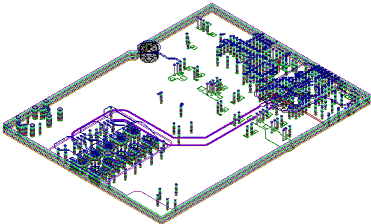
When compared to the traditional Classic mesh, the Phi mesher is several orders of magnitude faster, including from the initial meshes the adaptive meshing algorithm produces to the final convergence. Another advantage of the Phi mesher is its ability to mesh larger and more complex designs previously unmeshable from the traditional 3D interface or with the Classic mesher in the 3D Layout interface. In cases where Phi produces large meshes, you can use the HPC solver feature to leverage more cores and distributed memory to neutralize the time that would have otherwise been required for the simulation to complete.