
Visual Ray Tracing (VRT)
Visual Ray Trace (VRT) is a powerful feature available in HFSS for visualizing the ray geometry and interactions for an SBR+ simulation. Since SBR+ relies on “painting” physical optics (PO) currents on the geometry, VRT can provide valuable insight for analyzing these PO contributions from the direct illumination first-bounce rays and the multi-bounce GO rays. VRT can selectively display:
- ray hit (bounce) points on the scattering geometry,
- ray paths (lines) between each bounce, and
- triangular ray “footprints” that are used to integrate the PO currents.
The VRT feature includes a number of rendering controls and options to filter whole ray tracks or individual ray bounces, visualize ray scattering directions, and color ray point/lines/footprints according to different criteria.
When SBR rays are shot in VRT, SBR ray statistics are collated and displayed within the Statistics tab of the Properties window for the SBR Plot node of the Visual Ray Trace SBR plot folder:
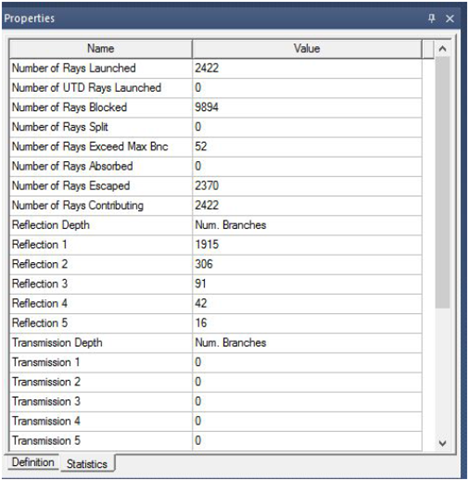
- Number of Rays Launched: Number of GO (non-UTD) rays illuminating the CAD model from the antenna or source, not including those blocked by other surfaces
- Number of UTD Rays Launched: Number of UTD rays illuminating the CAD model, not including those blocked by other surfaces
- Number of Rays Blocked: Number of potentially launched rays whose line-of-sight path was blocked by part of the CAD model
- Number of Rays Split: Number of rays that hit a penetrable surface (e.g., 2-sided Layered Impedance Boundary). These rays are split to form both a transmitted and reflected ray
- Number of Rays Exceed Max Bnc: Number of rays that would have continued propagating through the model, but were terminated because they reached the Max Number of Bounces limit set in the plot Definition
- Number of Rays Absorbed: Number of rays that hit a surface with a Perfect Absorber boundary. Ray track branches terminate on such surfaces.
- Number of Rays Escaped: Number of ray track branches whose final ray escapes the scene
- Number of Rays Contributing: Number of ray track branches that would contribute to the scattered field result in a corresponding simulation
- Reflection <N> under Reflection Depth: Number of branches that terminate/escape after <N> reflections
- Transmission <N> under Transmission Depth: Number of branches that terminate/escape after <N> transmissions
When Creeping Wave (CW) rays are shot in VRT, CW ray statistics are collated and similarly displayed:
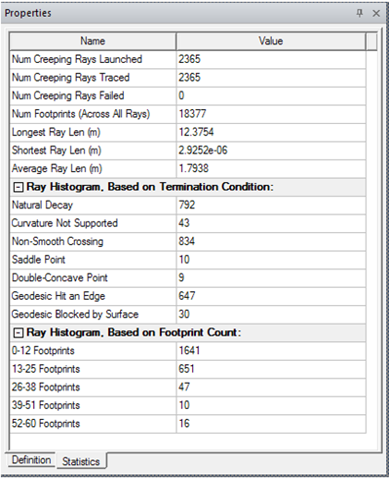
- Num Creeping Rays Launched: Total number of creeping rays launched
- Num Creeping Ray Traced: Number of launched creeping rays that were successfully traced
- Num Creeping Ray Failed: Number of launched creeping rays that failed to trace
- Num Footprints (Across All Rays): Total number of ray footprints generated across all traced creeping rays
- Longest Ray Len (m): Length of longest creeping ray (in meters)
- Shortest Ray Len (m): Length of shortest creeping ray (in meters)
- Average Ray Len (m): Average length among all creeping rays (in meters)
- Ray Histogram Based on Termination Condition: Breakout of number of rays terminated due to each termination type (e.g., Natural Decay, Non-smooth Crossing)
- Ray Histogram Based on Footprint Count: Number of creeping rays with a footprint count residing within a particular min/max range of footprint counts