
Using Causal Material Models
Using causal dielectric material models is one of the most important considerations to extract causal S parameter models. Causal material model means that the real and imaginary parts of the permittivity should satisfy the causality relationship (causal magnetic materials are not discussed here).
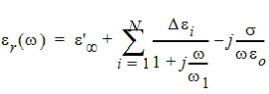
The most general material model is the multipole Debye model [3]:
|
|
|
(10) |
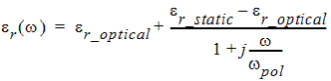
It is applicable when we have information about the permittivity and the loss tangent of the material in the frequency range, such as when measured material data are available. Single pole Debye model is also a good approximation when just polarization losses are present and the polarization frequency is known:
|
|
|
(11) |
In other cases, especially when the permittivity and loss tangent are known at only one or two frequencies, the broad band Djordjevic - Sarkar (D-S) material model can be used:

|
12 |
|
where
|
|

|
|
are the limits of the frequency range. The D-S model can also be viewed as a multipole Debye model with an infinite continuum of poles.
Using causal material models leads to frequency dependent complex materials, which is standard in most finite element codes.
Next