Further Details of the MLFMM Algorithm
Near-field interactions for a given reference box are defined to be between itself and the boxes that it touches at the same level. Far-field interactions for a given reference box are computed explicitly for all boxes it does not touch which reside in its parent's near field. The hierarchical nature of the algorithm automatically provides the near-field interactions at level n+1 when computing the various interactions at level n. This can be inferred by studying Figure 1 and 2. An outcome of this fact is that only the lowest level contains explicit near-field interactions which are done using standard MoM. Further, note that the far-field interactions between a reference box and boxes which are further away than the near-field of its parent are accounted for by the far-field interactions of its parent (and higher level parents if they exist).
Figure 1: shows a cross-section of "hierarchically nested" boxes overlaid on the mesh of an arbitrarily shaped sheet.
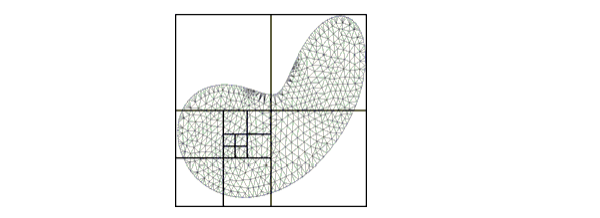
Figure 2: shows the decomposition of boxes into "near" and "far" fields at levels 1, 2, and 3. In each case, a reference box is shown in green and its immediate parent is shown with a red border. The orange color indicates boxes in the near-field of the reference box and the blue color indicate boxes in the far-field at each level. Note that the "near field" exists only at level 1.
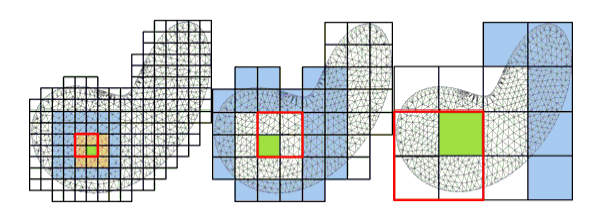
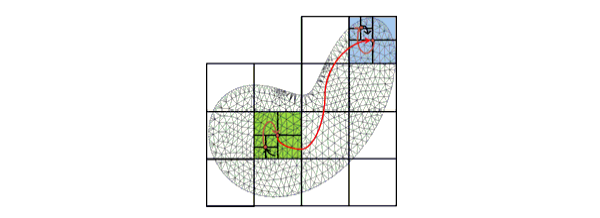
Figure 3: illustrates steps 2-6 in the MLFMM algorithm above. The black arrows indicate the multipole creation from basis functions and construction of the tested field from multipole expansions (steps 2 and 6). Orange arrows indicate the up-tree and down-tree traversals (steps 3, 5), and the red arrow indicates the translation of multipoles to its far field (step 4).