
Force per Unit Area in HFSS
This is mainly for the purpose of mapping surface force density in HFSS to Work Bench Mechanical. We will also provide it for post processing within HFSS. This feature should work regardless of HFSS solution types as long as surface forces exist. Surface forces may exist when one side is conductor but the other is not, or finite conductivity and layered impedance boundary.
The task is to calculate the force per unit area (fs) distribution on the surface or on a section of the surface of a solid body in HFSS. We presume the solution is known, so both the electric and the magnetic field is available in any point.
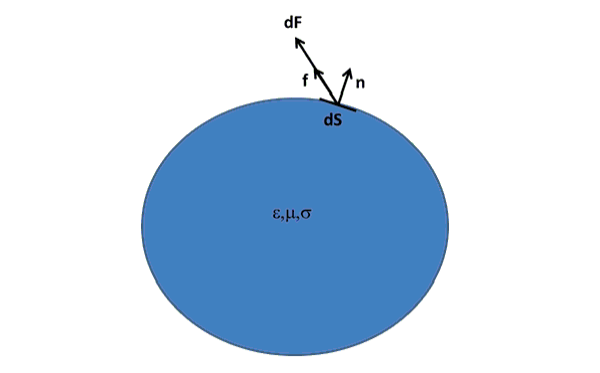
Fig. 1: Force and force per unit area on a solid body
Fig. 1 shows a solid body of homogeneous or inhomogeneous material characteristics (e,m, s). dS is an elementary section of its surface and n is the normal vector of the surface. If dF [N] is the force acting on the elementary surface dS, then:
|  | (1) |
where fs is the force per unit area. Knowing the electromagnetic field, dF can be calculated as:
| 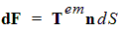 | (2) |
then
|  | (3) |
where Temis the electromagnetic Maxwell's stress tensor, which consists of the electric and the magnetic stress tensor as:
| 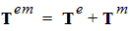 | (4) |
|
| (5) |
|
| (6) |
|  | (7) |
|  | (8) |
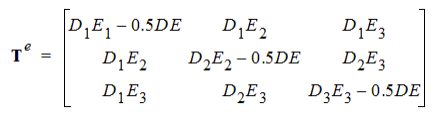
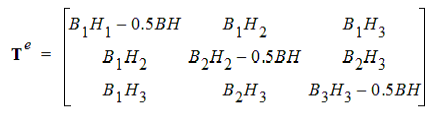
Indices 1,2 and 3 mean the first, second and third component. For example, in Cartesian coordinates, the meaning is x, y and z.
Using the notations:
|
| (9) |
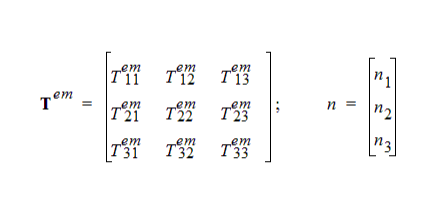
The force per unit area from Eq. (3) is:
|
| (10) |
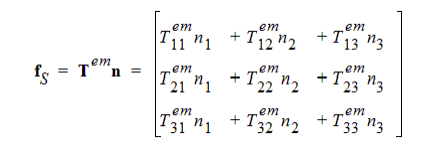
Note two things:
Stress tensor is defined on the surface of S
Force density might have both normal and tangential components on the surface
The filed quantities in formulas (1) - (10) are time dependent or static. We want to have the forces in steady state time harmonic case, too, by using the complex notations as the field quantities are defined in HFSS. It is derived for the magnetic stress tensor. The derivation for the electric stress tensor can be got by replacing Bk and Hk by Dk and Ek, respectively, where index k refers to the k-th component. The real time function of the k-th component of a complex field quantity can be written as:
|  | (11) |
where subscript c denotes complex quantity and superscript '*' means complex conjugate.
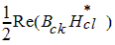
The stress tensor just contains products of BkHk where k =1,2,3 and l =1,2,3. Applying Eq. (10), we get:
| (12) | |


Eq. (12) has a constant component and a sinusoidal component of 2w. If we are interested in the time average force, Eq. (12) should be integrated for one period and divided by the period time:
| (13) | |
 |
| |

Performing the calculations for k=1,2,3 and l=1,2,3 the elements of the magnetic and electric stress tensor can be calculated as:
|  | (14) |
The time average surface force density is:
|
| (15) |
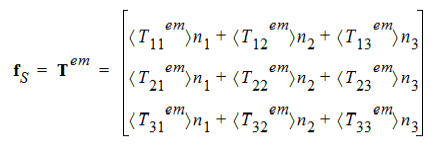
The volume force acting on a closed surface is:
| 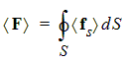 | (16) |
If a surface is selected to calculate the force, smoothing should not go through this surface.
The calculations just need post processing operations.
The relativistic electromagnetic momentum (radiation pressure), which is associated with the volume sources, has been neglected in the formulas. If it is necessary, it can be taken into account