
Computational Memory
Using domain decomposition we need to solve (factorize) A11, A22 compared to solving A using the standard method. When a direct solver is used, DDM is inherently more memory efficient since a series of smaller matrices are needed to be solved compared to a large matrix. This is evident by assuming that domains are equally partitioned so that N1 = N2 = N/2 where N1, N2, and N are numbers of unknown for the sub-domains and the original problem respectively. Memory requirement for original problem typically scales as C1Na where C1 is a constant and a > 1. For an M domain decomposition solve, the total memory requirement is
| 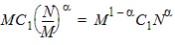 |
|
For example, if a = 1.5, using 2-domains we save about 30% of total memory. Also keep in mind that the memory can be distributed across different machines enabling a problem to be solved which is not possible on a single machine.