
Accepted Power
The accepted power is the time-averaged power (in watts) entering a radiating antenna structure through one or more ports.
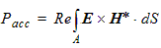
Fundamentally in HFSS, accepted power is computed as
|
|
|
(1) |
where
- Pacc is the accepted power in watts.
- Re is the real part of a complex number.
- A is the union of all port boundaries in the model, including Wave and Lumped Ports, but excluding Floquet ports.
- E is the electric field.
- H* is the conjugate of the magnetic field.
- dS is the local port-boundary unit normal directed into the 3D HFSS model.
Example: Consider the simple case of a single port antenna with zero imaginary port impedance modeled in a modal project. Then the general expression for accepted power reduces to
|
|

|
(2) |
where
- |a| is the complex modal excitation specified in the Edit Sources window.
- s11 is the single-entry generalized
scattering matrix.
Note:
Because the accepted power is calculated from the input signal at the port, a port must be defined for this quantity to be displayed.
Thus when |s11| approaches 1 (total reflection), Pacc approaches zero. When |s11| approaches 0 (perfect match), Pacc = |a|2, the total power carried by the incident mode.
In the multiport case the physical interpretation of accepted power can sometimes be confusing. By the fundamental definition, energy that leaves the antenna structure through a port reduces accepted power. This, in a multiport antenna, energy cross coupled from an excited port to a different port reduces accepted power. Therefore in such cases, even if an excited port is well-matched, Pacc may be small.
In the Edit Sources window of a terminal project, you specify total voltage V instead of model incident power. Using the underlying model S-matrix, HFSS converts the terminal excitation to total fields at the ports, and then applies the general definition.